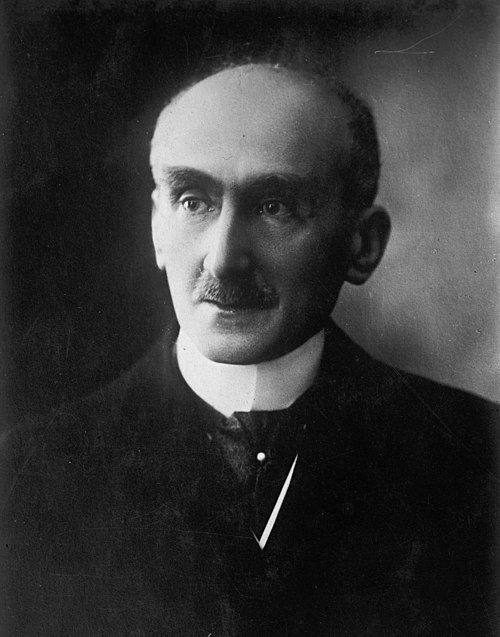
A Paris childhood between two Jewish worlds
Henri-Louis Bergson was born on October 18, 1859, in the Rue Lamartine in Paris, not far from the old opera house. He was the second of seven children. His father, Michał Bergson, was a composer and pianist from a prominent Polish-Jewish family, the family name had been Bereksohn, and Henri’s great-grandmother, Temerl Bergson, was remembered as a patroness of Polish Jewry, especially of the Hasidic movement. His mother, Katherine Levison, the daughter of a Yorkshire doctor, came from an English- and Irish-Jewish background.
The family spent several years in London after his birth, and the boy absorbed English from his mother before his parents settled in France. He received a Jewish religious education as a child, but by his own later account lost his faith in his mid-teens; one biographer links that crisis to his encounter with the theory of evolution. At eighteen he became a French citizen, though he could have chosen British nationality. It was a quiet decision with a long echo: for the rest of his life he would be thoroughly French in culture and fame, and unmistakably Jewish in the eyes of those who would one day count such things.
The mathematician who chose philosophy
At the Lycée Condorcet (then the Lycée Fontanes) Bergson was an exceptional pupil whose first gift seemed to be mathematics. He won first prize in the national Concours Général, and in 1878 his solution to a mathematical problem was published in the Nouvelles Annales de Mathématiques, his first appearance in print. When he chose the humanities instead, his disappointed teacher is reported to have told him he could have been a mathematician but would be “a mere philosopher.”
He entered the École Normale Supérieure in 1878 alongside Jean Jaurès and Émile Durkheim, read Herbert Spencer with enthusiasm, and in 1881 placed second in the fiercely competitive agrégation in philosophy. Then came the long apprenticeship of a French schoolmaster: teaching posts at Angers and at Clermont-Ferrand in the Auvergne, where he also lectured at the university and edited extracts from Lucretius for students. It was in these provincial years, away from Paris, that he began the work that would make him famous.
Time as it is lived
Bergson’s doctoral thesis, published in 1889 as Essai sur les données immédiates de la conscience (in English, Time and Free Will), began from a deceptively simple observation. Science treats time like space: a line of identical, measurable instants. But the time we actually live, what Bergson called durée, duration, is nothing like that. It is continuous, flowing and qualitative, each moment colored by everything that came before it. Mistaking lived time for clock time, he argued, is what makes free will look impossible.
Matter and Memory (1896) carried the argument into the relationship between mind and body, drawing on the medical literature of the day about memory and brain injury. His short book Laughter (1900) proposed that we laugh at “something mechanical encrusted on the living”, at people behaving like machines. Throughout, Bergson insisted that intuition, a sympathetic grasp of things from within, could reach realities that analysis, which cuts the world into fixed pieces, would always miss.
Creative Evolution and the Bergson boom
In 1900 Bergson was appointed to the Collège de France, first to the chair of Greek and Roman philosophy and from 1904 to the chair of modern philosophy. His Creative Evolution (1907) made him a celebrity. In it he accepted the fact of evolution but rejected both purely mechanical and purely purpose-driven explanations of it, proposing instead an original vital impetus, the élan vital, that drives life to diversify and invent new forms. By 1918 the book had gone through twenty-one French editions.
His open lectures became events. Society figures crowded in alongside students and poets; T. S. Eliot was among those who attended. When he lectured at Columbia University in 1913, the crowds were such that a traffic jam formed on Broadway. William James, who befriended him in 1908, hailed him as a genius and helped bring his work to English readers. Not everyone was charmed: Bertrand Russell mocked his reliance on intuition, and in 1914 the Catholic Church placed three of his books on its Index of prohibited works. That same year he was elected to the Académie française, the first Jew to join it.
Philosopher in public life
During the First World War Bergson put his prestige at France’s service. He wrote and spoke for the war effort, and in 1917 the French government sent him to the United States on diplomatic missions that brought him into contact with President Woodrow Wilson. Afterwards he became an advocate of international cooperation, and from 1922 he presided over the League of Nations’ International Committee on Intellectual Cooperation, a forerunner of UNESCO whose members included Albert Einstein and Marie Curie.
His encounter with Einstein produced one of the century’s famous intellectual collisions. In 1922 the two met at the French Philosophical Society, and Bergson published Duration and Simultaneity, questioning how relativity theory should be interpreted philosophically. Physicists largely judged that he had misunderstood the physics; Bergson later acknowledged the limits of his mathematics, while maintaining that relativity was a great advance. The episode is often cited as the moment when the prestige of philosophy and that of physics began to diverge.
The Nobel Prize and The Two Sources
In 1928 Bergson was awarded the Nobel Prize in Literature reserved from 1927, “in recognition of his rich and vitalizing ideas and the brilliant skill with which they have been presented.” He was too ill to travel to Stockholm. From the mid-1920s he suffered from severe, crippling arthritis that slowly withdrew him from public life; he lived quietly with his wife and daughter near the Porte d’Auteuil in Paris.
In 1932 he surprised his readers with a last major book, The Two Sources of Morality and Religion. It distinguished “closed” morality and religion, which bind a group together against outsiders, from “open” forms that reach toward all humanity, and it gave a central place to the mystics, prominently the Christian mystics, as the people through whom the creative impulse of life breaks through most fully. The book reopened debate about his own religious direction.
A Jew who would not leave his people
Bergson was not a practising Jew, and in his last decade he felt a strong pull toward Catholicism. In his will, dated 1937, he wrote that his reflections had led him closer and closer to Catholicism, in which he saw the complete fulfilment of Judaism, and then explained why he had not converted: he had seen a formidable wave of antisemitism gathering, and he wished to remain among those who would be persecuted. His widow later reported that he had resolved not to be baptised. Scholars have found no document to support the rumour that he converted secretly before his death.
When France fell in 1940 and the Vichy regime imposed antisemitic laws, Bergson’s fame made him a candidate for exemption. He refused it, and according to several accounts gave up the honours he had received rather than accept special treatment. When Jews were required to register, he reportedly described himself on the form as “Academic. Philosopher. Nobel Prize winner. Jew.” A widely repeated story holds that, frail and ill, he stood in line in the cold to register and caught the chill that killed him; the Stanford Encyclopedia of Philosophy treats this as a rumour rather than an established fact.
The man behind the lectures
Those who knew Bergson described a slight, courteous, reserved man, William James called him modest and unpretending. In 1891 he married Louise Neuberger, a cousin of Marcel Proust, who served as best man at the wedding. Their only child, Jeanne, was born deaf in 1896. Bergson’s sister Mina, known as Moina Mathers, became an artist and a figure in the occult Hermetic Order of the Golden Dawn, a reminder that his family’s worlds ranged far beyond the Sorbonne.
He was protective of his privacy to the end. His will instructed that his unpublished papers be destroyed, and his wife carried out his wishes, which is why the Bergson archives contain his library but few manuscripts. His published style, however, remained his public face: lucid, metaphorical and lyrical, it was precisely what the Nobel committee chose to honour.
Death in occupied Paris, and a lasting influence
Bergson died in occupied Paris in January 1941, at the age of eighty-one; the Nobel Foundation gives the date as January 4, while some biographers give January 3. A Catholic priest said prayers at his funeral at his request, and he was buried in the cemetery at Garches, outside Paris.
His influence outlasted the fading of his fame. He shaped the modernist novel and poetry, Proust, Willa Cather and Wallace Stevens among those touched by him, fed into American pragmatism through James, and inspired thinkers as different as Jacques Maritain, Georges Sorel and Pierre Teilhard de Chardin. After 1966 Gilles Deleuze revived him for a new generation, and the chemist Ilya Prigogine acknowledged him in his own Nobel lecture. His insistence that time is creation rather than mere succession remains one of philosophy’s great challenges to a purely mechanical picture of the world, and his last decision, to stand with the persecuted, remains one of the twentieth century’s quiet acts of moral courage.
Sources & further reading
Henri Bergson, Wikipedia · Henri Bergson, Stanford Encyclopedia of Philosophy · Henri Bergson, Facts, NobelPrize.org · Henri Bergson, Lapham’s Quarterly contributor page · Researched from the sources above and checked against them. Spotted an error? Tell us.
A life of tikkun olam. This is part of tikkun olam, the Jewish idea of repairing the world, and every one of us can add to it.