- Person
- Henri Bergson
- Lived
- 1859–1941
- Field
- Philosophy
- From
- French
The story
Henri Bergson was born in Paris in 1859 to a Polish-Jewish father, the composer Michał Bergson, and an English-Jewish mother. In books such as Time and Free Will, Matter and Memory and Creative Evolution, he argued that lived time, memory and intuition cannot be reduced to mechanical measurement, and that life is driven by a creative impulse he called the élan vital. His lectures at the Collège de France drew crowds far beyond academic philosophy.
From 1922 to 1925 he chaired the League of Nations' International Committee on Intellectual Cooperation, the forerunner of UNESCO, whose members included Albert Einstein and Marie Curie. In 1927 he was awarded the Nobel Prize in Literature "in recognition of his rich and vitalizing ideas and the brilliant skill with which they have been presented". The prize was presented a year later, in 1928; severe rheumatism kept him from travelling to Stockholm, so he sent a text instead. In 1930 France gave him the Grand Cross of the Legion of Honour.
In his last years Bergson felt drawn to Catholicism. In his will, dated 7 February 1937, he wrote that his thinking had always brought him nearer to Catholicism, which he saw as the perfect complement to Judaism. Yet as Nazism and antisemitism spread across Europe in the 1930s, he chose not to convert, because he did not want to appear to abandon those who were being persecuted. His wife later quoted him as saying he would have converted had he not seen a great wave of antisemitism preparing to spread over the world.
After the fall of France in 1940, the Vichy government offered the famous philosopher exemptions from its antisemitic regulations. He refused, and gave up his posts and honours instead. When Jews in occupied Paris were required to register with the police, he described himself on the form as an academic, a philosopher, a Nobel Prize winner and a Jew. He died in occupied Paris in early January 1941, aged 81.
Bergson's choice is remembered as an act of quiet courage: a man at the height of fame who would not accept privileges denied to others, and who stood with his people at the moment they were most in danger.
Why it matters
Bergson's philosophy of time and creativity shaped modern thought and literature, and his refusal to separate himself from persecuted Jews remains an example of moral solidarity.
About Henri Bergson
French philosopher of time, memory and the élan vital who won the 1927 Nobel Prize in Literature and, drawn to Catholicism, chose to remain among the persecuted Jews.
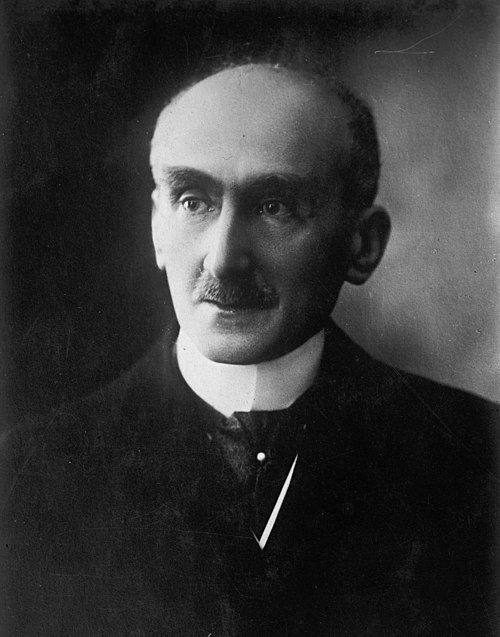
More about Henri Bergson
- Henri Bergson wrote a classic essay on why we laughIn Laughter (1900), Henri Bergson argued that comedy arises from "something mechanical encrusted on the living" and that laughter helps make social life possible.
- Bergson's Matter and Memory explored mind and brainIn Matter and Memory (1896), Henri Bergson investigated perception, memory and the brain, drawing on the medical research of his day.
- Bergson's first book redefined how we think about timeIn Time and Free Will (1889), Henri Bergson distinguished lived time, or duration, from clock time; Louis de Broglie said it anticipated ideas of Bohr and Heisenberg.
- Bergson's last book called for an open, universal moralityIn The Two Sources of Morality and Religion (1932), Henri Bergson contrasted a closed morality of the group with an open morality of love for all.
Sources
- Henri Bergson: Facts Nobel Prize
- Henri Bergson Wikipedia
- Henri Bergson Stanford Encyclopedia of Philosophy
Another act of tikkun olam. This is part of tikkun olam, the Jewish idea of repairing the world, and every one of us can add to it.