- Person
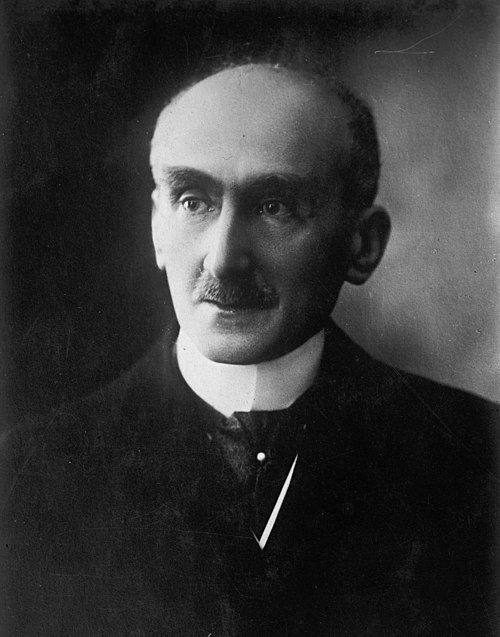
- Henri Bergson
- Lived
- 1859–1941
- Field
- Philosophy
- From
- French
The story
After graduating from the École Normale Supérieure in 1881, Henri Bergson taught philosophy at lycées in Angers and then Clermont-Ferrand, in the Auvergne. Alongside his teaching he found time for private study and original work. He wrote his doctoral thesis, Essai sur les données immédiates de la conscience, together with the Latin thesis then required, on Aristotle's idea of place. The University of Paris awarded the doctorate and Félix Alcan published the essay in 1889. It appeared in English in 1910 as Time and Free Will.
In it Bergson argued that the time we actually live through, which he called duration, is different from the measurable time of clocks and physics. A clock or a calendar divides time into equal, separate units, much as we count sheep in a field by placing each one in its own spot. In the Stanford Encyclopedia's account, the states of consciousness in duration are continuous and interpenetrate one another, and if we separate them as if they were laid out in space, their nature changes.
Bergson aimed the book against Immanuel Kant, who had placed freedom outside time and space, beyond knowledge. Bergson replied that Kant had confused time with its spatial representation. Once lived time is understood as duration, freedom no longer has to be taken on faith: for Bergson, freedom is this mobility. The distinction became the foundation for the rest of his philosophy, which held that immediate experience and intuition are more significant than abstract reasoning for understanding reality.
The book had a long reach. Jean-Paul Sartre said it was the text that attracted him to philosophy. The physicist Louis de Broglie later said that Time and Free Will anticipated by forty years the ideas of Niels Bohr and Werner Heisenberg on the physical interpretation of wave mechanics. Bergson dedicated it to his former teacher Jules Lachelier.
Bergson's idea of duration, of time as it is felt from within rather than measured from outside, influenced novelists, poets and painters as well as philosophers, and it still offers a way of thinking about memory, freedom and the flow of experience.
Why it matters
Bergson's idea of duration changed how philosophers, writers and artists understood time and inner experience.
About Henri Bergson
French philosopher of time, memory and the élan vital who won the 1927 Nobel Prize in Literature and, drawn to Catholicism, chose to remain among the persecuted Jews.
More about Henri Bergson
- Henri Bergson wrote a classic essay on why we laughIn Laughter (1900), Henri Bergson argued that comedy arises from "something mechanical encrusted on the living" and that laughter helps make social life possible.
- Bergson's Matter and Memory explored mind and brainIn Matter and Memory (1896), Henri Bergson investigated perception, memory and the brain, drawing on the medical research of his day.
- Henri Bergson, Nobel philosopher who stood with his peopleHenri Bergson won the 1927 Nobel Prize in Literature for his ideas on time and creativity, and later declined to convert so as not to leave the persecuted Jews of Europe.
- Bergson's last book called for an open, universal moralityIn The Two Sources of Morality and Religion (1932), Henri Bergson contrasted a closed morality of the group with an open morality of love for all.
Sources
- Henri Bergson Wikipedia
- Henri Bergson Stanford Encyclopedia of Philosophy
- Time and Free Will Wikipedia
Another act of tikkun olam. This is part of tikkun olam, the Jewish idea of repairing the world, and every one of us can add to it.