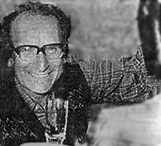
A Jewish family in Bahía Blanca
César Milstein was born on 8 October 1927 in Bahía Blanca, a port city in the south of Buenos Aires province, Argentina, the middle of three sons. His father, Lázaro Milstein, was a Jewish immigrant from Ukraine who, as Milstein later wrote, had been left to his own devices at the age of fifteen; he made his living as a salesman. His mother, Máxima Vapñarsky, was a teacher, herself the daughter of a poor immigrant family, who became a school headmistress while still young.
The family was active in the local Jewish community without being especially religious. Both parents, Milstein recalled, would make any sacrifice to see that their three sons went to university. His mother nurtured his interest in science by bringing home Paul de Kruif’s Microbe Hunters, a popular account of the great bacteriologists; reading it at about thirteen, he resolved to devote his life to research.
Student politics and a kibbutz honeymoon
After the Colegio Nacional in Bahía Blanca he studied chemistry at the University of Buenos Aires. He later admitted that he was not a particularly brilliant student; his energy went into the Student Union and student politics. It was through politics that he met Celia Prilleltensky, a fellow student who would become a biochemist and his research collaborator, whom he married in 1953.
The couple took a year off for what he called a most unusual and romantic honeymoon, hitch-hiking through most of the countries of Europe and spending a couple of months working on kibbutzim in Israel. Back in Buenos Aires he worked for a doctorate under the biochemist Andrés Stoppani with no financial support, while he and Celia earned just enough doing part-time clinical biochemistry. His thesis, on the kinetics of the enzyme aldehyde dehydrogenase, won an award from the Argentine Society for Biochemical Research in 1956.
Cambridge and Fred Sanger
In 1958 a British Council fellowship took him to the Department of Biochemistry at the University of Cambridge to work under Malcolm Dixon on how metals activate the enzyme phosphoglucomutase. He completed a second PhD in about two years. Through that enzyme he began collaborating with Frederick Sanger, who had just won the first of his two Nobel Prizes for determining the structure of insulin, and he joined Sanger’s group on a short-term Medical Research Council appointment.
Sanger became the strongest influence on his scientific life. But Milstein intended to build science in his own country, and in 1961 he returned to Buenos Aires to head a new division of molecular biology at the National Institute of Microbiology, the Instituto Malbrán.
Driven from Argentina
The return lasted about two years. After a military coup in 1962, Argentina entered a period of political persecution of liberal intellectuals and scientists. At the Malbrán it took the form, as Milstein put it, of a vendetta against the institute’s director, and many colleagues were dismissed. Milstein resigned in protest and went back to Cambridge in 1963 to rejoin Sanger, now head of protein chemistry at the newly built Medical Research Council Laboratory of Molecular Biology.
It was a loss for Argentina and a gain for British science. Milstein took British citizenship while keeping his Argentine nationality, and remained deeply attached to his homeland, helping scientists from Argentina and other developing countries for the rest of his life.
The puzzle of antibodies
At Sanger’s suggestion Milstein shifted from enzymes to immunology. The central mystery was antibody diversity: how the immune system produces an apparently limitless variety of antibodies, each recognising a different foreign target. Working partly with Celia, he studied the amino-acid sequences of antibodies and the disulphide bonds that hold them together, and later the messenger RNA that encodes them, providing the first evidence that secreted antibody chains are made with a signal sequence that is later removed.
A practical obstacle hampered everyone in the field. Antibodies taken from an animal’s blood are a mixture of many different molecules, and the cells that make any single antibody die quickly in the laboratory. Researchers could grow immortal cancerous antibody-producing cells, called myelomas, but these made antibodies of unknown and useless specificity.
Hybridomas
In the mid-1970s a young German postdoctoral researcher, Georges Köhler, joined Milstein’s laboratory. Together they tried fusing antibody-producing cells from the spleen of a mouse immunised against sheep red blood cells with mouse myeloma cells. The hybrid cells combined the two parents’ strengths: they made a single, chosen antibody, and they could grow indefinitely. The first viable monoclonal antibodies were made in January 1975, and the method was published in Nature on 7 August 1975, as a short letter rather than a full article; even the journal’s editors did not grasp its importance. The word hybridoma for the fused cells was coined shortly afterwards by Leonard Herzenberg during a sabbatical in Milstein’s laboratory.
Milstein shared the cell lines and the know-how freely, welcoming researchers into his lab to learn the method and collaborating to show what it could do. He made major contributions of his own, using monoclonal antibodies as markers to tell different types of cells apart, and with Claudio Cuello applying them to the study of the nervous system. He also foresaw that combining antibodies with recombinant DNA technology would allow them to be engineered, helping to inspire the field of antibody engineering that later produced safer and more powerful therapeutic antibodies.
The patent that never was
Milstein suggested to the Medical Research Council that the invention be patented. In the 1970s the rights to MRC inventions were handled by the National Research Development Corporation, which declined, saying it could not identify any immediate practical applications that could be pursued commercially. In 1979 and 1980 the first patents on monoclonal antibodies were granted to American scientists working with cells Milstein had sent them. Margaret Thatcher, who became prime minister in 1979, took up the missed opportunity forcefully, and a 1980 government working party led by Alfred Spinks largely blamed Milstein, who bore the criticism for years.
Milstein felt let down by the bureaucracy, but he did not regret the outcome. Asked later whether he was unhappy about the missing patent, he answered that he was not, though Thatcher was, and he came to regard the lack of a patent as a blessing that let him publish and share his work freely; he called secrecy an outrageous insult to science. Some historians now argue that the absence of a patent helped the field flourish. The MRC later earned hundreds of millions of pounds in royalties from patents on techniques, developed at the same laboratory, for engineering antibodies into drugs.
The Nobel Prize and a revolution in medicine
In 1984 Milstein and Köhler shared the Nobel Prize in Physiology or Medicine with the Danish immunologist Niels Jerne. By then monoclonal antibodies were transforming biology. They are used to type blood and tissue for transfusions and transplants, in pregnancy tests and countless diagnostic kits for infectious diseases and cancer, and as research tools in nearly every laboratory. Since the late 1990s they have also become one of the most important classes of medicines, treating cancers, rheumatoid arthritis and other autoimmune diseases; by the 2010s six of the world’s ten best-selling drugs were monoclonal antibodies.
Milstein himself returned to fundamental questions. In his later years he showed the importance of somatic hypermutation, the process by which antibody genes mutate during an immune response to produce antibodies that bind ever more tightly, and he devoted much of his final research to its mechanism. Among his many honours were election to the Royal Society in 1975, the Wolf Prize in Medicine in 1980, the Royal Society’s Copley Medal in 1989 and appointment as a Companion of Honour in 1995. He also received the Louisa Gross Horwitz Prize (1980), the Royal Society’s Royal Medal (1982), the Albert Lasker Basic Medical Research Award (1984) and, from the Hebrew University of Jerusalem, the Rabbi Shai Shacknai Memorial Prize (1982). He was a fellow of Darwin College, Cambridge, from 1980 until his death, and in 1993 Argentina’s Konex Foundation named him the country’s most important scientist of the previous decade.
The man and his legacy
Colleagues remembered a stimulating host with wide interests in politics, theatre, music and literature in both Spanish and English, a keen walker and skier and a talented cook. After heart problems in middle age he kept to a strict diet; in his last years he gave up Saturday mornings in the lab to buy fish at the Cambridge market. He and Celia, partners in life and often in the laboratory, had no children. He continued to publish after his formal retirement in 1995, and submitted a manuscript less than a week before his death.
César Milstein died in Cambridge on 24 March 2002, aged seventy-four, of the heart condition he had lived with for many years. Celia died in 2020. In Argentina he is honoured as one of the country’s three Nobel laureates in science, and a 2010 documentary film about his life, Un fueguito, won an Argentine film academy award. The son of a Jewish immigrant from Ukraine who had made his own way at fifteen gave the world a technique that sits behind millions of diagnoses and treatments every year, and he gave it away.
Sources & further reading
César Milstein, Biographical, NobelPrize.org · César Milstein, Wikipedia · César Milstein, Inspiring Physicians, Royal College of Physicians · Overlooked scientific innovation reaps rewards 40 years on, Lara Marks, History & Policy · Quote of the month: Dr César Milstein, History of Modern Biomedicine, QMUL · Researched from the sources above and checked against them. Spotted an error? Tell us.
A life of tikkun olam. This is part of tikkun olam, the Jewish idea of repairing the world, and every one of us can add to it.