- Person
- César Milstein
- Lived
- 1927–2002
- Field
- Immunology
- From
- Argentine-British
The story
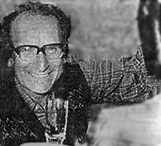
César Milstein was born in 1927 in Bahía Blanca, Argentina. His father was a Jewish immigrant from Ukraine and his mother a teacher, and they made great sacrifices so that their three sons could go to university. Milstein studied chemistry in Buenos Aires, where he met his wife, Celia, through student politics, and earned a PhD at Cambridge, where he began collaborating with Fred Sanger. After political persecution of scientists forced him out of his post in Argentina, he returned to Cambridge in 1963 to work at the Medical Research Council's new Laboratory of Molecular Biology, where he turned from enzymes to immunology.
Antibodies are proteins that recognise invaders with great precision, but the body makes millions of different ones. Researchers could study a single kind only through myeloma, a cancer of antibody-making cells, which produces identical antibodies that are not aimed at any chosen target. There was no way to make large amounts of one chosen antibody.
In 1975, with Georges Köhler, a postdoctoral fellow in his laboratory, Milstein solved the problem. They fused antibody-producing cells from an immunised animal with myeloma cells that multiply indefinitely. The resulting hybrid cells, later named hybridomas, inherited both abilities: they made a single antibody of the chosen specificity and could be grown without limit. Their paper appeared in Nature in August 1975 under the title “Continuous cultures of fused cells secreting antibody of predefined specificity.”
The discovery led to an enormous expansion in the use of antibodies in science and medicine. Milstein kept improving the technology, especially in using monoclonal antibodies as markers to tell different types of cells apart, and he worked with others to apply it in neuroscience and diagnostics. In 1984 Milstein and Köhler shared the Nobel Prize in Physiology or Medicine with Niels Jerne.
Milstein also devoted time to helping scientists in less developed countries, believing that science would fulfil its promise only when its benefits were shared by the poorest. He continued research until his death in Cambridge in 2002. The technique he created underlies countless laboratory tests and a large family of modern medicines.
Why it matters
Monoclonal antibodies are now used in many diagnostic tests and in a large family of medicines for cancer, autoimmune and infectious diseases.
About César Milstein
Argentine-born son of a Jewish immigrant who co-invented monoclonal antibodies in Cambridge in 1975, a technique left unpatented that now underpins diagnostics and drugs.
More about César Milstein
- César Milstein turned antibodies on the nervous systemWith Claudio Cuello, César Milstein used a monoclonal antibody in 1979 to detect substance P in the nervous system, laying foundations for studying neurological disease.
- César Milstein found the signal on newly made antibodiesStudying the messenger RNA that encodes antibodies, César Milstein provided the first evidence that secreted antibody chains are first made with a signal sequence.
- César Milstein foresaw antibody medicinesCésar Milstein foresaw that combining monoclonal antibodies with recombinant DNA technology could create new reagents, and he inspired the antibody engineering behind today's antibody drugs.
- César Milstein showed how antibodies get betterCésar Milstein demonstrated the importance of somatic hypermutation, the process by which antibody genes mutate during an infection to produce ever more effective antibodies.
Sources
- César Milstein: Biographical NobelPrize.org
- César Milstein Wikipedia
- Continuous cultures of fused cells secreting antibody of predefined specificity Nature (via PubMed)
Another act of tikkun olam. This is part of tikkun olam, the Jewish idea of repairing the world, and every one of us can add to it.