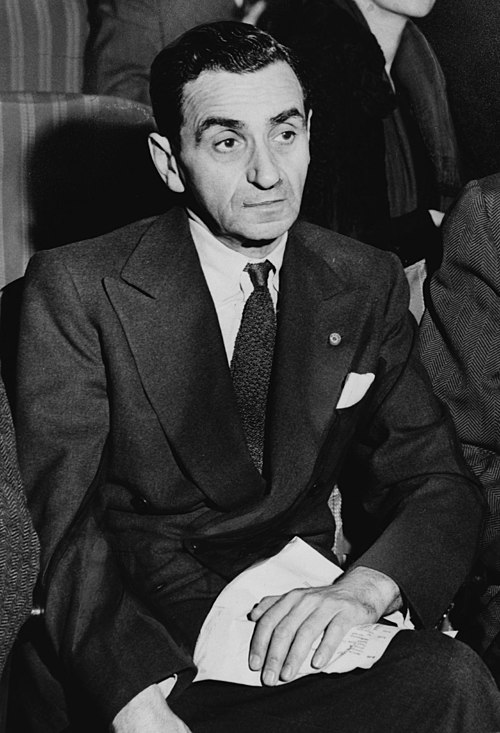
A cantor’s son from the Pale
Irving Berlin was born Israel Beilin on May 11, 1888, in the Russian Empire, one of eight children of Moses and Lena Beilin. The family came from the shtetl of Tolochin, in present-day Belarus; Berlin later learned that he had probably been born in Tyumen, in Siberia, where his father, an itinerant cantor, had taken the family. Of his first five years he retained, by his own account to his biographer, just one memory: lying on a blanket by the side of a road, watching his family’s house burn to the ground.
Like hundreds of thousands of Jewish families escaping poverty, discrimination and pogroms in the Russian Empire, the Beilins left. They sailed from Antwerp and arrived at Ellis Island on September 14, 1893, and the family name became Baline. They lived first in a basement flat on Monroe Street and then in a three-room tenement at 330 Cherry Street on the Lower East Side. Unable to find work as a cantor, Moses took a job at a kosher meat market and gave Hebrew lessons; he died in 1901, when Israel was thirteen.
Singing for pennies on the Bowery
With only a few years of schooling, the boy went to work at eight selling newspapers. His mother worked as a midwife, his sisters wrapped cigars and his brother assembled shirts in a sweatshop; each evening, the family dropped the day’s coins into Lena’s apron. Feeling that he was not earning his share, Izzy, as he was known, left home at about fourteen and lived in the lodging houses of the Bowery, singing popular ballads in saloons for whatever customers would throw him.
He became a song plugger and, in 1906, a singing waiter at the Pelham Café in Chinatown, where after hours he taught himself to pick out tunes on the piano in the back room. In 1907 he published his first song, “Marie from Sunny Italy” written with the café’s pianist; he was paid 33 cents for the publishing rights, and the sheet music bore the name “I. Berlin.” By 1909 he was a staff lyricist for a Tin Pan Alley publisher, and when a lyric of his was mistakenly assumed to come with a melody, he quickly wrote one, and discovered he could compose.
The songwriter who could not read music
Berlin never learned to read or write music in the conventional sense, and he played the piano almost entirely in one key, F-sharp, which uses mostly the black keys. To change key he relied on specially built transposing pianos with a lever that shifted the keyboard mechanically. Musical secretaries took down his melodies and harmonised them under his close direction. When he once asked the composer Victor Herbert whether he should study theory, Herbert reportedly told him it might help a little but could cramp his style.
What he had instead was an extraordinary ear, relentless work habits and a gift for plain American speech. He worked mostly at night, often until four or five in the morning, and claimed he did not believe in inspiration, only work. His stated aim was to reach the heart of the average American, whom he saw as the real soul of the country.
From ragtime to the Great American Songbook
In 1911 “Alexander’s Ragtime Band” made Berlin famous almost overnight and set off an international dance craze. Other hits poured out, he was writing several songs a week, and in 1914 he wrote his first full Broadway score, Watch Your Step, for the dancers Vernon and Irene Castle. That year he was also a founding member of ASCAP, the organisation that collects royalties for songwriters. Grief produced his first ballad: in 1912 he married Dorothy Goetz, who died within months of typhoid fever contracted on their honeymoon in Havana, and he poured his loss into “When I Lost You.”
Over the following decades came “A Pretty Girl Is Like a Melody” “What’ll I Do?” “Always” “Blue Skies” “Puttin’ on the Ritz” “Cheek to Cheek” “Easter Parade” “Heat Wave” and “There’s No Business Like Show Business.” In 1921 he and the producer Sam Harris opened the Music Box Theatre on West 45th Street, the only Broadway house built to showcase a songwriter’s work. His 1933 revue As Thousands Cheer included “Supper Time” sung by Ethel Waters, about a woman whose husband has been lynched, a rare protest song on the Broadway stage. In all, Berlin wrote well over a thousand songs (estimates run to about 1,500), the scores of some twenty Broadway shows and fifteen Hollywood films. Annie Get Your Gun (1946), written after the death of his friend Jerome Kern, ran for 1,147 performances and became his biggest stage success.
“White Christmas”
Berlin wrote “White Christmas” for the 1942 film Holiday Inn, starring Bing Crosby and Fred Astaire. According to Guinness World Records, he had written the song by 1940; Crosby recorded it in eighteen minutes on May 29, 1942. Released in a nation newly at war, it spoke to soldiers spending their first winter away from home, and it reached No. 1 in October 1942. It won the Academy Award for Best Original Song, Berlin, presenting the award that year, had to open the envelope and read out his own name.
Crosby’s recording is recognised by Guinness as the best-selling single of all time, with estimated sales of around 50 million copies, and the song has been recorded by countless artists since. There is a private sorrow in the family history behind it: Berlin and his second wife lost their infant son, Irving Berlin Jr., on Christmas Day 1928, less than a month after his birth. That a Jewish refugee should have written America’s most beloved Christmas song, and its favourite Easter song too, has long been seen as a sign of how fully he made the country’s public, secular holidays his own.
“God Bless America” and a patriot’s gifts
Berlin’s gratitude to the country that had taken in his family ran through his work. Drafted in 1917, he wrote the all-soldier revue Yip Yip Yaphank, which included “Oh! How I Hate to Get Up in the Morning.” He had also written a song called “God Bless America” for it but set it aside. Twenty years later, in 1938, with war again looming in Europe, he revised it for Kate Smith, and it quickly became an unofficial second national anthem. Berlin assigned all its royalties to the Boy Scouts and Girl Scouts through what became the God Bless America Fund.
During the Second World War he wrote This Is the Army, a show with a cast of some 300 soldiers that toured to Britain, North Africa, Italy, the Middle East and the Pacific. For three and a half years he took neither salary nor expenses, and the show and its film raised more than 10 million dollars for the Army Emergency Relief Fund. He received the Medal for Merit from President Truman, a Congressional Gold Medal from President Eisenhower in 1954, and the Presidential Medal of Freedom from President Ford in 1977.
A Jewish immigrant in American life
Berlin was not religiously observant as an adult, but his Jewish origins shaped both his story and how others treated him. In the 1920s he fell in love with Ellin Mackay, a writer and Catholic heiress of Irish descent, whose father, the telegraph magnate Clarence Mackay, bitterly opposed the match. The romance between the Lower East Side immigrant and the society girl became a newspaper sensation; the couple eloped and married in a civil ceremony at New York’s Municipal Building in January 1926. Berlin gave his bride the rights to “Always” as a wedding present, guaranteeing her an income. Her father would not speak to them for nearly three years, until the death of their baby son brought a reconciliation.
Berlin never forgot where he came from. He returned again and again to walk the streets of the Lower East Side and the Bowery, and in 1950 he wrote a song for the new State of Israel. Time magazine’s 1934 cover story called him the itinerant son of a Russian cantor and an American institution, the two halves of his identity in a single phrase.
Family, and the long retirement
Irving and Ellin Berlin were married for more than sixty-two years, until her death in July 1988. They had three daughters who survived to adulthood, Mary Ellin, Linda and Elizabeth, and from 1947 lived in a town house at 17 Beekman Place in Manhattan. He was driven and, for all his success, could be unsure of his own abilities; his daughter recalled that, despite the legend of effortless hits, he usually “sweated blood” over his songs.
His last Broadway show, Mr. President, opened in 1962, when he was seventy-four. Afterwards he withdrew almost entirely from public life, though he kept a close eye on his business affairs. His hundredth birthday in 1988 was celebrated with an all-star tribute at Carnegie Hall. He died in his sleep at home on September 22, 1989, at the age of 101, and was buried in Woodlawn Cemetery in the Bronx. That evening the lights of Broadway theatres were dimmed in his memory.
Legacy
George Gershwin called Berlin the greatest songwriter who had ever lived, and Jerome Kern famously said that Irving Berlin had no place in American music, he was American music. His songs topped the charts again and again for half a century, and they continue to be sung at weddings, ballgames, holidays and national ceremonies; after the attacks of September 11, 2001, members of Congress stood on the Capitol steps and sang “God Bless America.”
His life became the classic American rags-to-riches story: a refugee boy who sang for pennies in saloons and went on to write the songs a whole nation used to express its love, its longing and its patriotism. The royalties from his patriotic songs continue, as he arranged, to support the Scouts, a fitting legacy for a man who never stopped feeling that he owed his adopted country everything.
Sources & further reading
Irving Berlin, Wikipedia · Biography, The Official Irving Berlin website · Best-selling single, Guinness World Records · Researched from the sources above and checked against them. Spotted an error? Tell us.
A life of tikkun olam. This is part of tikkun olam, the Jewish idea of repairing the world, and every one of us can add to it.