- Person
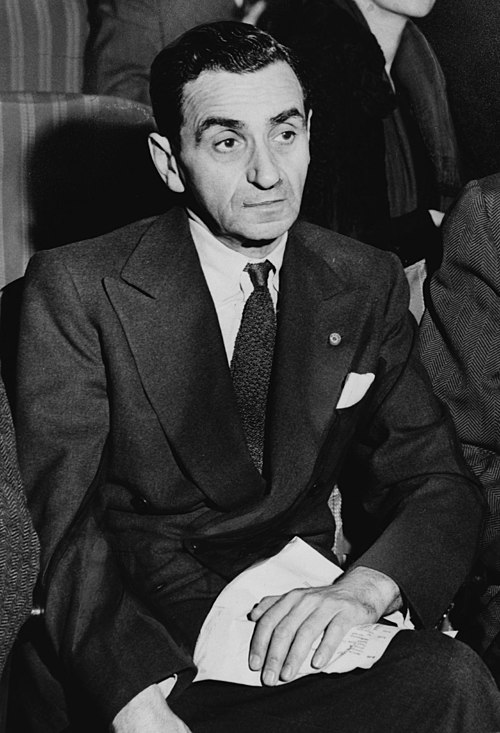
- Irving Berlin
- Lived
- 1888–1989
- Field
- Songwriting
- From
- Russian-born American
The story
Irving Berlin was born Israel Beilin on 11 May 1888 in the Russian Empire, and his family reached Ellis Island on 14 September 1893, part of the great wave of Jewish families escaping poverty and pogroms. His father, a cantor, died when the boy was 13. Berlin sold newspapers, sang for pennies in Bowery saloons and in 1906 became a singing waiter at the Pelham Cafe in Chinatown, where he taught himself piano after closing time. His first published song, "Marie from Sunny Italy" (1907), earned him 33 cents, and by 1909 he was a staff lyricist at the Ted Snyder music company.
In early 1911 Berlin wrote "Alexander's Ragtime Band" amid the din of the Snyder offices, where several pianos and singers played at once. It was a sequel to his 1910 song "Alexander and His Clarinet", and the title character was inspired by his friend Jack Alexander, an African American cornet player and bandleader. Colleagues complained that it was too long and not real ragtime; in truth it was closer to a march. The producer Jesse Lasky used only a whistled version of the tune in his new show, and Berlin briefly thought it a failure.
The vaudeville singer Emma Carus changed its fortunes when she introduced it at the American Music Hall in Chicago on 18 April 1911 and carried it on tour. A recording by Arthur Collins and Byron Harlan, released on 23 May, became the best-selling record in the country for ten weeks, and Berlin sang it himself at the Friars Frolic in New York five days later. The sheet music sold a million copies in 1911 and another million in 1912, and Variety hailed it as the musical sensation of the decade.
The song revived the ragtime fervour that Scott Joplin and other African American musicians had begun in the 1890s, and it sparked a dance craze led by stars such as Vernon and Irene Castle that soon swept London, Paris and beyond. The press crowned Berlin the "King of Ragtime", a title he declined, saying he had only brought the style to people's attention. George Gershwin called it the first real American musical work.
Its life was long. Bessie Smith, the Boswell Sisters, Louis Armstrong, Bing Crosby, Al Jolson and Ray Charles all had hits with it, about a dozen versions in under fifty years, and in 1938 it gave its title to a Twentieth Century Fox film starring Tyrone Power and Alice Faye that featured 26 Berlin songs.
Why it matters
The song helped launch the modern American popular song and made a penniless immigrant one of the world's best-known composers.
About Irving Berlin
Cantor’s son and refugee from the Russian Empire who never learned to read music, yet wrote “White Christmas” “God Bless America” and well over a thousand other songs.
More about Irving Berlin
- Irving Berlin wrote the score for Annie Get Your GunAfter Jerome Kern's sudden death, Irving Berlin took over Annie Get Your Gun and wrote what is considered his finest Broadway score, including "There's No Business Like Show Business".
- Berlin's Blue Skies was sung in the first feature talkieIrving Berlin's song "Blue Skies" was featured in The Jazz Singer (1927), the first feature-length talking picture, sung by Al Jolson.
- Irving Berlin wrote the best-selling single of all timeIrving Berlin, a refugee with no formal musical training, wrote "White Christmas", the best-selling single ever, and gave all royalties from "God Bless America" to the Scouts.
- Irving Berlin helped found ASCAP to protect songwritersIn 1914 Irving Berlin became a charter member of ASCAP, the American Society of Composers, Authors and Publishers, which has protected songwriters' royalties ever since.
- Irving Berlin set Emma Lazarus's sonnet to musicFor his 1949 musical Miss Liberty, Irving Berlin set the closing lines of Emma Lazarus's "The New Colossus" to music as "Give Me Your Tired, Your Poor".
Sources
- Irving Berlin Wikipedia
- Irving Berlin: Biography The Irving Berlin Music Company
- Alexander's Ragtime Band Wikipedia
Another act of tikkun olam. This is part of tikkun olam, the Jewish idea of repairing the world, and every one of us can add to it.