- Person
- Irving Berlin
- Lived
- 1888–1989
- Field
- Songwriting
- From
- Russian-born American
The story
By 1914 Irving Berlin was one of the most successful songwriters in America, yet he had never had a music lesson. He played almost entirely in one key, F sharp, used special transposing pianos to change key, and dictated his tunes to a musical secretary. Unsure of himself, he once asked the composer Victor Herbert whether he should study composition. Herbert told him he had a natural gift for words and music and that theory might cramp his style, and Berlin took the advice.
Herbert was also the driving force behind a new organisation. On 13 February 1914 in New York he founded the American Society of Composers, Authors and Publishers, ASCAP, together with a small group of composers, lyricists, publishers and a copyright lawyer. Berlin was among the founding composers. Their aim was to protect the copyrighted works of members, who were mostly Tin Pan Alley writers and publishers. ASCAP originally required members to read and write music, but an exception was made to admit Berlin.
The young society soon won a landmark case. In 1917 the US Supreme Court ruled in Herbert v. Shanley Co. that a restaurant playing music to entertain diners was using it for profit and had to pay the creators, even though it charged no entry fee. The decision secured ASCAP's future. In 1919 it signed the first reciprocal agreement with its British counterpart, and the rise of radio in the 1920s brought a major new source of income for songwriters.
Berlin was an astute businessman as well as an artist. Besides helping to found ASCAP he set up his own music publishing company, which he ran for the rest of his life, and with the producer Sam Harris he built his own Broadway theatre, the Music Box. When he died in 1989, ASCAP's president Morton Gould paid tribute to him as a founder of the society who had touched people of every age over many years.
Today ASCAP licenses performances of its members' music to venues, broadcasters and streaming services and passes the fees back as royalties. In 2024 it distributed about 1.7 billion dollars to rights holders and had around a million members.
Why it matters
ASCAP made it possible for songwriters to be paid whenever their music is performed, a system that still supports about a million music creators.
About Irving Berlin
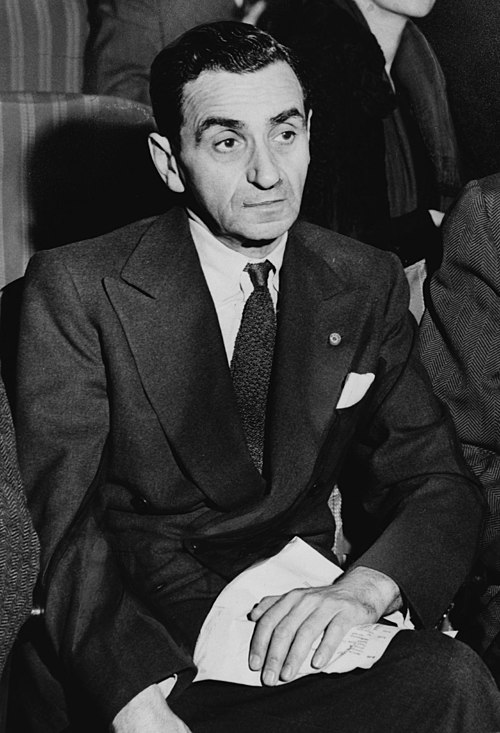
Cantor’s son and refugee from the Russian Empire who never learned to read music, yet wrote “White Christmas” “God Bless America” and well over a thousand other songs.
More about Irving Berlin
- Alexander's Ragtime Band made Irving Berlin a starIrving Berlin's 1911 hit "Alexander's Ragtime Band" made him a star, revived ragtime and sparked a national dance craze.
- Irving Berlin wrote the score for Annie Get Your GunAfter Jerome Kern's sudden death, Irving Berlin took over Annie Get Your Gun and wrote what is considered his finest Broadway score, including "There's No Business Like Show Business".
- Berlin's Blue Skies was sung in the first feature talkieIrving Berlin's song "Blue Skies" was featured in The Jazz Singer (1927), the first feature-length talking picture, sung by Al Jolson.
- Irving Berlin wrote the best-selling single of all timeIrving Berlin, a refugee with no formal musical training, wrote "White Christmas", the best-selling single ever, and gave all royalties from "God Bless America" to the Scouts.
- Irving Berlin set Emma Lazarus's sonnet to musicFor his 1949 musical Miss Liberty, Irving Berlin set the closing lines of Emma Lazarus's "The New Colossus" to music as "Give Me Your Tired, Your Poor".
Sources
- Irving Berlin Wikipedia
- Irving Berlin: Biography The Irving Berlin Music Company
- American Society of Composers, Authors and Publishers Wikipedia
Another act of tikkun olam. This is part of tikkun olam, the Jewish idea of repairing the world, and every one of us can add to it.