- Person
- Irving Berlin
- Lived
- 1888–1989
- Field
- Songwriting
- From
- Russian-born American
The story
In 1926 Irving Berlin had recently married the writer Ellin Mackay and he became a father for the first time when their daughter Mary Ellin was born. He wrote "Blue Skies" out of that happiness: blue days are gone, and from now on there is nothing but blue skies. The lyric's bluebirds are a classic image of cheer, although the minor key gives the tune a wistful edge.
The song began as a last-minute addition to Betsy, a 1926 Ziegfeld production with a score by Rodgers and Hart. The show lasted only 39 performances, but "Blue Skies" was an instant success. On opening night the audience demanded 24 encores from the star, Belle Baker, and when she forgot the words on the final repeat, Berlin sang them from his seat in the front row.
In 1927 the music was published and Ben Selvin's recording became a hit. That same year Al Jolson sang it in The Jazz Singer, the first feature-length film with synchronised talking and singing, which made "Blue Skies" one of the very first songs heard in a talking picture. The song was recorded for every major label of the day.
It kept returning. In 1946 Bing Crosby and Fred Astaire starred in a film named after it, and versions by Count Basie and Benny Goodman both reached the pop top ten. Ella Fitzgerald recorded it in 1958 for her Irving Berlin Song Book, and in 1978 Willie Nelson took it to number one on the country chart, 52 years after it was written.
The Jazz Singer also opened the way for Berlin's own work in Hollywood. Top Hat (1935) began a series of distinctive Berlin film musicals with stars such as Fred Astaire, Ginger Rogers, Bing Crosby, Judy Garland and Alice Faye, followed by Follow the Fleet, On the Avenue, Holiday Inn and Easter Parade. His songs have since appeared in dozens of other films, from The Jazz Singer to Titanic and The Green Mile.
Why it matters
Berlin's songs helped define the sound of early talking pictures and the golden age of the Hollywood musical.
About Irving Berlin
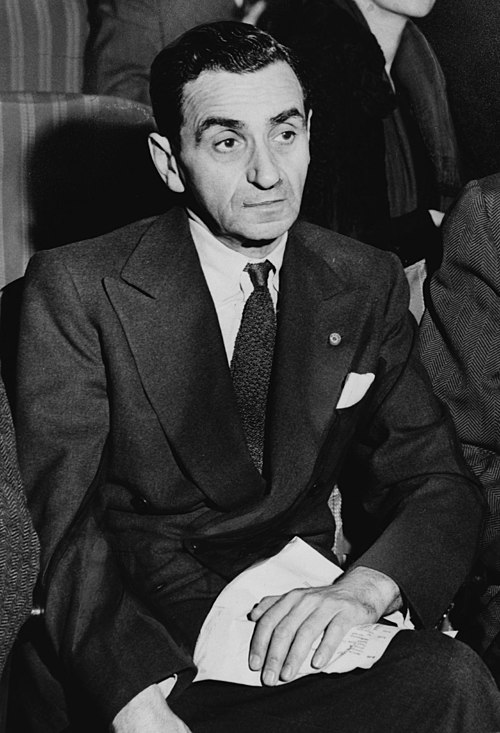
Cantor’s son and refugee from the Russian Empire who never learned to read music, yet wrote “White Christmas” “God Bless America” and well over a thousand other songs.
More about Irving Berlin
- Alexander's Ragtime Band made Irving Berlin a starIrving Berlin's 1911 hit "Alexander's Ragtime Band" made him a star, revived ragtime and sparked a national dance craze.
- Irving Berlin wrote the score for Annie Get Your GunAfter Jerome Kern's sudden death, Irving Berlin took over Annie Get Your Gun and wrote what is considered his finest Broadway score, including "There's No Business Like Show Business".
- Irving Berlin wrote the best-selling single of all timeIrving Berlin, a refugee with no formal musical training, wrote "White Christmas", the best-selling single ever, and gave all royalties from "God Bless America" to the Scouts.
- Irving Berlin helped found ASCAP to protect songwritersIn 1914 Irving Berlin became a charter member of ASCAP, the American Society of Composers, Authors and Publishers, which has protected songwriters' royalties ever since.
- Irving Berlin set Emma Lazarus's sonnet to musicFor his 1949 musical Miss Liberty, Irving Berlin set the closing lines of Emma Lazarus's "The New Colossus" to music as "Give Me Your Tired, Your Poor".
Sources
- Irving Berlin Wikipedia
- Irving Berlin: Biography The Irving Berlin Music Company
- Blue Skies (Irving Berlin song) Wikipedia
Another act of tikkun olam. This is part of tikkun olam, the Jewish idea of repairing the world, and every one of us can add to it.