- Person
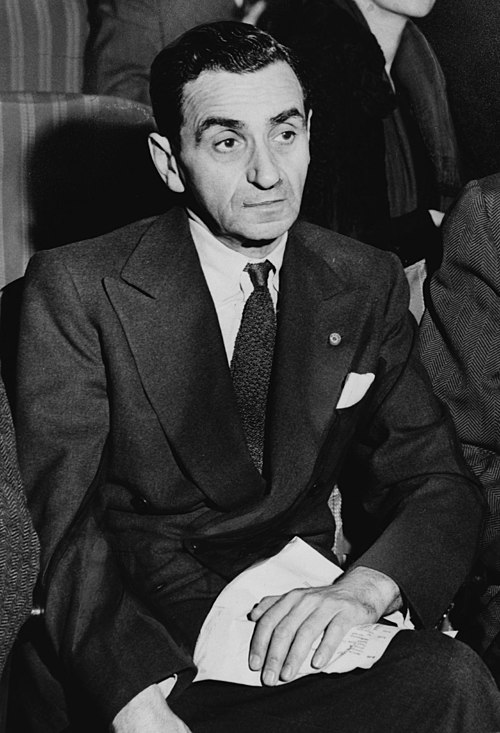
- Irving Berlin
- Lived
- 1888–1989
- Field
- Songwriting
- From
- Russian-born American
The story
Irving Berlin first saw New York harbour as a five-year-old in September 1893. His family had fled the Russian Empire, and at Ellis Island he and his brother and sisters were held in a pen until officials declared them fit to enter the city. The Statue of Liberty, dedicated only seven years earlier, stood at the entrance to their new country.
The poem that would come to define the statue was written by Emma Lazarus, a New York Jewish poet who helped refugees fleeing pogroms in Eastern Europe. She wrote her sonnet "The New Colossus" in 1883 for an art auction raising money to build the statue's pedestal. The poem soon faded from view and was not even read at the dedication in 1886. Only in 1903 did her friend Georgina Schuyler arrange for it to be mounted on a plaque inside the pedestal, and it returned to wide circulation in the 1930s, when immigration was tightly restricted.
During the Second World War the playwright Robert E. Sherwood crossed the Atlantic with 15,000 young soldiers and was deeply moved by what the sight of it meant to them, so he resolved to write about it. He invited Berlin to write the score, and Berlin brought in Moss Hart to direct. Miss Liberty, a comedy about a reporter's search for the model who posed for the sculptor Bartholdi, opened at the Imperial Theatre on 15 July 1949, with dances by Jerome Robbins.
For the score Berlin set the closing lines of Lazarus's sonnet to music as "Give Me Your Tired, Your Poor". The Jewish Women's Archive notes that her words became audible as well as visible when Berlin set them to music in the 1940s.
Critics were disappointed by the show, which ran for 308 performances, but its songs did well: 98 singles and three albums of its tunes were released. The setting of Lazarus's lines has outlived the musical, uniting two Jewish New Yorkers, a poet who aided refugees and a composer who had been one, in a hymn of welcome to people seeking a new home.
Why it matters
Berlin gave musical voice to America's promise of welcome, a promise he had lived himself as a refugee child.
About Irving Berlin
Cantor’s son and refugee from the Russian Empire who never learned to read music, yet wrote “White Christmas” “God Bless America” and well over a thousand other songs.
More about Irving Berlin
- Alexander's Ragtime Band made Irving Berlin a starIrving Berlin's 1911 hit "Alexander's Ragtime Band" made him a star, revived ragtime and sparked a national dance craze.
- Irving Berlin wrote the score for Annie Get Your GunAfter Jerome Kern's sudden death, Irving Berlin took over Annie Get Your Gun and wrote what is considered his finest Broadway score, including "There's No Business Like Show Business".
- Berlin's Blue Skies was sung in the first feature talkieIrving Berlin's song "Blue Skies" was featured in The Jazz Singer (1927), the first feature-length talking picture, sung by Al Jolson.
- Irving Berlin wrote the best-selling single of all timeIrving Berlin, a refugee with no formal musical training, wrote "White Christmas", the best-selling single ever, and gave all royalties from "God Bless America" to the Scouts.
- Irving Berlin helped found ASCAP to protect songwritersIn 1914 Irving Berlin became a charter member of ASCAP, the American Society of Composers, Authors and Publishers, which has protected songwriters' royalties ever since.
Sources
- Emma Lazarus Wikipedia
- Irving Berlin Wikipedia
- Emma Lazarus Jewish Women's Archive
- Miss Liberty Wikipedia
Another act of tikkun olam. This is part of tikkun olam, the Jewish idea of repairing the world, and every one of us can add to it.