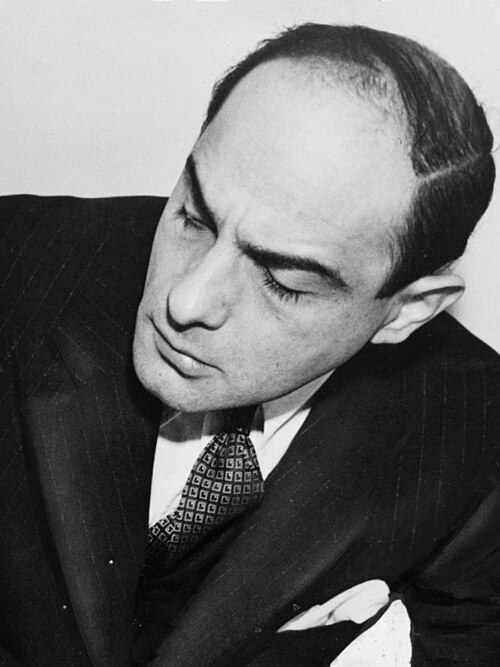
A New York childhood in the theatre
Lorenz Milton Hart was born in New York City on May 2, 1895, the elder of two sons of Max M. Hart and Frieda Isenberg Hart, German Jewish immigrants. Through his mother the family claimed descent from the German-Jewish poet Heinrich Heine, a lineage Hart was proud of. His father was a flamboyant business promoter with connections to Tammany Hall and a habit of skirting the law; his mother, to whom Larry was devoted, was cultured and indulgent. His younger brother, Teddy, grew up to be a musical comedy star.
The theatre was in Hart’s life from the start. His parents took the boys to Yiddish and German-language productions in New York, and as soon as they were old enough they went on their own. Precocious and widely read, Larry wrote poems and stories for student publications and comic revues for fellow campers at summer camp.
Columbia and the Shuberts
Hart attended Columbia Grammar School and DeWitt Clinton, spent boyhood summers at camp-schools in the Adirondacks where he wrote and staged shows, and then went to Columbia, where he spent two years at the School of Journalism from 1914 to 1916, less from any wish to be a reporter than for the discipline of constant writing. He later joked that he had “majored in Varsity Shows” the student musicals that sometimes caught the eye of Broadway producers.
By 1918 he was earning his living translating German plays and their songs into English for the Shubert brothers, the theatre magnates. He was short, standing about five feet tall, and by every account restless and very funny.
Meeting Richard Rodgers
Around 1919 a friend introduced Hart to Richard Rodgers, a gifted teenage composer seven years his junior who was writing music for Columbia’s varsity shows. Rodgers was himself the son of a Jewish physician. That year their song “Any Old Place With You” was interpolated into the Broadway musical A Lonely Romeo, and in 1920 several of their songs appeared in Poor Little Ritz Girl.
Success came slowly. Their breakthrough was The Garrick Gaieties of 1925, a revue for the Theatre Guild that ran for more than two hundred performances and introduced their first hit, “Manhattan.” The same year brought Dearest Enemy, and in the following years came The Girl Friend, Peggy-Ann and A Connecticut Yankee (1927). Its success brought the pair acclaim at last, and from then on producers sought them out.
The great run
Over a partnership of more than two decades, Rodgers and Hart wrote 26 Broadway musicals. In the early 1930s they spent several years in Hollywood, writing for films including Love Me Tonight (1932) and Hallelujah, I’m a Bum (1933), and providing English lyrics for Franz Lehár’s music in The Merry Widow (1934). At the height of the Depression Hart was earning some $60,000 a year.
The Hollywood years were productive but unhappy. They wrote songs for Maurice Chevalier and worked at several studios, including Paramount and MGM, but chafed at the studio system’s treatment of songwriters. Their film work also included The Phantom President (1932) and Mississippi (1935). Hart’s father, Max, had died in 1928, and Hart remained at home with his mother, who would be the central figure in his private life until her death.
Back on Broadway they produced a remarkable string of shows: Jumbo (1935), On Your Toes (1936), Babes in Arms and I’d Rather Be Right (1937), I Married an Angel and The Boys from Syracuse (1938), Too Many Girls (1939) and Higher and Higher (1940). Their songs, among them “Blue Moon” “The Lady Is a Tramp” and “My Funny Valentine” left the theatre to become standards for generations of singers and jazz musicians. Pal Joey (1940), adapted with John O’Hara from his own stories, was a gritty, sardonic musical drama far removed from conventional musical comedy. It received a mixed response at first, but its 1952 revival won the New York Drama Critics’ Circle award and it came to be seen as their masterpiece. Its score includes “Bewitched, Bothered and Bewildered.”
Wit with a broken heart
Hart’s lyrics are prized for their verbal fireworks: tumbling internal rhymes, multi-syllable rhymes and playful slang. The novelist and critic Anthony Burgess singled him out as one of the first to use such rhyming not merely for laughs but for wit “in the service of frustration or neurosis” and praised the conversational ease of lines that sounded like speech that happened to rhyme. He has been called “the expressive bard” of the urban generation that came of age between the world wars, and he was among the first musical-comedy lyricists to receive equal billing with his composer.
Beneath the cleverness ran a deep vein of melancholy. The critic Stephen Holden wrote that many of Hart’s ballads conveyed a heart-stopping sadness that reflected his conviction that he was too physically unattractive to be loved. The lyricist Alan Jay Lerner described him as a man who seemed deprived of the happiness his gifts gave to others. “In his lyrics, as in his life” Holden wrote, “Hart stands as a compellingly lonely figure” and it is the rueful vulnerability beneath the playfulness that gives the songs their singular poignancy.
Not everyone was an admirer. Stephen Sondheim, a demanding judge of lyrics, criticised Hart’s rhymes as sometimes lazy, and Hart’s friend the writer Henry Myers insisted that he was less a poet than a showman whose songs were written to be acted as part of a play: “Larry was a playwright” Myers said. Oscar Hammerstein II, who knew him well, remarked that Hart never walked slowly. The actress Edith Meiser called him “the American Toulouse-Lautrec”.
A private life in the shadows
Hart never married. He lived with his widowed mother almost all his life, and threw large parties. Many who knew him said he was homosexual, though in an era when that could not be spoken of publicly nothing about it appeared in print during his lifetime, and Rodgers fiercely protected him from gossip. His alcoholism grew steadily worse, leading to missed deadlines, blackouts and disappearances that could last for weeks, and it put increasing strain on the partnership. Rodgers, a fast and disciplined composer, increasingly struggled to get lyrics from him on time.
Hart’s Jewishness belonged to the New York of his childhood: immigrant parents, the Yiddish stage, a Heine ancestry he cherished. Like Rodgers and so many of the Jewish songwriters who built the American musical, he wrote not about Jewish life but about the city and its lovers, and in doing so helped create a distinctly American popular art.
Oklahoma! and the end
After By Jupiter (1942), their last new show together, the Theatre Guild proposed a musical based on Lynn Riggs’s play Green Grow the Lilacs. Hart, exhausted and doubtful that the rural material suited him, declined. Rodgers turned to Oscar Hammerstein II, and the result, Oklahoma!, opened on March 31, 1943, to triumph. Hart attended the opening and congratulated Rodgers at Sardi’s, though accounts differ on what he really felt. His mother died that April, and he sank further into depression and drink.
Rodgers brought him back for a revival of A Connecticut Yankee, for which Hart wrote six new numbers, including “To Keep My Love Alive” his last lyric. On the opening night, November 17, 1943, at the Martin Beck Theatre, he arrived drunk, then slipped away into the cold night to keep drinking. Within days he was in hospital with pneumonia, and he died on November 22, 1943, aged forty-eight. He was buried in Mount Zion Cemetery in Queens.
He died nearly bankrupt. Money he had entrusted to a manager could not be found, and a dispute over his will led to a lawsuit by his brother’s family that estranged the Rodgers and Hart families for years.
Legacy
Hart’s life was romanticised beyond recognition in the 1948 film Words and Music, in which Mickey Rooney played him and both his drinking and his sexuality were erased. A franker portrait came in Richard Linklater’s 2025 film Blue Moon, set on the night Oklahoma! opened, which earned Ethan Hawke an Academy Award nomination for playing him.
Biographers have tried to recover the man behind the songs. His sister-in-law, Dorothy Hart, published Thou Swell, Thou Witty: The Life and Lyrics of Lorenz Hart in 1976; Frederick Nolan’s Lorenz Hart: A Poet on Broadway followed in 1994, and Gary Marmorstein’s A Ship Without a Sail in 2012. The screenwriter Robert Kaplow, who wrote Blue Moon, summed up the portrait that emerges: a man so uncomfortable in his own skin that he got through life by being the funniest, smartest person in the room. Hart is buried in Mount Zion Cemetery, a Jewish cemetery in Queens, near the city whose rhythms his lyrics caught so exactly.
His songs needed no film to keep them alive. Generations of singers and jazz musicians have recorded them, and they remain at the heart of the Great American Songbook. Rodgers went on to even greater commercial success with Hammerstein, but the sharp, sad, urbane voice of the Rodgers and Hart songs belonged to Larry Hart alone, a small, lonely man who gave the twentieth century some of its most enduring words about love.
Sources & further reading
Lorenz Hart, Wikipedia · Lorenz Hart, Broadway: The American Musical, PBS · Lorenz Hart, EBSCO Research Starters · That Old Feeling: Heart to Hart, Richard Corliss, TIME (2002) · Researched from the sources above and checked against them. Spotted an error? Tell us.
A life of tikkun olam. This is part of tikkun olam, the Jewish idea of repairing the world, and every one of us can add to it.