- Person
- Lorenz Hart
- Lived
- 1895–1943
- Field
- Broadway lyricist
- From
- American
The story
By the end of the 1920s Lorenz Hart and Richard Rodgers were among the most popular songwriters in America, with fifteen Broadway scores between 1925 and 1931. Then the stock market crash of 1929 and the Great Depression brought Broadway production almost to a halt. Like many theatre writers, the partners went west, spending about five years in Hollywood writing for Warner Bros., Paramount, United Artists and Metro-Goldwyn-Mayer.
They wrote music and lyrics for films including Love Me Tonight (1932), The Phantom President (1932), Hallelujah, I'm a Bum (1933) and Mississippi (1935). Love Me Tonight, directed by Rouben Mamoulian, starred Maurice Chevalier as a Parisian tailor posing as a nobleman and Jeanette MacDonald as a princess. Its songs include 'Isn't It Romantic?', which travels in one continuous sequence from Chevalier's tailor shop through a taxi, a troop train and a gypsy camp to MacDonald's room, as well as 'Mimi' and 'Lover'. In 1990 the Library of Congress selected the film for the National Film Registry.
'Blue Moon' also came from the Hollywood years, though it took several attempts. Hart wrote one lyric for a song intended for Jean Harlow, which was cut, and others for MGM films before the studio's music publisher urged him to write a standalone version. Recorded by Glen Gray and the Casa Loma Orchestra in 1936, it topped the charts, and it went to number one again in 1961 in a doo-wop version by the Marcels. Hart also wrote English lyrics to Franz Lehár's music for the 1934 film The Merry Widow.
EBSCO's biography notes that, although the partners were unhappy with studio conditions, film work taught them new techniques, such as integrating songs with action and using rhythmic dialogue to lead into songs, which they brought back to Broadway. After the Depression eased, they returned to the stage in 1935 with Billy Rose's Jumbo, which introduced 'The Most Beautiful Girl in the World' and 'My Romance'.
Those lessons fed the remarkable string of stage hits that followed. The songs from the Hollywood years also lived on: 'Blue Moon' alone has been recorded by artists ranging from Elvis Presley in 1956 to Bob Dylan in 1970.
Why it matters
Hart's film songs reached audiences far beyond Broadway, helped shape the early movie musical and became lasting standards.
About Lorenz Hart
Lyricist of Rodgers and Hart, whose witty, rueful words for “Blue Moon” “My Funny Valentine” and “The Lady Is a Tramp” helped make the Broadway song an art form.
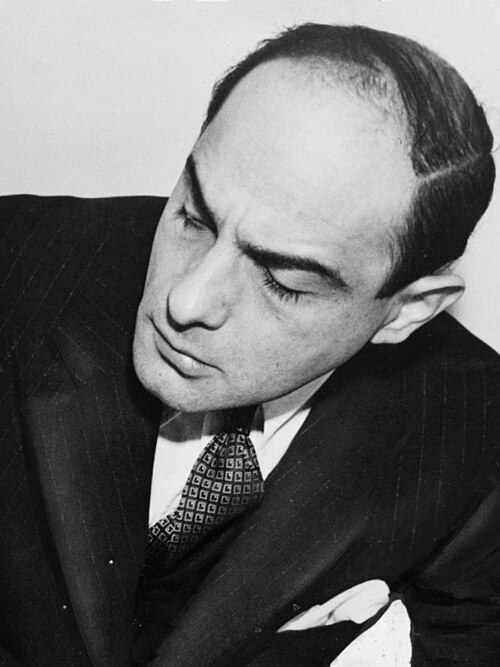
More about Lorenz Hart
- One Hart show gave the world 'My Funny Valentine'Babes in Arms (1937) alone gave the world 'My Funny Valentine', 'The Lady Is a Tramp', 'Where or When' and 'Johnny One-Note'.
- Lorenz Hart helped bring Shakespeare to musical comedyRodgers and Hart's The Boys from Syracuse (1938), based on The Comedy of Errors, was a pioneering Shakespeare adaptation for musical comedy.
- Lorenz Hart turned Mark Twain's Connecticut Yankee into songRodgers and Hart's A Connecticut Yankee (1927), based on Mark Twain's novel, confirmed Hart as a leading lyricist; he revised it as his final work.
- Lorenz Hart pioneered the conversational song lyricLorenz Hart was among the first lyricists to use polysyllabic rhyme for wit and insight and to write in a natural, conversational voice.
- Hart's I'd Rather Be Right satirised a sitting presidentRodgers and Hart's 1937 musical I'd Rather Be Right took the unprecedented step of satirising an American president still in office.
- Lorenz Hart's Pal Joey triumphed when revived in 1952Pal Joey (1940), the first musical with unromanticised realism, won the New York Drama Critics Award when revived in 1952.
- Lorenz Hart wrote lyrics for 28 Rodgers and Hart musicalsLyricist Lorenz Hart and composer Richard Rodgers wrote 28 stage musicals and more than 500 songs together, including 'Blue Moon', many now classics of the American songbook.
Sources
- Lorenz Hart EBSCO Research Starters
- Lorenz Hart Wikipedia
- Love Me Tonight Wikipedia
- Rodgers and Hart Wikipedia
Another act of tikkun olam. This is part of tikkun olam, the Jewish idea of repairing the world, and every one of us can add to it.