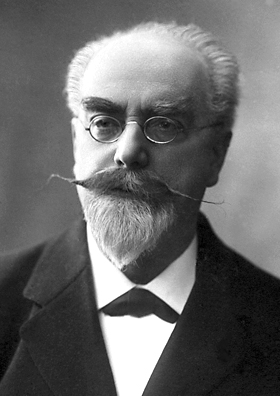
Born in Luxembourg, raised in Paris
Jonas Ferdinand Gabriel Lippmann was born on 16 August 1845 in Bonnevoie, in the commune of Hollerich, Luxembourg, to French parents. Both were Jewish: his father, Isaïe Lippmann, came from Lorraine and managed a glove-making business in Bonnevoie, and his mother came from Alsace. In 1848 the family moved to Paris, where his mother taught him at home before he entered the Lycée Napoléon, now the Lycée Henri-IV, in 1858.
He was, his Nobel biography says, not a markedly successful student, because he concentrated only on what interested him and neglected the rest. He was admitted to the École normale supérieure in 1868 but failed the agrégation, the examination that would have qualified him to teach. Physics, not a conventional career, was what held his attention.
Training in Germany
In 1873 the French government sent Lippmann on a scientific mission to Germany to study how science was taught there. In Heidelberg he worked with the physiologist Wilhelm Kühne and the physicist Gustav Kirchhoff, and he earned a doctorate with highest distinction in 1874. He then visited Hermann von Helmholtz in Berlin before returning to Paris, where in July 1875 he submitted his doctoral thesis on electrocapillarity, the relationship between electrical and capillary phenomena.
In 1878 he joined the Faculty of Sciences of the University of Paris. He became professor of mathematical physics in 1883 and in 1886 professor of experimental physics, succeeding Jules Jamin, and director of the research laboratory that later moved to the Sorbonne. He held that post for the rest of his life. Among the young researchers working in his laboratory in the 1890s was Marie Skłodowska, the future Marie Curie.
A tool that recorded the heartbeat
Lippmann’s studies in Heidelberg showed that the surface tension of mercury in contact with dilute acid changes with electrical voltage. He turned this into an instrument of extraordinary sensitivity, the capillary electrometer: a glass tube of mercury drawn to a very fine point dipping into acid, whose meniscus moves visibly under a microscope when tiny voltages are applied. It could detect differences of potential far smaller than earlier instruments could measure.
Physiologists soon realised that it could capture the faint electrical signals of living tissue. In 1887 the British physiologist Augustus Waller used a Lippmann capillary electrometer to record the first electrocardiogram from a human heart. Willem Einthoven in the Netherlands, who saw Waller’s demonstrations, first worked with the capillary electrometer and then developed the more practical string galvanometer, making the electrocardiogram a clinical tool. Today the ECG is one of the most common tests in medicine, used every day in hospitals, clinics and ambulances to diagnose heart attacks and rhythm problems; its history begins with Lippmann’s mercury tube.
The French physiologist Étienne-Jules Marey had already used a mercury capillary electrometer in 1876 to record the electrical activity of an animal heart, and Waller went on to lecture across Europe and America on the new technique, often demonstrating it on his dog Jimmy. Waller himself doubted that it would ever have much clinical use. It was Einthoven’s refinement of the recordings, and the instruments that grew out of them, that gave the electrocardiogram the immense clinical value it has today.
Colour photography from the physics of light
Early photographs were black and white, and inventors had long dreamed of capturing colour directly. By 1886 Lippmann had worked out a theory for doing so using interference, the way light waves reinforce and cancel each other. He coated a glass plate with an extremely fine-grained, nearly transparent emulsion and placed it against a mirror of liquid mercury. Light passing through the emulsion reflected back on itself, forming standing waves whose pattern was recorded as microscopically thin layers of silver. When the developed plate was viewed in white light, those layers reflected back exactly the colours that had made them.
On 2 February 1891 he announced to the French Academy of Sciences that he had fixed the colours of the spectrum on a photographic plate, permanently and without fading in daylight. By 1892 he was showing colour images of a stained-glass window, flags, a bowl of oranges with a red poppy and a multicoloured parrot, and in 1893 he presented brilliant colour photographs taken by the Lumière brothers using his method. He published the complete theory in 1894. The process was slow and each image was unique and could not be copied, so it never became popular, but it was a landmark: the first way to record colour directly from the physics of light rather than from pigments or filters.
A beautiful but difficult process
In practice, Lippmann photography was hard to use. The ultra-fine emulsions that could record detail smaller than a wavelength of light were far less sensitive than ordinary plates, so exposures typically took minutes even in bright sunshine. A shallow glass prism was usually cemented to the finished plate to deflect surface reflections, which kept plates small: his early photographs measured about 4 by 4 centimetres, later about 6.5 by 9. The colours could be seen properly only under the right lighting and viewing angle, the process produced no paper prints, and a Lippmann image could not be duplicated by rephotographing it.
Special plates and a plate holder with a built-in mercury reservoir were sold commercially for a few years around 1900, but even experts struggled to get consistent results. Pure spectral colours came out brilliantly; the broad, mixed colours of everyday objects were more difficult. The method remained a scientifically elegant laboratory achievement rather than a popular technology, but it stimulated interest in the further development of colour photography, and surviving Lippmann plates are preserved in museum collections as early masterpieces of colour.
Seeds of holography and 3D imaging
Lippmann’s ideas reached far beyond his own lifetime. His colour process, which records light as standing waves inside a photographic layer, foreshadowed holography. The reflection holograms later developed by the Soviet physicist Yuri Denisyuk work on the same principle and are often called Lippmann–Bragg holograms.
In 1908 he proposed integral photography: a camera using a sheet of tiny lenses to record a scene from many slightly different viewpoints at once, so that when the image is viewed through a matching lens array it appears in three dimensions, shifting realistically as the viewer moves. The materials to build it did not yet exist, but the principle of recording what is now called a light field underlies today’s light-field cameras and microscopes and the lenticular 3D images found on everything from postcards to packaging.
Others soon took up his idea. In the 1920s the mathematician Eugène Estanave, using glass Stanhope lenses, and Louis Lumière, using celluloid, made promising trials of integral photography. Lippmann’s proposal became the foundation of research on three-dimensional and animated lenticular images, and the same principle, many small lenses each capturing the scene from its own angle, is used in modern light-field imaging research.
An inventive mind
Lippmann contributed to many other branches of physics, especially electricity, thermodynamics, optics and photochemistry. In 1881 he predicted the converse piezoelectric effect, the deformation of certain crystals under an electric field, a phenomenon at the heart of the quartz oscillators in modern watches and electronics and of ultrasound transducers. He invented the coelostat, an astronomical device that compensates for the Earth’s rotation so a region of sky can be photographed without apparent movement, and which proved especially useful during eclipses.
In 1895 he devised a method of eliminating the personal equation, the reaction-time error of human observers, in time measurements by using photographic registration, and he studied ways to correct the irregularities of pendulum clocks. In 1900 he described a mechanical thought experiment now known as the Brownian ratchet. His papers to the Academy of Sciences were noted for their conciseness and originality.
Nobel Prize and honours
In 1908 Lippmann received the Nobel Prize in Physics “for his method of reproducing colours photographically based on the phenomenon of interference.” He had been elected to the French Academy of Sciences in 1886 and served as its president in 1912. He was also a member of the Bureau des Longitudes and a Foreign Member of the Royal Society of London.
His Jewish family background, from the long-established Jewish communities of Lorraine and Alsace, was typical of the French-Jewish families who entered the professions and the sciences in the century after French Jews gained equal citizenship. He is counted among Jewish Nobel laureates by the Jewish Virtual Library; there is no record in the sources consulted of his religious practice as an adult.
Death at sea and legacy
In 1888 Lippmann married the daughter of the novelist Victor Cherbuliez, a member of the Académie française. In 1921 he travelled to North America as a member of a French mission led by Marshal Fayolle. On the voyage home aboard the liner France he died at sea in July 1921, aged seventy-five. He was buried in the Montparnasse Cemetery in Paris.
Few people today have seen a Lippmann colour plate, but many have benefited from his work without knowing it. Every electrocardiogram traces its ancestry to his capillary electrometer; every reflection hologram and light-field camera follows a path he opened; and the piezoelectric effect he predicted keeps time in quartz watches. He was, in his Nobel biographer’s words, a physicist of original and independent mind.
Sources & further reading
Gabriel Lippmann, Biographical, NobelPrize.org · Gabriel Lippmann, Wikipédia (French) · Augustus Desiré Waller, Life in the Fast Lane (LITFL) · Gabriel Lippmann, Jewish Virtual Library · Gabriel Lippmann, Wikipedia · Researched from the sources above and checked against them. Spotted an error? Tell us.
A life of tikkun olam. This is part of tikkun olam, the Jewish idea of repairing the world, and every one of us can add to it.