- Person
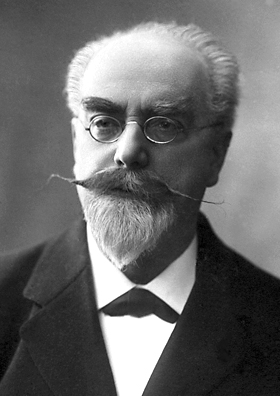
- Gabriel Lippmann
- Lived
- 1845–1921
- Field
- Physics, optics
- From
- French
The story
Gabriel Lippmann was born in Luxembourg in 1845 to French Jewish parents, his father from Lorraine and his mother from Alsace, and grew up in Paris. In 1873 the French government sent him to Germany to study science teaching, and in Heidelberg, working with Wilhelm Kühne and Gustav Kirchhoff, he investigated how electricity affects the surface tension of mercury.
From that research he built the capillary electrometer. A glass tube filled with mercury is drawn out to a very fine point, a few thousandths of a millimetre across, and dipped into dilute sulphuric acid. When a voltage is applied, the mercury’s surface moves, and under a microscope the movement reveals electrical differences far smaller than earlier instruments could detect. His Nobel biography describes it as extraordinarily sensitive.
Physiologists quickly saw its value. The heart produces tiny electrical signals each time it beats, but they were too faint to record. The French physiologist Étienne-Jules Marey used a mercury capillary electrometer in 1876 to record the electrical activity of an animal heart, and in 1887 the British physiologist Augustus Waller, at St Mary’s Hospital in London, used a Lippmann capillary electrometer to record the first electrocardiogram from a human being. Waller demonstrated the technique across Europe and America; the Dutch physiologist Willem Einthoven, who saw his work, first used the capillary electrometer and then developed the string galvanometer, which turned the electrocardiogram into a practical clinical test.
Lippmann went on to win the 1908 Nobel Prize in Physics for a different invention, colour photography by light interference, and spent the rest of his career directing the physics research laboratory at the Sorbonne, where he devised other ingenious instruments, including the coelostat for photographing the sky. But the instrument born of his doctoral research on electricity and mercury opened the way to one of medicine’s most important diagnostic tools. Waller himself doubted the technique would ever be clinically useful; the decades that followed proved how wrong that doubt was.
Why it matters
The electrocardiogram, whose first human recording was made with Lippmann’s electrometer, is now one of the most common medical tests in the world, used daily to diagnose heart attacks and irregular heart rhythms.
About Gabriel Lippmann
French-Jewish physicist who invented interference colour photography and the capillary electrometer used for the first human ECG, and foresaw 3D light-field imaging. Nobel 1908.
More about Gabriel Lippmann
Sources
- Gabriel Lippmann Wikipedia
- Gabriel Lippmann, Biographical NobelPrize.org
- Augustus Desiré Waller Life in the Fast Lane (LITFL)
- Willem Einthoven and the string galvanometer Hektoen International
Another act of tikkun olam. This is part of tikkun olam, the Jewish idea of repairing the world, and every one of us can add to it.