- Person
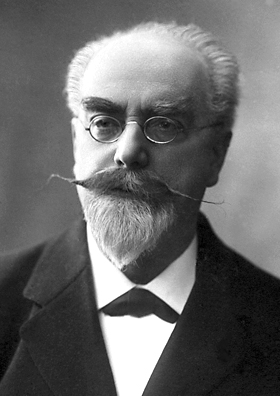
- Gabriel Lippmann
- Lived
- 1845–1921
- Field
- Physics, optics
- From
- French
The story
Gabriel Lippmann, born in Luxembourg in 1845 to French Jewish parents and raised in Paris, became professor of experimental physics at the Sorbonne in 1886. That year he also worked out a theory for a problem that had defeated photographers since the invention of the camera: how to record the colours of the world directly.
His solution used interference, the way light waves reinforce and cancel one another. He coated a glass plate with an extremely fine-grained, nearly transparent emulsion and placed it against a mirror of liquid mercury. Light passing through the emulsion reflected back on itself and formed standing waves, which the emulsion recorded as microscopically thin layers of silver spaced according to the wavelength of each colour. When the developed plate was lit with white light, each point reflected back the colour that had created it.
On 2 February 1891 he told the French Academy of Sciences that he had fixed the image of the spectrum with its colours on a photographic plate, permanently and without fading in daylight. By April 1892 he was showing colour photographs of a stained-glass window, flags, a bowl of oranges with a red poppy and a parrot, and in 1893 he presented photographs taken by the Lumière brothers with his method. He published the full theory in 1894, and in 1908 received the Nobel Prize in Physics for his method of reproducing colours photographically based on the phenomenon of interference.
The process needed long exposures and produced unique images that could not be copied, so it never became popular. But it was scientifically profound. Recording light as standing waves inside a photographic layer foreshadowed holography; the reflection holograms later developed by Yuri Denisyuk work the same way and are often called Lippmann–Bragg holograms. In 1908 Lippmann also proposed integral photography, which records a scene through an array of tiny lenses and is the principle behind today’s light-field cameras and lenticular 3D images.
Why it matters
Lippmann’s interference method stimulated the development of colour photography and laid foundations for reflection holography and 3D light-field imaging used in science and industry today.
About Gabriel Lippmann
French-Jewish physicist who invented interference colour photography and the capillary electrometer used for the first human ECG, and foresaw 3D light-field imaging. Nobel 1908.
More about Gabriel Lippmann
Sources
- Gabriel Lippmann, Biographical NobelPrize.org
- Gabriel Lippmann Wikipedia
- Gabriel Lippmann Wikipédia (French)
Another act of tikkun olam. This is part of tikkun olam, the Jewish idea of repairing the world, and every one of us can add to it.