A liberal Jewish home in Minden
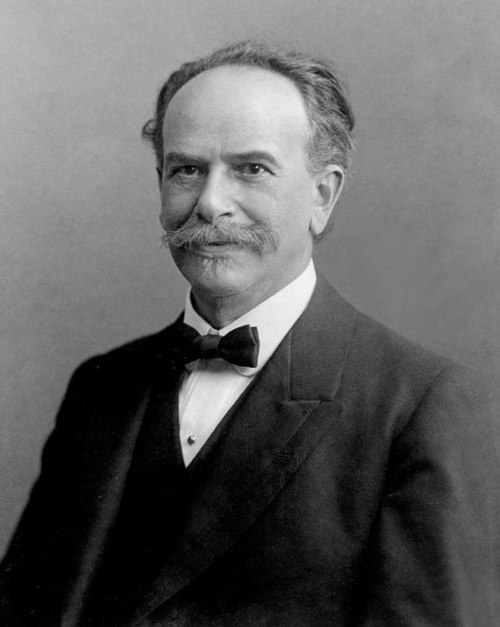
Franz Uri Boas was born on July 9, 1858, in Minden, a garrison town in Westphalia, then part of Prussia. His father, Meier Boas, was a merchant; his mother, Sophie Meyer, had founded the town’s kindergarten and took a lively interest in public affairs and science. His grandparents had been observant Jews, but his parents had embraced the Enlightenment and the liberal hopes of the revolution of 1848. In an autobiographical sketch, Boas wrote that his parents had “broken through the shackles of dogma,” and that his father kept an emotional attachment to the ceremonies of his own childhood home without letting it govern his thinking.
Another early influence was Abraham Jacobi, his mother’s brother-in-law, a pioneering paediatrician in New York and a friend of Karl Marx. Jacobi would advise and support his nephew for decades. Young Franz was a frail child who took refuge in books and in nature, collecting plants and studying their geographic distribution at school. He never practised Judaism as a religion, but he also refused to convert to Christianity, as many ambitious German Jews of his generation did. He would describe himself, in effect, as a German Jew who believed in reason and freedom above every inherited loyalty.
Duels, physics and the colour of water
Boas studied at Heidelberg, Bonn and Kiel, taking physics, mathematics and geography. German student life was dominated by duelling fraternities and, increasingly, by nationalism and antisemitism. Boas fought his first duel at Heidelberg in 1877, at nineteen, and more followed; the sculptor Jacob Epstein, who made his bust in 1927, described his face as criss-crossed with the scars of his student duels. At Kiel, he wrote home that one could not survive without quarrelling and fighting with the antisemites.
In 1881 he received his doctorate in physics at Kiel with a dissertation on the colour of water, which examined how light is absorbed and reflected in it. The research left him puzzled less by water than by perception: how could an observer reliably judge faint differences in colour? That question, about the gap between the world as it is and the world as a particular mind perceives it, would become the thread running through his whole career. After a year of military service he turned to geography, partly because it offered a route to the expedition he was planning.
A winter with the Inuit
In 1883 Boas sailed to Baffin Island in the Canadian Arctic to study how the environment shaped the migrations of the Inuit. He went with a family servant, Wilhelm Weike, but in practice he depended on Inuit families for food, shelter, directions and company through the long polar winter. On one occasion he and his companion were lost and had to keep sledding for twenty-six hours in bitter cold. In his diary he wrote that the more he saw of Inuit customs, the more he felt that “we have no right to look down upon them,” and that “we ‘highly educated people’ are much worse, relatively speaking.”
The year changed him. He went north as a geographer interested in terrain and came back fascinated by how people lived and thought. His monograph The Central Eskimo appeared in 1888. Back in Berlin he worked at the Royal Ethnological Museum with the pathologist Rudolf Virchow and the ethnologist Adolf Bastian, who taught that all human beings share the same basic mental capacities. There he met visiting members of the Nuxalk Nation from British Columbia, beginning a lifelong engagement with the peoples of the Pacific Northwest.
A new life in America
In 1886, after qualifying as a university lecturer in geography, Boas made a field trip to British Columbia by way of New York. Early in 1887 he was offered a job as an assistant editor of the journal Science and decided to stay. Growing antisemitism and nationalism in Germany, and the narrow prospects there for a Jewish geographer, made the decision easier, and so did his engagement to Marie Krackowizer, an Austrian-American whom he married in 1887.
His first American years were unsettled. He taught at Clark University, resigned in 1892 in a dispute over academic freedom, helped prepare the anthropology exhibits at the 1893 World’s Columbian Exposition in Chicago, worked briefly at the new Field Museum and then joined the American Museum of Natural History in New York. There he organised the Jesup North Pacific Expedition, a five-year survey of the peoples on both sides of the Bering Strait. In 1899 Columbia University made him its professor of anthropology, a post he held until his retirement in 1937. For decades he worked closely with George Hunt, his collaborator in British Columbia, publishing volume after volume of Kwakiutl texts that recorded Kwakwaka’wakw stories, customs and language.
Culture, not race
In Boas’s time, much of Western science held that humanity was divided into fixed races ranked from “primitive” to “civilised,” and that differences in behaviour flowed from biology. Boas attacked this view with evidence. For the United States Immigration Commission he measured nearly eighteen thousand immigrants and their children in New York and found that the American-born children differed measurably in head shape from their parents, with the change greater the longer the mother had lived in America. Head form, treated by racial theorists as one of the most stable racial markers, turned out to respond to environment. Later researchers have debated the size of the effect, but the larger point stood: human types are plastic, not fixed.
In The Mind of Primitive Man (1911) he set out his central argument. Biology, language and culture vary independently; none determines the others. Differences between peoples are best explained by history and by culture, learned and passed on, not by innate capacity. He rejected the idea that all societies climb a single ladder with Europe at the top, and insisted that every culture be understood in its own terms. This principle, later called cultural relativism, became the foundation of modern anthropology and transformed how educated people everywhere talk about human difference.
Teacher of a discipline
At Columbia Boas built American anthropology almost single-handedly. He insisted that the field unite four approaches: the study of living cultures, of languages, of archaeology and of human biology. He trained a remarkable generation of scholars, including Alfred Kroeber, Robert Lowie, Edward Sapir, Ruth Benedict, Margaret Mead, Melville Herskovits, Ella Cara Deloria and the novelist Zora Neale Hurston. Many went on to found anthropology departments across the country, and an unusually large share of his doctoral students were women, at a time when few fields welcomed them.
He also laid foundations for the scientific study of Native American languages. His Handbook of American Indian Languages (1911) set out methods for recording unwritten languages on their own terms, rather than forcing them into the grammar of Latin. Thanks to Boas and his students, vast amounts of language, song, story and knowledge from Indigenous communities were documented at a time when many of those languages were under severe pressure.
A scientist who spoke out
Boas believed that knowledge carries moral obligations. In 1906, at the invitation of W. E. B. Du Bois, he gave the commencement address at Atlanta University, telling Black graduates that Africa had a rich history of achievement, including the smelting of iron, and that claims of their racial inferiority had no basis in science. He spoke to the NAACP, criticised the racial theories of writers such as Madison Grant, and with his students argued in the press against scientific racism.
In 1919 he denounced, in a letter to The Nation, anthropologists who had used research trips as cover for spying during the war, writing that such a person “prostitutes science.” The American Anthropological Association censured him by twenty votes to ten, a decision coloured by anti-German and probably antisemitic feeling; it was not rescinded until 2005. When the Nazis came to power, Boas fought them openly. His books were burned in Germany, including by students of his own university at Kiel. He organised a statement by scientists rejecting the Nazi idea of “Jewish science,” protested to President Hindenburg, and worked to help scholars escape Germany and find positions in America.
Shadows on the record
Boas’s legacy is not without stains, and fairness requires naming them. As a young collector short of money, he took bones and skulls from Indigenous graves in British Columbia to sell to museums; in his diary he called it “most unpleasant work” but did it anyway. At the American Museum of Natural History he asked the explorer Robert Peary to bring an Inuk from Greenland; Peary brought six in 1897. Four died of tuberculosis within a year, and the museum kept the remains of one, the father of a boy named Minik, while staging a sham burial. Boas has been widely criticised for his part in that episode.
His own students also corrected him. He had at first defended head measurements as a guide to heredity and later rejected his earlier views, and he encouraged students to criticise his work as freely as anyone else’s. That habit of self-correction was part of what he meant by science.
Death and legacy
Boas retired from Columbia in 1937 but kept writing and campaigning against racism to the end. On December 21, 1942, at a luncheon at Columbia’s faculty club, while discussing the urgent need to fight racism, he collapsed and died at the age of eighty-four. The French anthropologist Claude Lévi-Strauss, who was present, later recalled that Boas died in his arms. His student Ruth Benedict wrote that he believed the world must be made safe for differences.
Boas is called the father of American anthropology, but his influence reaches far beyond one discipline. The modern understanding that culture is learned, that no people is innately superior, and that human difference must be studied with humility and evidence owes more to him than to anyone else. His work supplied scholars, lawyers and activists with the science they used against segregation and immigration quotas based on race. The physicist who began by puzzling over how an observer sees the colour of water spent his life teaching the world to see other human beings more clearly.
Sources & further reading
Franz Boas, Wikipedia · Franz Boas, Jewish Virtual Library · Franz Boas, Anthropologist and Defender of Differences, The New York Review of Books (2020) · Researched from the sources above and checked against them. Spotted an error? Tell us.
A life of tikkun olam. This is part of tikkun olam, the Jewish idea of repairing the world, and every one of us can add to it.