Eight generations of rabbis
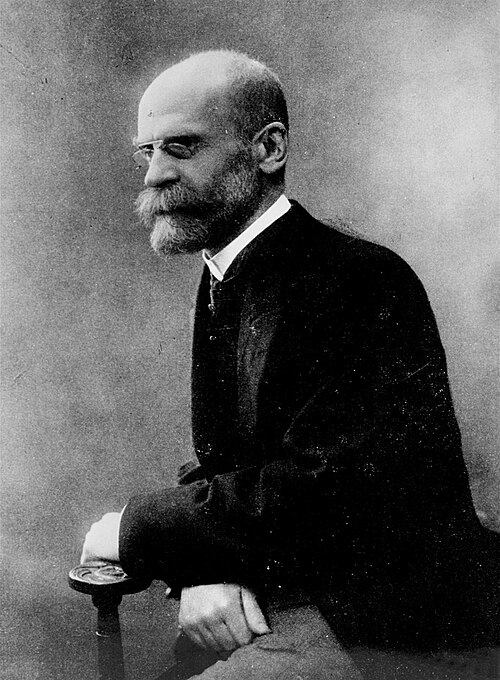
David Émile Durkheim was born on April 15, 1858, in Épinal, a small town in the Vosges in French Lorraine. His father, Moïse Durkheim, was the town’s rabbi and chief rabbi of the Vosges and Haute-Marne; his grandfather and great-grandfather had been rabbis before him, part of a line of Alsatian Jewish scholars that stretched back, by the usual count, eight generations. His mother, Mélanie, was a merchant’s daughter. Émile was the youngest of the surviving children, and he was expected to carry the family vocation forward. As a boy he was sent to a rabbinical school.
But while still a schoolboy he turned away from the rabbinate. At the Collège d’Épinal he skipped two years and earned his baccalauréats in letters and in sciences by seventeen. He would live a thoroughly secular life, and much of his scholarship argued that religion arises from the life of human communities rather than from revelation. Yet he never cut himself off from his family or from French Jewry. Many of his closest collaborators were Jewish, and the most famous of them, the anthropologist Marcel Mauss, was his own nephew. Scholars still debate how far the rabbinic world of his childhood shaped his thinking; what is certain is that he grew up inside a close community bound by law, ritual and shared belief, the very subject he would spend his life explaining.
A science that did not yet exist
Durkheim moved to Paris to prepare for the École normale supérieure, the elite school that trained France’s professors. He failed the entrance examination twice and was admitted on his third attempt, in 1879. His classmates included the future socialist leader Jean Jaurès and the philosopher Henri Bergson. He studied under the historian Numa Denis Fustel de Coulanges, who treated ancient institutions with a social scientist’s eye, and he read Auguste Comte and Herbert Spencer, who had argued that society could be studied as rigorously as nature.
There was a problem: French universities taught no such subject. Durkheim found the polished humanism of the École dull and drifted from philosophy toward ethics and, eventually, toward a discipline that had a name but no home. Despite a serious illness the year before, he passed the agrégation in philosophy in 1882 and spent five years teaching in provincial lycées. In 1885 and 1886 he studied in Germany, at Marburg, Berlin and Leipzig, where he admired the experimental psychologist Wilhelm Wundt and learned to value careful empirical work over abstract system-building. His reports on German social science, published back in France, caught the attention of the education official Louis Liard, and opened a door.
Bordeaux and the first course in social science
In 1887 Durkheim was appointed to the University of Bordeaux to teach “social science and pedagogy.” It was the first time sociology had been taught in a French university, and the appointment of a social scientist to a faculty of letters was itself a sign of changing times. The same year he married Louise Dreyfus; they had two children, Marie and André.
The fifteen years in Bordeaux were astonishingly productive. In 1893 he published his doctoral thesis, The Division of Labour in Society, which asked what holds a modern society together once the shared beliefs of small traditional communities have faded. His answer was that modern solidarity rests increasingly on interdependence: as people specialise, they need one another more. In 1895 came The Rules of Sociological Method, a manifesto insisting that society has its own reality, made of what he called “social facts,” such as laws, customs, moral rules and collective beliefs, which exist outside any single person and press upon everyone. That year he also created, at Bordeaux, what is usually described as the first university department of sociology in Europe.
Counting what seemed most private
Durkheim’s most famous demonstration came in 1897 with Suicide. Nothing, it might seem, is more personal than the decision to end one’s life. Durkheim gathered official statistics from across Europe and showed that suicide rates were remarkably stable within a given society from year to year, yet differed sharply between societies and groups: between Protestants, Catholics and Jews, between married and unmarried people, between times of peace and times of upheaval. Something social, he argued, was at work.
He proposed that the risk rises when people are too loosely tied to a group, which he called egoistic suicide, and when the norms that regulate life break down, a condition he named anomie. He also described rarer forms linked to excessive integration and excessive regulation. Later researchers have criticised his data and refined his categories, but the method itself changed the study of human behaviour: measure carefully, compare groups, and look for causes in the structure of social life. Modern public health research on isolation, social connection and suicide works in a tradition he helped to found. Suicide is still taught as a model of how a sociological study should be built.
Dreyfus and the defence of the individual
Durkheim was a patriot and a firm supporter of the secular Third Republic, with sympathy for moderate socialism. As a Jew from Lorraine in a France humiliated by its defeat in 1870, he knew that he stood in a political minority. When the Dreyfus Affair split the nation, he took sides publicly. In 1898 he became secretary of the Bordeaux section of the new League for the Rights of Man, founded to defend the Jewish army captain Alfred Dreyfus, who had been falsely convicted of treason.
That year he also published “Individualism and the Intellectuals,” a reply to the critic Ferdinand Brunetière, who had attacked the intellectuals defending Dreyfus as agents of anarchy. Durkheim answered that respect for the dignity and rights of the individual was not selfishness but the moral faith of modern society itself, and that to abandon one innocent man for reasons of state would betray it. In 1899, answering Henri Dagan’s published inquiry on antisemitism, he described it as a symptom of social crisis: when a society suffers, he wrote, it looks for someone to blame, and the Jews, already disfavoured, are made its “expiatory victims.” For a scholar who usually kept his politics out of his books, it was an unusually direct stand, and it placed him among the defenders of justice in one of the defining struggles of modern France.
Religion, schools and a moral republic
In 1902 Durkheim finally reached Paris, appointed to teach education at the Sorbonne; he became full professor in 1906, and in 1913 his chair was renamed for the science of education and sociology. Because the university trained France’s future schoolteachers, his lectures on moral education were compulsory for a whole generation of them, and he advised the Ministry of Education. He wanted secular schools to teach discipline, attachment to the group and personal autonomy without relying on religious authority.
Meanwhile he built a school of thought. His journal L’Année sociologique, whose first volume appeared in 1898, gathered a brilliant team of young scholars, including Mauss, Henri Hubert and Maurice Halbwachs, who reviewed and organised research across law, religion, economics and anthropology. In 1912 Durkheim published his last great book, The Elementary Forms of the Religious Life. Drawing on reports of Aboriginal Australian totemism, he argued that religion is how a group represents itself to itself, and that rituals renew the bonds of a community by creating moments of shared intensity he called “collective effervescence.” The book shaped the study of religion for a century and still frames how scholars think about ritual, symbols and the sacred.
War and grief
When the First World War broke out, Durkheim threw himself into the national effort despite poor health. He organised a committee to publish studies and documents about the war for readers in neutral countries, countering German propaganda, and wrote patriotic pamphlets. His position was patriotic but never nationalist, and that nuance, together with his Jewish origins and German-sounding name, made him a target. On at least two occasions he faced public insinuations of disloyalty that his biographers describe as plainly antisemitic.
The war also destroyed the school he had built. Many of his brightest students died in the trenches. His son André, a promising linguist who had joined the Année circle, was sent to the Balkan front late in 1915 and reported missing; his death was confirmed in 1916. Durkheim never recovered. He withdrew into what one account calls a ferocious silence and forbade friends to speak of his son. He kept working, but his strength was gone. On November 15, 1917, after a stroke, Émile Durkheim died in Paris at the age of fifty-nine. He was buried in the Montparnasse Cemetery.
The man behind the method
Contemporaries remembered Durkheim as austere, intensely serious and almost priestly in his devotion to work, a man who carried the moral earnestness of his rabbinic ancestors into a secular calling. He could be a combative polemicist, and some colleagues complained of “sociological imperialism” as his influence grew. Yet his students were devoted to him, and he poured enormous effort into their careers and into the collective labour of his journal, which he saw as a shared enterprise rather than a personal platform.
He believed that knowledge should serve society. The point of studying moral rules scientifically, he argued, was not to dissolve them but to understand which ones a modern society truly needed, and how institutions such as schools, professions and the law could give people the sense of belonging and purpose that tradition once supplied.
What sociology gave the world
Durkheim is usually named with Karl Marx and Max Weber as one of the founders of modern social science, and of the three he did the most to turn sociology into an academic discipline with its own subject, methods and institutions. His insistence that social patterns can be measured and explained laid foundations for survey research, criminology, the sociology of education and religion, and much of anthropology. Ideas he named, such as anomie and collective consciousness, have passed into everyday speech.
His practical legacy is wide. Governments that study unemployment, crime, school failure or suicide by looking at social conditions, rather than blaming individual weakness alone, are working in the way he argued for. Teachers trained in his lectures carried his vision of a secular, inclusive civic education into French classrooms. And his defence of Dreyfus remains a model of a scholar using his authority for justice. The rabbi’s son who left the synagogue spent his life showing why human beings need one another, and how much of what we take to be private is woven from the life we share.
Sources & further reading
Émile Durkheim, Wikipedia · Emile Durkheim: His Life and Work, University of Chicago Durkheim pages · Durkheim, Émile, Encyclopedia of Religion and Society (Hartford Institute) · Chad Alan Goldberg, Introduction to Durkheim’s “Antisemitism and Social Crisis” (2008) · Researched from the sources above and checked against them. Spotted an error? Tell us.
A life of tikkun olam. This is part of tikkun olam, the Jewish idea of repairing the world, and every one of us can add to it.