- Person
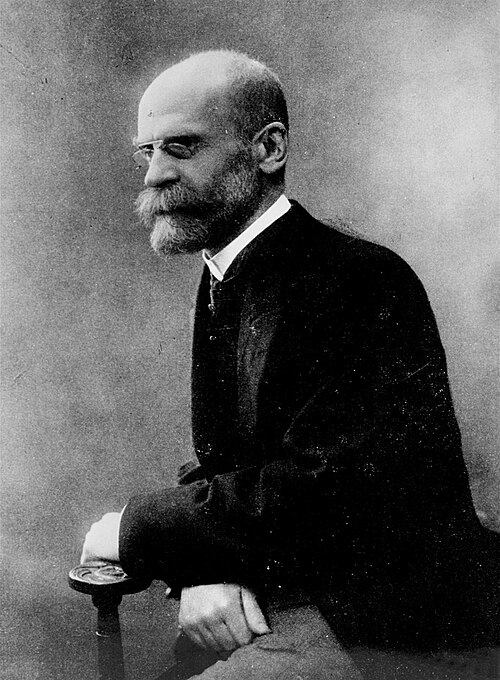
- Émile Durkheim
- Lived
- 1858–1917
- Field
- Sociology
- From
- French
The story
Émile Durkheim, born in 1858 in Épinal, France, to a Jewish family descended from generations of rabbis, was the founding figure of French sociology. In 1897 he published Le Suicide: Étude de sociologie, known in English simply as Suicide. It became one of the most famous studies in the history of the social sciences.
Before Durkheim, suicide was widely treated as a purely individual act, explained by madness, weakness or personal misfortune. Durkheim asked a different question. If suicide were purely individual, why did suicide rates differ so steadily between groups and countries, year after year? He argued that suicide rates reflect conditions in society itself, and that they could be studied as a social fact.
To test this, he compared statistics across many groups: people of different religions, married and unmarried people, parents and the childless, soldiers and civilians, men and women, and populations in peace and war. He drew heavily on data gathered by earlier researchers, and his reasoning has since been criticised, for example over how deaths were recorded. But his central insight endured.
Durkheim concluded that suicide rates depend on two social forces: integration, meaning how strongly people are bound into communities, and regulation, meaning how far society gives people's lives direction and limits. He described four types. Egoistic suicide comes from weak bonds and isolation. Altruistic suicide comes from bonds so strong that the group outweighs the individual. Anomic suicide follows a loss of moral direction, often after sudden economic upheaval, whether ruin or a windfall. Fatalistic suicide comes from regulation so harsh that it blocks any future.
Suicide is often cited as a classic case study that showed what a careful sociological study could look like, combining a clear theory with systematic evidence. It went on to influence later theories about how social bonds shape behaviour.
Durkheim's lasting lesson is that loneliness, broken social ties and sudden upheaval are not just private troubles. They are conditions that families, communities and societies can notice and act on, which is why his book is still read by students and researchers more than a century later.
Why it matters
Durkheim's evidence that isolation and upheaval drive suicide rates helps people see suicide as something communities can recognise and respond to, not only a private tragedy.
About Émile Durkheim
A rabbi’s son from Lorraine who made sociology a science, showing with data that society shapes even the most private acts, and who stood up for Dreyfus and the rights of the individual.
More about Émile Durkheim
Sources
- Suicide (Durkheim book) Wikipedia
- Émile Durkheim (1858 to 1917) Internet Encyclopedia of Philosophy
- Émile Durkheim Wikipedia
Another act of tikkun olam. This is part of tikkun olam, the Jewish idea of repairing the world, and every one of us can add to it.