- Person
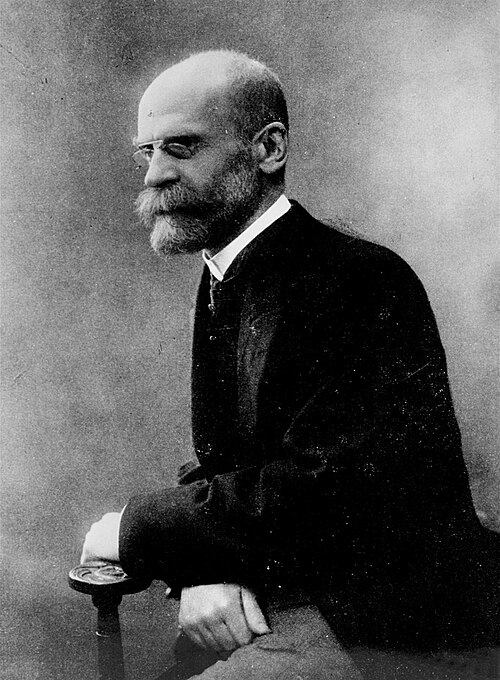
- Émile Durkheim
- Lived
- 1858–1917
- Field
- Sociology
- From
- French
The story
Émile Durkheim was born in 1858 in Épinal, in the Lorraine region of France, into a Jewish family with a long line of rabbis that included his father, grandfather and great-grandfather. He began rabbinical schooling as a boy but chose a different path, entering the École normale supérieure in Paris in 1879 and training as a philosopher. He went on to become one of the principal architects of modern social science.
In the 1880s, there was no such thing as a sociology department. Thinkers had written about society for centuries, but mostly as philosophy or speculation. Durkheim believed society could be studied as carefully as nature. In 1887 he was appointed to the University of Bordeaux, where he taught the first official sociology courses in France.
In 1895 he published The Rules of Sociological Method, a manifesto explaining what sociology is and how it should be done. Its central idea was that of the social fact: ways of acting, thinking and feeling that exist outside any one person yet shape everyone's behaviour, such as laws, customs, language and moral rules. His first rule was to treat social facts as things, to be defined clearly, studied objectively and explained by causes, with personal preconceptions set aside. That same year he set up the first European department of sociology and became France's first professor of the subject.
In the late 1890s he founded L'Année sociologique, the first French social science journal, which gave researchers a place to publish and debate their findings and helped secure sociology's place in academic life. In 1902 he moved to the Sorbonne in Paris, where his chair was later expanded to cover both education and sociology, and where he trained a generation of scholars.
His students included Marcel Mauss and Maurice Halbwachs, and later thinkers such as Talcott Parsons and Claude Lévi-Strauss built on his ideas. His influence spread far beyond France, shaping both sociology and anthropology.
Today, sociology is taught in universities across the world, and its methods are used to study poverty, education, crime, health, work and family life. Governments, charities and researchers who use careful evidence to understand how social conditions affect people's lives are working in a tradition that Durkheim did much to create.
Why it matters
The discipline Durkheim built gives societies a rigorous way to study social problems, from poverty to education, and to base policy on evidence rather than guesswork.
About Émile Durkheim
A rabbi’s son from Lorraine who made sociology a science, showing with data that society shapes even the most private acts, and who stood up for Dreyfus and the rights of the individual.
More about Émile Durkheim
Sources
- Émile Durkheim Wikipedia
- Émile Durkheim (1858 to 1917) Internet Encyclopedia of Philosophy
Another act of tikkun olam. This is part of tikkun olam, the Jewish idea of repairing the world, and every one of us can add to it.