- Person
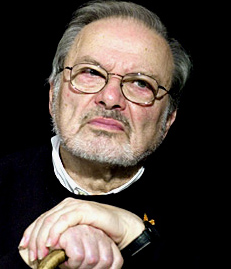
- Maurice Sendak
- Lived
- 1928–2012
- Field
- Children's Literature
- From
- American
The story
Maurice Sendak adored classical music. Mozart was his favourite composer, a god he could respect because he was an artist, and The Magic Flute his favourite opera; Mozart even makes a cameo appearance in his picture book Outside Over There (1981). He said that if life had a purpose, for him it was to hear Mozart.
In 1978 the opera director Frank Corsaro asked him to design sets and costumes for The Magic Flute. Sendak protested that he had no idea how to do such a thing, but Corsaro sensed that his visual storytelling suited the opera's dark fairytale world. The production opened at Houston Grand Opera in November 1980, and it launched a second career. In the decade that followed Sendak designed about a dozen more stage productions.
Many were with Corsaro. In 1981 they staged Janáček's The Cunning Little Vixen at New York City Opera, and in May 1982 Prokofiev's The Love for Three Oranges opened at the Glyndebourne Festival in England, with designs that borrowed from the drawings of the Venetian painters Giovanni Battista and Giovanni Domenico Tiepolo. Sendak returned to Glyndebourne for the composer Oliver Knussen's opera of his own Higglety Pigglety Pop! in 1985 and for Ravel's L'enfant et les sortilèges and L'heure espagnole in 1987. Knussen also turned Where the Wild Things Are into an opera. For Pacific Northwest Ballet in Seattle he designed an award-winning Nutcracker in 1983, and in 1997 he created the designs for Houston Grand Opera's production of Humperdinck's Hansel and Gretel.
Those Hansel and Gretel designs later became the illustrations for a book, Hansel and Gretel, with a text by Stephen King, published in September 2025 in close collaboration with the Maurice Sendak Foundation. Sendak also painted album artwork, including the cover of James Levine's 1976 recording of Mahler's Third Symphony with the Chicago Symphony Orchestra.
In 2013 his estate bequeathed about 900 of his opera and ballet designs to the Morgan Library & Museum in New York, which showed some 150 of them in the 2019 exhibition Drawing the Curtain. Pacific Northwest Ballet dedicated its 2012 season of his Nutcracker to his memory, and his designs continue to draw new audiences, young and old, to the theatre.
Why it matters
Sendak's stage designs brought his vivid, childlike imagination to the opera house, introducing new audiences, young and old, to classical music.
About Maurice Sendak
Author and illustrator of "Where the Wild Things Are"; redefined the picture book.
More about Maurice Sendak
- Sendak illustrated Little Bear and produced its TV seriesMaurice Sendak illustrated the first five Little Bear books by Else Holmelund Minarik and later co-created and produced the Little Bear television series (1995–2001).
- Sendak created the musical Really Rosie with Carole KingMaurice Sendak wrote and directed Really Rosie, a 1975 animated television musical featuring the voice of Carole King.
- Sendak helped shape Sesame StreetMaurice Sendak was an early member of the national board of advisors of the Children's Television Workshop as Sesame Street was being developed, and created animations for it.
- Sendak made a picture book about the AIDS crisisIn 1993 Maurice Sendak published We Are All in the Dumps with Jack and Guy, a picture book about the AIDS crisis.
- Sendak revived Brundibár, sung by children in TheresienstadtMaurice Sendak and Tony Kushner brought new life to Brundibár, a children's opera performed by Jewish children in the Theresienstadt camp, as a 2003 book and stage production.
Sources
- Maurice Sendak Wikipedia
- Maurice Sendak, Center Stage The New York Review of Books
- Hansel and Gretel Hachette Children's Group
Another act of tikkun olam. This is part of tikkun olam, the Jewish idea of repairing the world, and every one of us can add to it.