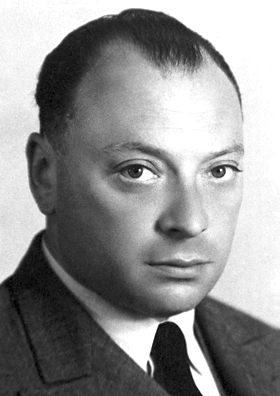
A Viennese family
Wolfgang Ernst Pauli was born in Vienna on April 25, 1900, the son of Wolfgang Josef Pauli, born Pascheles, and Bertha Camilla Schütz. His paternal grandparents came from prominent Jewish families of Prague, and his great-grandfather was the Jewish publisher Wolf Pascheles. His mother’s father, Friedrich Schütz, was a Jewish writer, while her mother was Roman Catholic, and Bertha was raised in her mother’s faith. Pauli thus had three Jewish grandparents, and he was raised as a Roman Catholic.
His middle name honoured his godfather, the physicist and philosopher Ernst Mach. His younger sister, Hertha Pauli, became a writer and actress. Wolfgang attended the Döblinger Gymnasium in Vienna and graduated with distinction in 1918. Just two months later he published his first scientific paper, on Albert Einstein’s general theory of relativity.
A prodigy in Munich
Pauli studied at the University of Munich under Arnold Sommerfeld, one of the great teachers of the new atomic physics, and received his doctorate in 1921 with a thesis on the quantum theory of the ionized hydrogen molecule. While still a student, Sommerfeld asked him to write a review of relativity for the Encyclopedia of Mathematical Sciences. Pauli produced a 237-page article that Einstein praised; published as a book, it remains a standard reference.
He then spent a year in Göttingen as assistant to Max Born and a year in Copenhagen with Niels Bohr, before becoming a lecturer at the University of Hamburg from 1923 to 1928. With Bohr he worked on the building-up principle, which describes how electrons fill the shells of atoms one element after another. These were the years in which quantum mechanics was born, and Pauli, still in his twenties, was at the centre of it.
The exclusion principle
In the early 1920s physicists knew that the electrons in atoms are arranged in shells, and that chemical behaviour depends on how many electrons sit in the outermost shell. But no one could explain why the shells fill up the way they do, with two electrons in the first, eight in the next, and so on, or why the electrons do not all simply collapse into the lowest energy state.
In 1924 and 1925 Pauli proposed that each electron needs a new property with two possible values, in addition to the three numbers already used to describe its state, and he formulated a rule: no two electrons in an atom can share the same set of these four quantum numbers. This is the Pauli exclusion principle, which he later showed applies to a whole class of particles, the fermions, including electrons, protons and neutrons. A year later George Uhlenbeck and Samuel Goudsmit identified Pauli’s two-valued property as the electron’s spin, an idea that Ralph Kronig had also considered and that Pauli himself resisted for a long time. Pauli then gave spin its mathematical form with the 2 by 2 matrices that still bear his name.
Why it matters to everyone
The exclusion principle explains why matter is built the way it is. Because electrons cannot crowd into the same state, they stack up in shells of increasing energy, and that stacking produces the periodic table of the elements and the whole of chemistry: why sodium reacts violently, why neon is inert, why carbon can form the molecules of life. Without it, as Freeman Dyson and Andrew Lenard proved mathematically in 1967, ordinary matter would collapse into a far smaller volume. The same principle holds up white dwarf and neutron stars against gravity.
It is also the foundation of modern technology. In a solid, the exclusion principle forces electrons into bands of energy levels, and many of the electrical, magnetic, optical and chemical properties of materials follow directly from it. Pauli himself used it in 1926 to explain the magnetic behaviour of metals, by recognizing that their free electrons obey the statistics now named for Fermi and Dirac. The physics of semiconductors, and therefore of transistors, computer chips, solar cells, LEDs and lasers, rests on the way electrons fill these bands. Every phone and computer works because electrons obey Pauli’s rule.
Dear radioactive ladies and gentlemen
In 1928 Pauli became professor of theoretical physics at the Federal Institute of Technology, the ETH, in Zurich. Soon afterwards he confronted a crisis in nuclear physics. In beta decay, a nucleus emits an electron, but the electrons came out with a range of energies, as if energy were disappearing. Some physicists were prepared to give up the law of conservation of energy.
On December 4, 1930, Pauli wrote an open letter to a meeting of physicists in Tübingen, beginning “Dear radioactive ladies and gentlemen.” He proposed what he called a desperate remedy: a very light, electrically neutral particle, emitted along with the electron and carrying off the missing energy. He apologized that he could not attend because he was needed at a ball in Zurich. In 1934 Enrico Fermi built the particle, which he named the neutrino, into his theory of beta decay. In 1956 Frederick Reines and Clyde Cowan finally detected neutrinos, and Pauli replied by telegram that everything comes to him who knows how to wait. Neutrinos are now studied in huge detectors around the world and help scientists understand the Sun, exploding stars and the basic forces of nature.
Persecution and exile
When Nazi Germany annexed Austria in 1938, Pauli became a German citizen, a dangerous position once war broke out in 1939. Under the Nuremberg Laws, his three Jewish grandparents meant that he was classified as Jewish, whatever his upbringing, and he was in grave danger. In 1940 he tried in vain to obtain Swiss citizenship, which would have let him stay safely at the ETH.
That year he moved to the United States and became professor of theoretical physics at the Institute for Advanced Study in Princeton. There, in 1940, he gave a proof of the spin-statistics theorem, one of the fundamental results of quantum field theory, which shows why particles with half-integer spin obey the exclusion principle. In 1945, after a nomination by Einstein, he received the Nobel Prize in Physics for the discovery of the exclusion principle. He became a naturalized American citizen in 1946 and then returned to Zurich, where he received Swiss citizenship in 1949.
The conscience of physics
Pauli was famous as a perfectionist and a fearless critic. Colleagues called him the conscience of physics, and he could dismiss a theory as utterly wrong. For papers so unclear that they could not be tested, he reserved his harshest judgement: they were not even wrong. Much of his influence came through long letters to Bohr, Heisenberg and others, which were copied and circulated, and many of his ideas were never formally published. Einstein called him his spiritual heir, and Max Born thought him comparable to Einstein himself.
He was also a figure of legend. Experimental physicists joked about the Pauli effect, his supposed ability to make equipment break simply by walking into a laboratory, and he was delighted by the stories. After a personal crisis in the early 1930s, following his mother’s death and a brief, unhappy first marriage, he consulted the psychiatrist Carl Jung, and the two carried on a long collaboration on dreams, symbols and the relationship between mind and matter. In 1934 he married Franziska Bertram, known as Franca, who remained with him for the rest of his life.
Faith and identity
Pauli’s relationship to religion was unusual. He was raised a Roman Catholic, had Jewish ancestry through three of his four grandparents, and was persecuted as a Jew under Nazi law. In adult life he is generally considered to have been a deist and a mystic rather than an adherent of any church. In a letter to the historian of science Shmuel Sambursky, he wrote that, in opposition to the monotheist religions but in unison with the mysticism of all peoples, including Jewish mysticism, he believed that the ultimate reality is not personal.
His family history is a vivid example of Central European Jewish families who intermarried and integrated into Christian society, only to find that Nazi racial law ignored all of that. Pauli lived in neutral Switzerland, but without Swiss citizenship his position was precarious, and he found a place in America at the decisive moment.
Death and legacy
In 1958 Pauli was awarded the Max Planck Medal. That year he fell ill with pancreatic cancer. Throughout his life he had puzzled over why a basic constant of physics, the fine-structure constant, is so close to one divided by 137. When his last assistant, Charles Enz, visited him in hospital in Zurich, Pauli asked whether he had noticed the room number. It was 137. Pauli died there on December 15, 1958, at the age of 58.
His widow later gave his scientific archive, including his Nobel medal, to CERN, the European laboratory for particle physics near Geneva, where it remains a major resource for historians. The physicist George Gamow wrote that it is as difficult to find a branch of modern physics in which the Pauli principle is not used as to find a man as gifted, amiable and amusing as Pauli was. Every atom in the reader’s body, and every chip in the reader’s devices, obeys the principle that bears his name.
Sources & further reading
Wolfgang Pauli, Biographical, NobelPrize.org · Wolfgang Pauli, Wikipedia · Pauli exclusion principle, Wikipedia · Pauli’s letter of the 4th of December 1930, Royal Holloway, University of London · Researched from the sources above and checked against them. Spotted an error? Tell us.
A life of tikkun olam. This is part of tikkun olam, the Jewish idea of repairing the world, and every one of us can add to it.