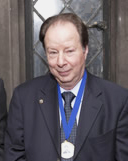
A grocer’s son in Montreal
Sidney Altman was born on May 7, 1939, in Montreal, the second son of Jewish immigrants from Eastern Europe who had come to Canada as young adults in the 1920s. His mother, Ray Arlin, came from Białystok in Poland and worked in a textile mill; his father, Victor Altman, was born in Ukraine and had worked on a collective farm in the Soviet Union before emigrating. In Montreal he worked in a grocery store and later ran his own. In his Nobel autobiography Altman called them poor immigrants and said it was from them that he learned that hard work in stable surroundings could bring rewards, even if only in tiny increments.
Canada, he wrote, was a land of opportunity for his family, and the first generation of Canadian-born children was told plainly that the path to that opportunity ran through education. No sacrifice was too great to pay for it, and books and a tradition of study were part of family life. By the time Sidney reached high school, the grocery had made the family comfortable enough that he could choose whatever subjects he liked.
From the atom bomb to molecular biology
Altman remembered two sparks for his interest in science. The first was the atomic bomb, whose mystique impressed him at six years old. The second, about seven years later, was a book about the periodic table, which showed him for the first time the elegance and predictive power of scientific theory. Einstein, he recalled, was held up as a model for a boy who did well at school; he added fiction writers and hockey and baseball stars to his personal pantheon.
He meant to go to McGill University but ended up studying physics at the Massachusetts Institute of Technology, where he played on the ice hockey team and graduated in 1960. In his final semester he took a short introductory course in molecular biology, taught by Cyrus Levinthal, simply to see what the excitement was about. It changed his direction. After an unhappy spell as a physics graduate student at Columbia University, he was steered by the physicist George Gamow to Leonard Lerman at the University of Colorado, where he earned a doctorate in biophysics in 1967, studying how certain dyes affect the copying of viral DNA. He then worked with Matthew Meselson at Harvard before joining the group led by Sydney Brenner and Francis Crick at the Medical Research Council Laboratory of Molecular Biology in Cambridge, England. As a former physicist, he said, it felt like joining Niels Bohr’s circle in 1920s Copenhagen; he called it scientific heaven.
The enzyme that was not what it seemed
Every living cell builds proteins using small adaptor molecules called transfer RNAs, or tRNAs. They are made first as longer precursor molecules that must be trimmed to the right length before they can work. In Cambridge, Altman found the first purified precursor to a tRNA, and then the enzyme that trims it, which he named ribonuclease P, or RNase P. That work won him a post as assistant professor at Yale University in 1971, at a time when academic jobs were scarce.
At Yale he discovered something odd about RNase P. Unlike almost every enzyme then known, it was made of two parts: a protein and a piece of RNA. In 1978 his group showed that if the RNA was removed, the enzyme stopped working. That alone was surprising, because for a century biochemists had assumed that enzymes, the catalysts that drive the chemistry of life, were always proteins. RNA was thought of as a messenger that carried genetic information, not a worker that did chemistry.
Altman kept pushing. In 1983, working with his colleague Cecilia Guerrier-Takada and with Norman Pace’s group in Colorado, his laboratory showed that under the right conditions the RNA part of RNase P, with no protein at all, could cut precursor tRNA by itself. RNA could be an enzyme. At almost the same time, Thomas Cech at the University of Colorado showed independently that an RNA molecule from a single-celled organism could cut and splice itself. Many scientists were skeptical at first, and Altman later said the road had been long and difficult. But the evidence held, and catalytic RNAs, now called ribozymes, became an accepted part of biology.
Why RNA enzymes matter
The discovery solved a riddle about how life could have begun. Modern cells store information in DNA and do chemistry with proteins, and each depends on the other to be made, a chicken-and-egg problem. A molecule that can both carry genetic information and catalyse reactions offers a way out. Altman’s and Cech’s ribozymes became the central evidence for the idea that early life passed through an “RNA world” in which RNA did both jobs. Later research showed that the very heart of the ribosome, the machine that builds every protein in every cell, is itself an RNA enzyme. RNase P itself turned out to be present in essentially every form of life, from bacteria to human cells, a sign of how ancient this RNA machinery is.
The discovery also changed medicine and biotechnology. Once scientists knew that RNA molecules could recognise and cut other RNAs, they began designing RNA-based tools to silence chosen genes, a field that now includes antisense drugs and RNA-targeting therapies. Altman himself showed how RNase P could be aimed at a target. In 1990 his laboratory reported that a short “external guide sequence” could direct RNase P to cut almost any messenger RNA chosen by the scientist. In 1997 his group used this method in bacteria to destroy the messages for antibiotic-resistance genes, turning drug-resistant bacteria back into drug-sensitive ones. The approach has since been explored by other laboratories as a way to block viruses and to counter antibiotic resistance.
Colleagues at Yale later said that the discovery revolutionised the way the whole scientific community thought about enzymes, and that his influence could be felt in every RNA research project that followed.
The Nobel Prize
In October 1989 the Royal Swedish Academy of Sciences awarded the Nobel Prize in Chemistry jointly to Sidney Altman and Thomas Cech for their discovery of catalytic properties of RNA. The two had worked independently, on different molecules, and reached the same conclusion. Altman had already received the Rosenstiel Award in 1988, and he was later elected to the US National Academy of Sciences and the American Philosophical Society. In 2016 the Russian Academy of Sciences gave him its Lomonosov Gold Medal.
After the prize he often gave public talks about the difficulties of doing science in America, especially for young researchers, and he argued that funding agencies should back young risk-takers whose unconventional ideas struggle to win grants.
Dean of Yale College
Altman spent his whole independent career at Yale. He became a full professor in 1980, chaired his department from 1983 to 1985, and was then appointed Dean of Yale College, serving from 1985 to 1989. As dean he led an expansion of the college’s science and foreign-language requirements; Yale’s president later recalled that he believed non-scientists should understand science. He said the deanship showed him the full range of human and academic problems in a university and gave him many friends outside the sciences. He returned to full-time research on July 1, 1989, a few months before the Nobel announcement, and later held the title of Sterling Professor of Molecular, Cellular and Developmental Biology and Chemistry, Yale’s highest faculty rank.
Jewish roots
Altman’s story is a classic one of Jewish immigrant families of the early twentieth century: parents who left Poland and Soviet Ukraine, worked in mills and shops, and pinned their hopes on their children’s schooling. Yale noted after his death that he was proud of his Jewish roots. He helped establish Judaic Studies at Yale in the 1980s and was an honorary trustee of the university’s Slifka Center for Jewish Life. He is listed among Jewish Nobel laureates in chemistry.
The man
Friends described him as persistent, careful with detail and confident in his ideas even when others doubted them. He was a voracious reader and a fine writer who had once hoped to make writing his career, and he valued the humanities as much as science. He married Ann Körner in 1972, calling her his colleague, mentor and friend in every respect; they had two children, Daniel and Leah, and later divorced. He became a United States citizen in 1984 while keeping his Canadian citizenship.
He nominally retired in 2014, but his laboratory kept working until 2021, studying microbial communities and antisense molecules that block RNase P. He died on April 5, 2022, in Rockleigh, New Jersey, after a long illness, at the age of 82. He was survived by his children and four grandchildren.
Legacy
Before Altman, biology textbooks said that enzymes were proteins. After him, they had to make room for RNA. That single correction reshaped the study of life’s origins, revealed that the ribosome is an RNA machine, and helped launch a generation of RNA-based research tools and medicines designed to silence harmful genes. Every scientist who works with ribozymes, gene-silencing RNAs or the RNA world idea builds on the stubborn experiment of a grocer’s son from Montreal who would not let go of an odd result.
Sources & further reading
Sidney Altman, Biographical, NobelPrize.org · Sidney Altman, pathbreaking scientist, Yale Department of Chemistry · In memoriam: Sidney Altman, ASBMB Today · Phenotypic conversion of drug-resistant bacteria to drug sensitivity, PNAS 1997 (PubMed Central) · Sidney Altman, Wikipedia · Researched from the sources above and checked against them. Spotted an error? Tell us.
A life of tikkun olam. This is part of tikkun olam, the Jewish idea of repairing the world, and every one of us can add to it.