- Person
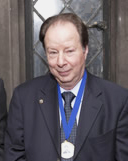
- Sidney Altman
- Lived
- 1939–2022
- Field
- Molecular biology
- From
- Canadian-American
The story
Enzymes are the catalysts that run the chemistry of life: they digest food, copy genes and build every part of a cell. For most of the twentieth century, biochemists were certain that all enzymes were proteins. RNA, the cousin of DNA, was seen as a passive messenger that carried genetic instructions from one place to another.
Sidney Altman, the son of Jewish immigrants from Poland and Ukraine who settled in Montreal, began to challenge that idea while working in Cambridge, England, in the early 1970s. There he found an enzyme, which he named ribonuclease P or RNase P, that trims the precursor molecules of transfer RNA, the adaptors cells use to build proteins. At Yale University he discovered that RNase P was unusual: it was made of a protein and a strand of RNA. In 1978 his group showed that removing the RNA destroyed the enzyme’s activity.
In 1983 Altman’s laboratory, with Cecilia Guerrier-Takada and with Norman Pace’s group, published the decisive result in the journal Cell: under the right conditions, the RNA part of RNase P could do the cutting entirely on its own. RNA could be an enzyme. Thomas Cech reached the same conclusion independently with a self-splicing RNA, and the two shared the 1989 Nobel Prize in Chemistry.
The finding has had wide consequences. It gave strong support to the idea that early life passed through an “RNA world,” in which RNA both stored information and did chemistry, solving a puzzle about how life could begin. It helped scientists recognise that the core of the ribosome, the protein-building machine in every cell, works as an RNA enzyme. And it encouraged researchers to design RNA molecules that seek out and destroy chosen messages in the cell. Altman’s own laboratory showed in 1990 that short “external guide sequences” could steer RNase P to cut a target RNA, and in 1997 it used them to make drug-resistant bacteria sensitive to antibiotics again.
Colleagues at Yale said after his death in 2022 that the discovery revolutionised how the whole scientific community thought about enzymes.
Why it matters
Altman’s discovery reshaped the science of life’s origins and helped open the way to RNA-based tools and medicines that silence harmful genes.
About Sidney Altman
Montreal-born biologist who proved that RNA, not only protein, can act as an enzyme, changing how scientists understand life’s origins and opening new ways to switch genes off. Nobel Prize 1989.
Sources
- Sidney Altman, Biographical NobelPrize.org
- Sidney Altman, pathbreaking scientist Yale Department of Chemistry
- Phenotypic conversion of drug-resistant bacteria to drug sensitivity PNAS (PubMed Central)
Another act of tikkun olam. This is part of tikkun olam, the Jewish idea of repairing the world, and every one of us can add to it.