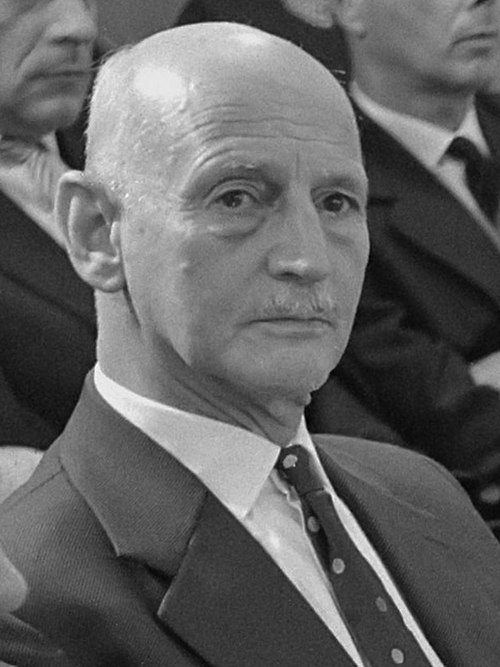
A Frankfurt banker’s son
Otto Heinrich Frank was born on May 12, 1889, in Frankfurt am Main, the second of four children of Michael Frank, the owner of a small bank, and Alice Betty Stern. The family were liberal, well-to-do German Jews who valued Jewish traditions and holidays without observing every religious law, and who felt themselves thoroughly German. After school he briefly studied at Heidelberg before training in business.
As a young man he spent time in New York, gaining work experience at Macy’s department store through his college friend Nathan Straus Jr., whose family owned it. His father’s sudden death in 1909 brought him home. When the First World War came he enlisted in 1915 and served in an artillery range-finding unit, which worked out where enemy artillery fire was coming from. He fought on the Western Front, including at the Somme and Cambrai, rose to lieutenant in 1917, and was decorated. After the war he joined the family bank.
Marriage, daughters and flight
In May 1925, at the age of thirty-six, Otto married Edith Holländer, the daughter of a prosperous Jewish family from Aachen; the religious ceremony took place in Aachen’s synagogue. They settled in Frankfurt, where their daughters were born: Margot on February 16, 1926, and Annelies Marie, Anne, on June 12, 1929. Otto was a devoted father who encouraged his daughters’ reading and schooling. But the family bank was failing in the economic crisis, and Hitler’s movement was gaining strength.
In 1933, after the Nazis came to power, Otto and Edith decided to leave Germany, driven both by their business problems and by the rising tide of antisemitism. Otto moved to Amsterdam, where he set up the Dutch branch of Opekta, a company selling pectin for making jam; Edith and the girls followed. In 1938 he founded a second firm, Pectacon, selling herbs and spices, and took on another German Jewish refugee, Hermann van Pels. For a few years the family felt safe. Otto later said that in the Netherlands they had been able to make a fresh start and feel free.
Into hiding
That freedom ended when Germany invaded the Netherlands in May 1940. Anti-Jewish decrees followed one after another; Jews were barred from owning businesses, and with the help of his non-Jewish employees and Jan Gies, Otto managed to keep his companies out of Nazi hands on paper. He tried desperately to emigrate. He sought visas for the United States and Cuba, and on December 1, 1941, was granted a single visa to Cuba, cancelled days later when the United States entered the war and the borders closed.
In the spring of 1942 Otto quietly prepared a hiding place in the empty rear annex of his business premises at Prinsengracht 263, and asked four trusted employees, Miep Gies, Johannes Kleiman, Victor Kugler and Bep Voskuijl, to help. All agreed. On July 5, 1942, Margot received a summons to report for a labour camp in Germany. The next morning the family went into hiding in the annex. The van Pels family joined them a week later, and in November the dentist Fritz Pfeffer made eight.
Two years in the annex
For twenty-five months Otto was the steady centre of the hidden household. He taught the girls, kept up with the business, lying with his ear to the floor to listen when visitors came to the office below, and read Dickens with a dictionary at hand. After the Allied landings of June 6, 1944, he followed their advance by sticking pins into a small map on the wall. Anne called him “Pim”, and her diary shows how much he worked to keep the peace among eight people with very different temperaments. Miep Gies remembered him as the calm one, the children’s teacher, the most logical, the one who balanced everyone out.
On August 4, 1944, the hiding place was raided by Dutch police officers under the SS sergeant Karl Josef Silberbauer, and everyone was arrested, along with Kleiman and Kugler, for which Otto felt deep guilt. The prisoners were sent to the Westerbork transit camp and, in early September, on the last train from Westerbork to Auschwitz-Birkenau. On the platform the men and women were separated. It was the last time Otto saw his wife and daughters.
The sole survivor
In Auschwitz Otto was put to hard labour in a gravel pit and on road-building. Peter van Pels, who worked in the camp post office, sometimes brought him extra food; when Otto lost hope after a beating, fellow prisoners and a Dutch doctor got him into the sick barracks. When the SS evacuated the camp in January 1945, he was too weak to march, he weighed fifty-two kilograms, and was left behind. Soviet troops liberated Auschwitz on January 27, 1945. He wrote to his mother that he had been lucky and had good friends.
Because fighting continued across Europe, his journey home went by way of Odessa, where he boarded the ship Monowai for Marseille. On the way he learned from Rosa de Winter, who had been with Edith in Birkenau, that his wife had died there in January. “Only the children matter, the children” he wrote from the ship. He reached Amsterdam on June 3, 1945, and moved in with Miep and Jan Gies. In July he met the Brilleslijper sisters, who had been in Bergen-Belsen with Margot and Anne, and learned that both girls had died there of disease and exhaustion. Of the eight people hidden in the annex, he alone had survived.
Publishing the diary
When the girls’ deaths were confirmed, Miep Gies gave Otto the diary and loose pages that she had rescued from the annex after the arrest. At first he could not bring himself to read them; when he did, he was gripped. He discovered a daughter he had not fully known, her depth of feeling, her sharp observation, her ambition to be a writer, and later admitted that he had had no idea of the depth of her thoughts. He typed out passages for family and friends, some of whom urged him to publish.
It was not easy: publishers doubted that anyone wanted to read a girl’s wartime diary so soon after the war. Otto edited the text from Anne’s two versions, omitting some passages he thought too personal or unflattering to others, and the Amsterdam firm Contact published Het Achterhuis (“The Secret Annex”) on June 25, 1947. Anne would have been so proud, he wrote. Translations followed into French, German and, in 1952, English as The Diary of a Young Girl; a stage adaptation in 1955 and a Hollywood film in 1959 carried the story to millions more. Today the diary is available in more than seventy languages.
A life given to Anne’s message
Amsterdam held too much pain for him, and in 1952 Otto moved to Basel, Switzerland, where he had family, including his sister Leni and her husband, Erich Elias. On November 10, 1953, in Amsterdam, he married Elfriede “Fritzi” Geiringer, a former Amsterdam neighbour and fellow Auschwitz survivor; her daughter Eva, born in 1929 like Anne, became his stepdaughter. Together they spent much of each day answering letters from readers of the diary around the world, many from young people.
When the building at Prinsengracht 263 was threatened with demolition, Otto helped establish the Anne Frank Foundation in Amsterdam in 1957, and on May 3, 1960, the Anne Frank House opened as a museum; at the opening he was too moved to say more than a few words. In 1963 he founded the Anne Frank Fonds in Basel, which he made his universal heir, and he initiated international youth conferences in Amsterdam on subjects such as religion, youth protest and human rights. He also fought those who claimed the diary was a forgery, filing a criminal complaint in 1959 against two members of the far-right Deutsche Reichspartei who had called it fiction, and suing the Nazi sympathiser Ernst Römer in 1976. Forensic examination by Germany’s Federal Criminal Police Office later found no diary entries written in ballpoint ink, disposing of one of the deniers’ favourite claims.
Death and legacy
Otto Frank died of lung cancer on August 19, 1980, at his home in Birsfelden, near Basel, aged ninety-one. His ashes were buried in the town’s cemetery, where Fritzi was laid beside him eighteen years later; he was survived by his stepdaughter, Eva Schloss, a fellow survivor who would co-found the Anne Frank Trust UK and spend decades speaking about the Holocaust. Shortly before his death he said that although his strength was fading, the mission Anne had passed on kept giving him new strength, to fight for reconciliation and for human rights across the world.
Without Otto Frank there would be no published diary and no Anne Frank House. Because of him, a teenage girl’s notebook became one of the most widely read books of the twentieth century and, for generations of schoolchildren, the first human face of the Holocaust. The house he helped save receives visitors from all over the world, and the foundations he created continue his work. His own life, a German Jewish patriot turned refugee, a father who lost everything and chose to spend what remained building understanding, is a testament to the power of memory used for good.
Sources & further reading
Otto Frank, Wikipedia · Otto Frank, Anne Frank House · Anne Frank Fonds, Basel · Researched from the sources above and checked against them. Spotted an error? Tell us.
A life of tikkun olam. This is part of tikkun olam, the Jewish idea of repairing the world, and every one of us can add to it.