- Person
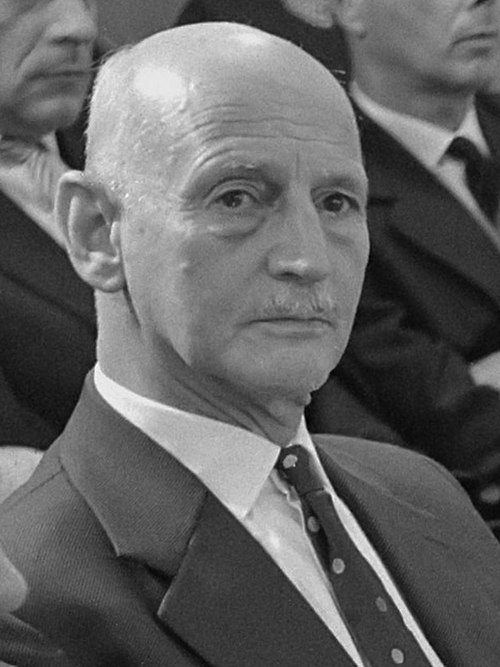
- Otto Frank
- Lived
- 1889–1980
- Field
- Holocaust memory
- From
- German
The story
Otto Frank was born in Frankfurt in 1889 to a German Jewish family. After the Nazis came to power he moved his wife Edith and daughters Margot and Anne to Amsterdam, where he ran the Opekta company. On 6 July 1942, after Margot was summoned for so-called labour duty, the family went into hiding in the rear annexe of his business premises at Prinsengracht 263, behind a bookcase. Four other Jews joined them, and Otto's colleagues, including Miep Gies, kept them supplied.
On 4 August 1944 the hiding place was discovered and all eight were arrested. They were sent through the Westerbork transit camp to Auschwitz-Birkenau, where Otto was separated from his wife and daughters. He was in the sick barracks when Soviet troops liberated the camp on 27 January 1945. On 3 June 1945 he returned to Amsterdam. He soon learned that Edith had died in Auschwitz, and that Anne and Margot had died of illness and exhaustion in Bergen-Belsen. He was the only one of the eight to survive.
Miep Gies had rescued Anne's diary and papers from the ransacked annexe, and she gave them to him. At first he could not bear to read them. He typed the diary into a single manuscript, leaving out passages he felt were too personal or too ordinary. After the historian Jan Romein wrote about it in the newspaper Het Parool in April 1946, a publisher accepted it, and on 25 June 1947 it appeared in Dutch as Het Achterhuis, 'The House Behind'. Otto said that Anne would have been very proud to see it. An English translation followed in 1952, then a stage play in 1955 and a film in 1959.
When the building at Prinsengracht 263 was threatened with demolition, Otto and Johannes Kleiman helped establish the Anne Frank Foundation in Amsterdam on 3 May 1957. With public donations it bought and restored the house, which opened as the Anne Frank House on 3 May 1960. He also started international youth conferences in Amsterdam, and in 1963 he founded the Anne Frank Foundation (Anne Frank Fonds) in Basel, which uses the diary's royalties for charity, education and human rights work.
For the rest of his life he answered letters from countless readers, often ending with the hope that Anne's book would inspire them to work for unity and peace. Shortly before his death on 19 August 1980, he said that the mission Anne had passed on kept giving him new strength.
Why it matters
Through Otto Frank's work, Anne's diary has taught generations of young people about the Holocaust, and the hiding place he saved welcomes visitors from all over the world.
About Otto Frank
Anne Frank’s father, the only one of the eight people hidden in the Amsterdam annex to survive, who published her diary and spent his life spreading its message.
Sources
- Otto Frank Anne Frank House
- Otto Frank Wikipedia
Another act of tikkun olam. This is part of tikkun olam, the Jewish idea of repairing the world, and every one of us can add to it.