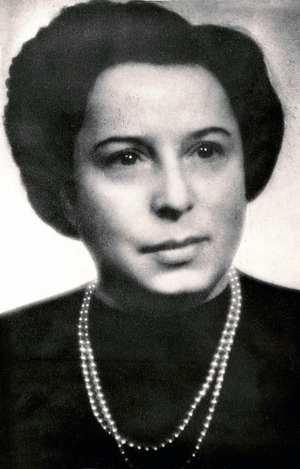
A daughter of Pressburg
Gisela Fischer was born on January 21, 1892, in Pressburg, Pozsony to Hungarians, later Bratislava, capital of Slovakia, then a city of the Kingdom of Hungary. She was the eldest of three children of Julius Fischer and Jetty Elinger, both natives of the city, who ran a hotel and a kosher restaurant in its Jewish quarter. The family belonged to Pressburg’s Orthodox community, one of the most renowned in Europe, the home of the great Pressburg yeshiva.
Her brothers went to university: Desider became a paediatrician and Gustav a doctor of law. Gisi, as a girl, was given only eight years of schooling. She made up the rest herself, reading German literature, art history and history, and developing the natural authority that would later make people of every outlook turn to her. Like most Pressburg Jews she grew up speaking German and Hungarian; when Czechoslovakia was created in 1918 she became, at twenty-six, a citizen of a new state whose Slovak language she could not yet speak.
Zionist and organiser
In 1915 she married Josef Fleischmann, an affluent businessman, and they had two daughters, Alice, born in 1917, and Judith, born in 1920. Around the same time she was drawn to Zionism, then opposed by much of the Orthodox leadership. Her parents, though members of the Orthodox community, let their children turn the family restaurant into a meeting place for Zionists. In 1925 she joined Julia Knoepfelmacher, founder of the Women’s International Zionist Organization (WIZO) in Slovakia, and quickly became its vice-president, organising social work, education and pioneer training.
When refugees fled Germany after 1933 she was among the first to respond, arranging aid and vocational retraining and making the contacts with the American Jewish Joint Distribution Committee that would later prove vital. In 1938, when Austrian Jews expelled from Burgenland were left stranded on a boat on the Danube, refused by both Hungary and Slovakia, she was central to the effort that brought them to safety. By the outbreak of war she represented both the Joint and HICEM, the Jewish emigration agency, in Slovakia.
Choosing to stay
In the summer of 1939 she travelled to London and Paris to plead for entry visas for Jews desperate to leave; Western governments would not take them. Friends urged her not to return to Slovakia. She refused: she saw herself as the representative of those seeking a haven, and her own rescue, she felt, was out of the question. She did manage to send her daughters to Palestine in 1939.
Personal tragedy followed quickly. On September 4, 1939, her younger brother Gustav was beaten to death by antisemitic thugs in Bratislava, and his widow, Lily, later took her own life. Gisi lost her husband as well, while her widowed mother came to live with her. All of this happened as the new Slovak state, a client of Nazi Germany under the Catholic priest Jozef Tiso, introduced ever harsher anti-Jewish laws.
Inside the Jewish Center
In September 1940 the Slovak government abolished independent Jewish organisations and created a compulsory Jewish council, the Ústredňa Židov (Jewish Center). Fleischmann, by then on the executive of the Zionist Federation, argued that Jewish leaders could not stand aside and must work from within, even inside a body imposed by their persecutors. She headed its emigration department and, when emigration became impossible, joined the management of its welfare department, caring for thousands of Jews driven from their livelihoods.
Her office, in a building separate from the council’s official leadership, became a gathering place for workers who distrusted that leadership, especially a council official, Karol Hochberg, seen as a collaborator with Adolf Eichmann’s representative in Slovakia, the SS officer Dieter Wisliceny. Assimilationists, Zionists and ultra-Orthodox Jews met there. From these meetings grew a small clandestine circle, the Pracovná skupina, or Working Group. When the Orthodox Rabbi Michael Dov Weissmandl joined its efforts in 1942, he proposed Fleischmann as its leader, and the choice was unanimous; ‘Gisi’s conducting of the orchestra had become a tradition’ recalled her colleague Oskar Neumann.
Bribes, and the halt of 1942
In March 1942 Slovakia became the first Nazi ally to hand its Jews over for deportation; the Slovak government even paid Germany for each person taken. Between March and October 1942 about 58,000 Jews were deported to Auschwitz and to camps and ghettos in the Lublin region of occupied Poland, where nearly all were murdered. The Working Group, unable to stop the transports through official channels, turned to bribery: money was passed to Slovak officials and, through Hochberg, to Wisliceny.
In October 1942 the deportations stopped, and for nearly two years some twenty thousand or more Jews remained in Slovakia. Weissmandl and many in the group believed their payments had worked. Historians now see a mix of causes, bribes to Slovak officials, the intervention of Slovak officials who were not bribed, economic exemptions and pressure from the Vatican and local bishops, but most agree that the Working Group’s efforts had some effect.
The Europa Plan and the window to Poland
Encouraged, the group attempted something far more ambitious: the so-called Europa Plan, an attempt to buy a halt to deportations across Europe through Wisliceny. The SS asked for a ransom on the order of one to two million dollars, with a down payment first. Fleischmann carried on a vast secret correspondence to raise the money, with Saly Mayer, the Joint’s representative in Switzerland, with Jewish Agency officials and with the Jewish rescue committee in Istanbul. Allied bans on sending funds into enemy territory, the limited sums available and the scepticism of Jewish leaders abroad left her pleas largely unanswered. The talks were broken off in September 1943, and historians still debate whether the offer was ever sincere.
Meanwhile the Working Group used couriers to locate deported Jews in Poland and send them help, and organised the escape of Polish Jews across Slovakia to the relative safety of Hungary. The rescue committee in Istanbul called these contacts ‘the only window to the site of the Holocaust.’
In 1943 she also threw herself into a Children’s Rescue Plan, initiated by Jewish leaders in Palestine and passed by the British government to Germany through the Swiss legation, which proposed exchanging thousands of Jewish children for German prisoners. Wisliceny told her that a thousand children from the Białystok ghetto had already been moved to Theresienstadt; tragically, they were later sent to Auschwitz and murdered. To smooth the route through Slovakia, Fleischmann bribed the wife of a senior Interior Ministry official, Izidor Koso. When a letter linking the two was discovered at the border, Fleischmann was arrested and interrogated, and in January 1944 she was imprisoned again, this time for four months.
The last months
Released in May 1944, she was urged again to leave for Palestine, where her daughters were waiting; arrangements had been made. She refused, unwilling to abandon the people who depended on her. Instead she worked to bring back to Slovakia Jewish children who had earlier been smuggled into Hungary and were now in danger there. ‘We cannot refrain from trying anything possible in this matter’ she wrote to Nathan Schwalb of the Hechalutz movement in Geneva. That spring the Working Group helped record and circulate the testimony of Rudolf Vrba and Alfred Wetzler, two prisoners who had escaped from Auschwitz to Slovakia, and a version of their report travelled via Budapest to George Mantello in Geneva, whose publicity campaign helped bring the deportations from Hungary to a halt.
After the Slovak National Uprising broke out at the end of August 1944, German forces occupied the country and the deportations resumed. In a raid on the night of September 28 about 1,800 Bratislava Jews, including most of the Working Group, were seized and sent to the Sereď camp. SS officer Alois Brunner allowed Fleischmann to remain in her office, under watch, to supply the prisoners. Offered a way out to partisan-held territory, she declined once more, as she had twice before. On October 15 she was writing to a Jew in hiding when an SS officer burst in; she had managed only the line ‘Regrettably, I am in the lion’s mouth.’ Taken to Sereď, she refused under interrogation to reveal the hiding places of other Jews. On October 17 she was put on the last transport from Slovakia to Auschwitz, her name marked on Brunner’s order with the letters R.U., Rückkehr unerwünscht, return undesirable. At Auschwitz she was called out by name, led away by SS men and never seen again. She was fifty-two.
Legacy
Her elderly mother survived the war, never learning why her daughter had fallen silent. Her daughters lived on in Israel. Gideon Hausner, the prosecutor at the Eichmann trial, declared that her name deserved to be immortalised in the annals of the Jewish people.
Gisi Fleischmann stands as one of the very few women to lead a Jewish rescue organisation in Nazi-dominated Europe, a self-educated hotelier’s daughter who bargained with the SS, smuggled people across borders, raised money across continents and, given three chances to save herself, chose each time to stay. Her life is the subject of Joan Campion’s biography In the Lion’s Mouth (1987), the 2014 documentary Gisi, and a Stolperstein memorial stone in Bratislava.
Sources & further reading
Gisi Fleischmann, Jewish Women’s Archive Encyclopedia (Gila Fatran) · Gisi Fleischmann, Wikipedia · The Working Group, Bratislava community exhibition, Yad Vashem · Working Group (resistance organization), Wikipedia · Researched from the sources above and checked against them. Spotted an error? Tell us.
A life of tikkun olam. This is part of tikkun olam, the Jewish idea of repairing the world, and every one of us can add to it.