- Person
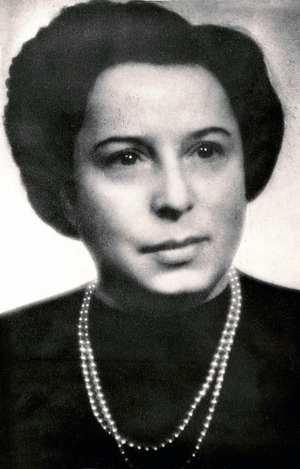
- Gisi Fleischmann
- Lived
- 1892–1944
- Field
- Holocaust rescue
- From
- Slovak
The story
Gisi Fleischmann was born in Pressburg, today Bratislava, in 1892, the eldest child of a family that ran a hotel and kosher restaurant in the city. Girls of her generation were given little schooling, so she taught herself literature, art history and history. In 1925 she joined the Women's International Zionist Organization in Slovakia and soon became its vice president, and after 1933 she organised help for refugees fleeing Germany and later Austria. By the outbreak of war she represented the Joint Distribution Committee and the emigration agency HICEM in Slovakia.
In 1939 she sent her two daughters to safety in Palestine, but she refused to leave herself, seeing her place beside those still seeking refuge. When the Slovak state began deporting its Jews in March 1942, she became leader of the Working Group, an underground circle that met in her office and brought together Zionists, assimilated Jews and ultra-Orthodox activists such as Rabbi Michael Dov Weissmandl. The group bribed Slovak officials and the SS officer Dieter Wisliceny, gathered news of the deportees, sent them relief and helped more than two thousand Polish Jews escape through Slovakia to Hungary.
About 57,000 Jews were deported from Slovakia in 1942, but after 20 October the trains stopped for almost two years. Most historians agree the Working Group's actions had some effect, although the extent of its role is debated. Fleischmann then wrote tirelessly to Jewish organisations in Switzerland and Istanbul to raise money for the far more ambitious Europa Plan, an attempt to buy a halt to deportations across Europe, which collapsed when Wisliceny broke off talks in September 1943.
She was arrested twice in connection with a plan to rescue children, spending four months in prison in 1944, and on her release she again refused a chance to emigrate. That spring the Working Group helped distribute the report by Auschwitz escapees Rudolf Vrba and Alfred Wetzler, which became a major factor in halting the deportation of Hungarian Jews in July 1944.
After the Germans occupied Slovakia, she kept working from her office to help Jews in hiding. She was seized on 15 October 1944, deported on the last transport to Auschwitz two days later, and murdered there. Gideon Hausner, the prosecutor at the Eichmann trial, said her name deserved to be remembered as a radiant example of heroism and boundless devotion.
Why it matters
Fleischmann's leadership helped keep thousands of Slovak Jews alive for two more years and helped carry the truth about Auschwitz to the world.
About Gisi Fleischmann
Bratislava Zionist leader who headed the clandestine Working Group, bargaining, bribing and smuggling to save Slovak and Polish Jews, and refused to flee until she was deported to Auschwitz.
Sources
- Gisi Fleischmann Jewish Women's Archive
- Working Group (resistance organization) Wikipedia
- Gisi Fleischmann Wikipedia
Another act of tikkun olam. This is part of tikkun olam, the Jewish idea of repairing the world, and every one of us can add to it.