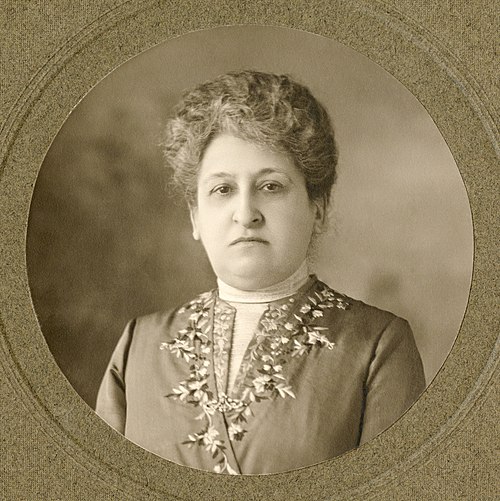
A doctor’s daughter in Sappemeer
Aletta Henriette Jacobs was born on February 9, 1854, in Sappemeer, a small town in the northern Dutch province of Groningen. She was the eighth of eleven children of Abraham Jacobs, a country doctor, and Anna de Jongh. The family was of assimilated Jewish heritage and kept close social and intellectual ties with other Jewish families in the region.
As a small girl Aletta went with her adored father on his rounds and decided she would be a doctor too. Dutch society had other plans for girls. When she finished the village school in 1867, the only further education open to her was a finishing school; she tried one for two weeks, found it idiotic, and left. She worked as an apprentice dressmaker and studied at home instead, learning French and German from her mother and Greek and Latin from her father.
Breaking into the university
Two Jewish physicians who were close family friends helped her find a way in. The hygienist Levy Ali Cohen suggested she first qualify as a pharmacist’s assistant, an examination a woman had recently been allowed to sit. She passed in 1870. Encouraged by Cohen and by Samuel Siegmund Rosenstein, rector of the University of Groningen, she prepared for university, sitting in on classes at the local state secondary school and becoming the first Dutch girl to attend one.
Then she did something bold. She wrote secretly to the head of the Dutch government, the liberal statesman Johan Rudolph Thorbecke, asking permission to begin university studies. He granted it, provisionally, for one year. On April 20, 1871, Jacobs entered the University of Groningen as its first woman student, aware that the chances of every woman who followed would depend on her performance. After Thorbecke’s death in 1872 she was formally admitted as a medical student. Despite periods of illness she passed her licensing examinations, and on March 8, 1879, she received her doctorate with a thesis on the localisation of functions in the brain, an unusual subject at the time. She was the first woman to attend a Dutch university and the first Dutch woman to earn a medical degree.
Free care for poor women
After further training in London, where she observed women doctors at several hospitals and met Elizabeth Garrett Anderson, Britain’s first woman physician, and reformers campaigning for birth control and women’s suffrage, Jacobs returned home in September 1879. So many women asked for her services that she opened a practice in Amsterdam. Women doctors were not then allowed to treat men, so her patients were women and children.
She was struck by the poverty, ignorance and ill health of working-class women. Twice a week she held free clinics where poor women could get medical care and advice on hygiene and childcare, and demand was so great she had to add sessions. She saw how pregnancy after pregnancy, year after year, wore mothers out and contributed to high infant mortality, and through her contact with prostitutes she learned about the toll of sexually transmitted disease.
The first birth control clinic
Jacobs became convinced that reliable contraception would relieve much of this suffering. After reading about the occlusive pessary, a diaphragm devised by the German physician Wilhelm Mensinga, she corresponded with him, tried the method with a range of her patients and found it effective. In 1882 she began offering birth control information and diaphragms, free of charge, at her clinics for the poor. It was the first birth control clinic in the Netherlands and is widely described as the first clinic in the world devoted to giving out contraceptive advice. The device became known to English speakers as the Dutch cap.
The reaction from her profession was fierce. Many doctors argued that contraception interfered with the divine plan, encouraged sex outside marriage and would weaken the nation, and some saw unwanted pregnancy and venereal disease as fitting punishment for sin. Jacobs pressed on. The Netherlands was then the only European country where giving out birth control information was not illegal, and a Dutch Neo-Malthusian League, which Jacobs joined, had been formed in 1881 to promote smaller families as a remedy for poverty. Unlike many earlier birth control advocates, who addressed the middle class, Jacobs aimed her free advice squarely at the poor. Following her lead, similar clinics opened in other Dutch cities. Her clinic came more than three decades before the first birth control clinics of Margaret Sanger in the United States and Marie Stopes in Britain, and later American campaigners, Sanger among them, drew on her example. In 1897 she published De vrouw, a book explaining women’s anatomy and reproductive system to ordinary readers, with movable illustrated plates; it went through six further editions by 1921.
Health for working women
Jacobs’s concern for women’s health extended to the workplace. From 1886 she campaigned for shops to give saleswomen seats so that they could rest between customers, at a time when many stood for more than ten hours a day, with serious effects on their health. About two decades later Dutch law regulated rest breaks. She wrote about the problems of shop workers, about prostitution and venereal disease, arguing for health education rather than moral judgment, and in 1900 co-founded a society to improve the conditions of nurses.
She also lived her convictions. She and the reformer and politician Carel Victor Gerritsen began a free union in the 1880s and formally married in 1892, but she kept her own name and her own work, rare for a married woman of her day. Their only child, a son, died a day after his birth in 1893.
Votes for women
In 1883 Jacobs noticed that Dutch electoral law did not explicitly exclude women and asked to be put on the voters’ register. Amsterdam refused, the courts ruled that women were not full citizens, and an 1887 constitutional amendment closed the loophole by giving the vote expressly to men. She did not forget. In 1903 she retired from medicine, financing her campaigning partly by selling her library, and became president of the Dutch Association for Women’s Suffrage, a post she held for sixteen years.
She worked internationally too, with the International Woman Suffrage Alliance, founded in 1904. After her husband died of cancer in 1905 she toured with its American president Carrie Chapman Catt, hosted its congress in Amsterdam in 1908, and in 1911 and 1912 travelled with Catt for sixteen months through Africa and Asia, meeting women and encouraging them to organise. Her travel letters reflected, alongside her feminism, the widespread European belief of her era in the benevolence of colonial rule, a view historians have since examined critically. In 1917 Dutch women gained the right to stand for parliament, though not yet to vote; in 1918 Jacobs ran for the Free-thinking Democratic League and won more votes than any other woman candidate, though she was not elected. In 1919 a women’s suffrage bill introduced by Henri Marchant passed, and Queen Wilhelmina signed it on September 18. Dutch women had won the vote.
Women for peace
When the First World War broke out, Jacobs used her international network to try to stop it. With Mia Boissevain and Rosa Manus she organised an International Congress of Women in neutral The Hague, chaired by the American reformer Jane Addams. Despite wartime dangers and government obstruction, over a thousand women from neutral and warring countries met from April 28, 1915, and adopted far-sighted resolutions for a negotiated peace. Jacobs joined one of the delegations that visited European leaders to urge mediation, and in 1915 she went to the United States in an unsuccessful attempt to persuade President Woodrow Wilson to lead it. The congress gave rise in 1919 to the Women’s International League for Peace and Freedom, which still works for peace today.
Jewish heritage
Jacobs grew up in an assimilated Jewish family, part of a network of Jewish families in the Groningen region, and Jewish physicians were her first mentors: Levy Ali Cohen guided her toward pharmacy, and Samuel Siegmund Rosenstein welcomed her to the university. The sources describe her family as assimilated, and religion played little visible part in her public life, which was devoted to secular reform. Within the international women’s movement her close colleagues included the Hungarian Jewish feminist and pacifist Rosika Schwimmer, from whom she later became estranged.
Last years and legacy
After the suffrage victory Jacobs moved to The Hague. She wrote her memoirs, published in 1924, served on the advisory board of the American Voluntary Parenthood League and kept attending international women’s congresses. Having lost most of her money, she lived with close friends, the Broese van Groenou family. She died on August 10, 1929, in Baarn. The next year an Amsterdam contraception advice centre was named after her.
Her legacy is woven into ordinary life. Women study at universities and practise medicine; family planning advice is part of routine health care; women vote. Jacobs summed up her life’s three aims as opening every opportunity of study and work to women, making motherhood a matter of choice rather than duty, and political equality, and she lived to see all three realised in her own country. Her book collection on women’s history, sold to a Chicago library, became the core of the Gerritsen Collection, now a major resource for the study of women’s history.
Sources & further reading
Aletta Henriette Jacobs, Jewish Women’s Archive Encyclopedia (by Harriet Feinberg) · Aletta Jacobs, Wikipedia · First Birth Control Clinic Opens in Amsterdam, EBSCO Research Starters · Aletta Jacobs, EBSCO Research Starters · Researched from the sources above and checked against them. Spotted an error? Tell us.
A life of tikkun olam. This is part of tikkun olam, the Jewish idea of repairing the world, and every one of us can add to it.