- Person
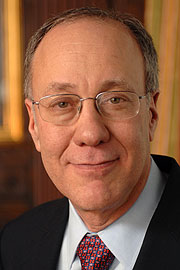
- Roger Myerson
- Lived
- b. 1951
- Field
- Economics, game theory
- From
- American
The story
Roger Myerson was born in Boston in 1951 into a Jewish family and studied applied mathematics at Harvard. In the late 1970s, as a young professor at Northwestern University, he became absorbed by a basic problem: how should rules be designed when the people taking part know things that the designer does not, and have every reason to keep them hidden?
Auctions were the clearest example. Each bidder knows how much an item is worth to them, but a seller does not, and bidders will shade their bids to pay less. During a visit to Bielefeld University in Germany in 1978 and 1979, Myerson applied a new tool, the revelation principle, which he had helped extend and generalize. It showed that the search for the best possible selling rules could be narrowed to rules in which bidders simply report their values and in which telling the truth is in their own interest. Using it, he derived the auction that maximizes the seller’s expected revenue, published in 1981 as “Optimal Auction Design.”
The paper gave a precise answer to practical questions: when a seller should set a minimum price, known as a reserve price, how high it should be, and which bidder should win. It also proved a revenue-equivalence result showing that, under standard conditions, many different auction formats bring the seller the same expected revenue, so designers can focus on the features that really matter, such as reserve prices and who is allowed to bid.
The ideas moved from theory into everyday commerce. Much internet advertising is sold by automated auctions, and setting reserve prices well is one of the main tools platforms have. In a large field experiment in sponsored search advertising, the economists Michael Ostrovsky and Michael Schwarz set reserve prices using optimal auction theory and found that revenues increased substantially. Economists at the National Bureau of Economic Research have since shown how to estimate Myerson-style optimal reserve prices directly from historical bids, illustrated with auction data from eBay.
The same reasoning is used whenever governments and companies sell or buy through auctions, from public assets to procurement contracts, and it earned Myerson a share of the 2007 Nobel Memorial Prize in Economic Sciences for laying the foundations of mechanism design theory.
Why it matters
Myerson’s optimal auction theory guides how reserve prices and auction rules are set in online advertising, e-commerce and public auctions, helping sellers, including governments, get fair value while goods go to those who value them most.
About Roger Myerson
Boston-born economist who showed how to design auctions and rules that work even when people keep secrets, ideas used in auctions, online ad markets and regulation. Nobel Prize 2007.
Sources
- Roger B. Myerson, Biographical NobelPrize.org
- Popular information: The Prize in Economic Sciences 2007 NobelPrize.org
- Reserve Prices in Internet Advertising Auctions: A Field Experiment Stanford Graduate School of Business
- The Simple Empirics of Optimal Online Auctions National Bureau of Economic Research
Another act of tikkun olam. This is part of tikkun olam, the Jewish idea of repairing the world, and every one of us can add to it.