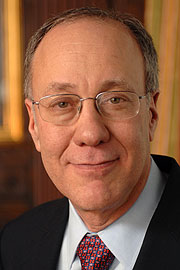
A boy who worried about the bomb
Roger Bruce Myerson was born on March 29, 1951, in Boston, into a Jewish family, and grew up in a comfortable suburb of the city with good public schools. In his Nobel autobiography he describes a household that greatly valued reading and scientific learning. His father did research and engineering for a family business that manufactured artificial teeth, and both of his parents went back to school to earn advanced degrees while he was growing up.
He was a child of the early nuclear age, and the danger stayed with him. He remembers telling his father that he was frightened by political cartoons about the 1956 Suez crisis. His father reassured him that the world’s leaders were bringing all their wisdom to the task of keeping the peace. The young Myerson drew his own conclusion: perhaps it would be better if leaders had even more wisdom and understanding to draw on. At twelve he read a classic science-fiction novel in which a mathematical social science guided a new civilization, and he began to hope that advances in the social sciences might one day help humanity manage the dangers that advances in the physical sciences had created.
Discovering game theory
Myerson loved history and historical maps, but he wanted something more analytical. He began reading Paul Samuelson’s economics textbook during a high school vacation and, at Harvard College, concentrated in economics and applied mathematics. In the spring of 1972 he took a course on decision analysis from Howard Raiffa, who told the class at the end that the study of interactions among several rational decision-makers was called game theory, and that only limited progress had been made in it. Myerson took that as a challenge. If he could not analyse such basic models of social decision-making, he reasoned, how could he claim to understand anything in social science?
Harvard had no regular course on game theory, so he taught himself, scribbling notes in the margins of photocopied articles by John Nash, John Harsanyi, Reinhard Selten, Lloyd Shapley, Thomas Schelling and Robert Aumann. Harsanyi’s work on games in which players hold different information gripped him most. He earned his A.B. summa cum laude and an S.M. in applied mathematics in 1973 and a Ph.D. in 1976, with a thesis on cooperative games supervised by Kenneth Arrow. That year he joined the Kellogg School of Management at Northwestern University, then one of the few places in the world where game theory and the economics of information were treated as central rather than fringe subjects. He stayed for twenty-five years.
The problem of private information
Classical economics showed that, under ideal conditions, free markets allocate resources efficiently. Real life is rarely ideal. A seller knows things about her product that the buyer does not. A buyer knows how much he would really pay but has every reason to hide it. A company knows its true costs better than the regulator who sets its prices. Insurance buyers know more about their own risks than insurers do. In each case people have an incentive to use their private information to their own advantage, and the result can be deals that fall through, projects that never get built, and rules that are easy to game.
Mechanism design, the field founded by Leonid Hurwicz and developed by Eric Maskin and Myerson, turns the usual question of economics around. Instead of asking how a given market behaves, it asks which rules, or mechanisms, would produce the best possible outcome given that people will act in their own interest and keep what they know to themselves. A mechanism can be an auction, a voting rule, a tax system, a contract or a regulatory scheme. The goal is to find the rules under which honest, cooperative behaviour is also the self-interested choice.
The revelation principle
Myerson’s great tool for this task was the revelation principle, which he developed in its most general form in papers published in 1979, 1982 and 1986. Others, including Allan Gibbard and Eric Maskin with colleagues, had reached versions of the idea, but Myerson extended it to the broad setting economists use for uncertainty, and then to problems of hidden actions and to processes that unfold over many stages. In his own words, it says that for any equilibrium of any communication system, a trustworthy mediator can create an equivalent system in which honesty is a rational choice for everyone.
That sounds abstract, but its practical effect was enormous. Before it, finding the best set of rules meant searching through an almost infinite variety of possible institutions. The revelation principle showed that a designer could restrict attention to a much simpler class of mechanisms in which people are simply asked to report what they know, with the rules arranged so that telling the truth pays. Once the best of these is found, it can be translated back into a practical institution. The Nobel committee wrote that this seemingly roundabout method let researchers solve problems of institutional design that would otherwise have been effectively intractable.
Designing the best auction
Myerson’s most famous application came in a paper written during a visit to Bielefeld University in Germany in 1978 and 1979 and published in 1981 as “Optimal Auction Design.” He asked how a seller should run an auction to raise the most money when each bidder privately knows how much the item is worth to them. His answer gave a precise recipe for the revenue-maximizing auction, including how and when a seller should set a minimum price, known as a reserve price. Along the way he proved a powerful revenue-equivalence result: under standard conditions, many quite different auction formats bring the seller the same expected revenue, which tells designers to focus on the features that really matter.
With his Northwestern colleague Mark Satterthwaite he then proved, in 1983, one of the most cited results in economics. The Myerson–Satterthwaite theorem shows that when a buyer and a seller each have private information about what a good is worth to them, no voluntary trading system can guarantee that every mutually beneficial trade takes place. It explains why haggling so often breaks down, and it also identified the best that any trading mechanism can achieve. With David Baron he showed how to regulate a monopoly whose costs the regulator cannot observe, and with Bengt Holmström he reworked the basic idea of economic efficiency for a world in which people hold private information.
What his ideas do for people today
Mechanism design is now part of the basic toolkit of economics, and it touches daily life in ways most people never see. Auction theory built on Myerson’s work underlies the design of government auctions of radio spectrum, treasury securities and other public assets, helping governments raise money for taxpayers while putting resources in the hands of those who value them most. In the online world, the reserve prices used in internet advertising auctions are a direct application of optimal auction theory. In one large field experiment, published by Michael Ostrovsky and Michael Schwarz, reserve prices set using the theory substantially increased revenues in sponsored search auctions, and economists have since developed methods to estimate Myerson-style optimal reserve prices from data on platforms such as eBay.
The same logic shapes regulation of utilities and other monopolies, the design of insurance and procurement contracts, and the rules that public agencies use to buy goods and services. The Nobel committee summed it up: mechanism design allows us to tell when markets work well and when they do not, and it has helped economists identify efficient trading mechanisms, regulation schemes and voting procedures. It also explains why some goods, such as public projects shared by everyone, are poorly provided by markets alone and may need other institutions, such as taxation.
From markets to democracy
From the late 1980s Myerson turned the same tools on politics. Electoral systems and constitutions, he argued, are the rules of the game by which politicians compete for power, so game theory should help predict how changing those rules changes politicians’ behaviour. With Robert Weber and others he compared electoral systems, showing how some rules encourage candidates to appeal broadly while others reward narrow appeals, and how some can shut out good new candidates, letting established leaders profit from their power. He found that approval voting could push politicians to compete more vigorously for the centre. He also wrote a widely read textbook, Game Theory: Analysis of Conflict (1991), and an MBA text on probability models that teaches through spreadsheet simulation.
In 2001 he moved to the University of Chicago, where he is now the David L. Pearson Distinguished Service Professor of Global Conflict Studies at the Harris School of Public Policy. His later work studies how states are built and how democracy can take root. After the 2003 invasion of Iraq he argued, drawing on Schelling’s ideas about credible restraint, that a superpower most needs clear limits on its use of force, and that the occupation’s first priority should have been elected, well-funded local councils in which new leaders could build reputations for serving voters.
Family and Jewish background
Myerson was born into a Jewish family in Boston, as Wikipedia and the Jewish Virtual Library record, and he is listed among Jewish Nobel laureates in economics. He has not written publicly about religious practice, and his own account of his upbringing emphasizes a family devoted to books, science and education, and a childhood shaped by the anxieties of the Cold War.
In 1980 he met Regina (Gina) Weber, and they married in 1982. Their children, Daniel and Rebecca, were born in 1983 and 1985; Rebecca became a health economist. Myerson has written that everything in his life since then has been a joint venture shared with them. Gina Myerson later became a dean in Northwestern’s McCormick School of Engineering.
Honours and legacy
In 2007 Myerson shared the Nobel Memorial Prize in Economic Sciences with Hurwicz and Maskin “for having laid the foundations of mechanism design theory.” He is a member of the National Academy of Sciences, the American Academy of Arts and Sciences and the American Philosophical Society, and his name is attached to the Myerson–Satterthwaite theorem, the Myerson auction and the technique economists call Myerson ironing.
His deeper legacy is a way of thinking. Instead of taking institutions as given, Myerson taught economists and policy designers to ask what rules would bring out the truth and lead self-interested people to good collective outcomes. That question now guides the design of auctions that fund public budgets, online advertising markets, contracts, regulations and voting rules. It is a long way from a boy in suburban Boston worrying about nuclear war, but it is the same hope: that careful thinking about human incentives can help build a safer and better-run world.
Sources & further reading
Roger B. Myerson, Biographical, NobelPrize.org · Popular information: The Prize in Economic Sciences 2007, NobelPrize.org · Roger Myerson, Jewish Virtual Library · Reserve Prices in Internet Advertising Auctions: A Field Experiment, Stanford Graduate School of Business · The Simple Empirics of Optimal Online Auctions, NBER · Roger Myerson, Wikipedia · Researched from the sources above and checked against them. Spotted an error? Tell us.
A life of tikkun olam. This is part of tikkun olam, the Jewish idea of repairing the world, and every one of us can add to it.