- Person
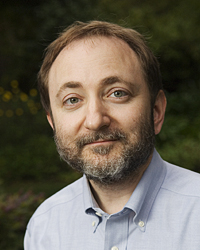
- Andrew Fire
- Lived
- b. 1959
- Field
- Genetics
- From
- American
The story
In the 1990s Andrew Fire, a geneticist raised in a Jewish family in Sunnyvale, California, was studying tiny roundworms at the Carnegie Institution of Washington in Baltimore. With Craig Mello of the University of Massachusetts he tested a hunch that confusing gene-silencing results were caused by double-stranded RNA. Injecting the two matching strands of RNA together into worms shut down the corresponding gene with remarkable potency and precision, while either strand alone had little effect.
Their paper, published in Nature on February 19, 1998, named the process RNA interference. The Nobel committee, which awarded Fire and Mello the 2006 Nobel Prize in Physiology or Medicine, explained that double-stranded RNA activates machinery in the cell that destroys messenger RNA carrying the same genetic code, so the corresponding protein is no longer made. The mechanism works in humans, helps defend cells against viruses and, through hundreds of small natural microRNAs, regulates our own genes.
RNAi immediately became a standard laboratory tool, letting researchers switch off any chosen gene to learn what it does. The committee also predicted that it might lead to treatments, and that hope came true. In August 2018 the U.S. Food and Drug Administration approved patisiran (Onpattro), described by the Max Planck Society as the first RNAi therapeutic, for the nerve damage caused by hereditary transthyretin amyloidosis, a rare inherited disease. The drug silences the gene for the harmful protein at its source.
On December 22, 2021, the FDA approved inclisiran (Leqvio), the first small interfering RNA therapy to lower LDL, or “bad,” cholesterol, for adults with cardiovascular disease or inherited high cholesterol who need further lowering despite other treatment. After an initial dose and one at three months, it is given just twice a year. In trials it reduced LDL cholesterol by up to an additional 52 percent in the approved patient groups. More RNAi medicines are in development for other diseases.
Why it matters
Medicines based on RNA interference now treat a rare inherited nerve disease and help people with heart disease lower their cholesterol with two injections a year.
About Andrew Fire
Stanford geneticist who, with Craig Mello, discovered RNA interference, a natural way to switch off genes that is now a universal lab tool and the basis of new medicines. Nobel Prize 2006.
Sources
- Press release: The Nobel Prize in Physiology or Medicine 2006 NobelPrize.org
- FDA approves patisiran: first RNAi medication Max Planck Society
- FDA approves Novartis Leqvio (inclisiran), first-in-class siRNA to lower cholesterol Novartis
- FDA approves inclisiran for LDL lowering Healio
- Andrew Fire Wikipedia
Another act of tikkun olam. This is part of tikkun olam, the Jewish idea of repairing the world, and every one of us can add to it.