
A child with leukaemia, a patient with a new kidney, a blood donor, a patient having a hormone test: every day, millions of people are helped by the work of four Jewish women scientists, several of whom had to fight their way into a laboratory at all.
Gertrude Elion: medicines by design
Gertrude Elion was born in New York in 1918 to immigrant parents. When she was 15 her beloved grandfather died of cancer, and she resolved to fight the disease. She studied chemistry at Hunter College, which was free, but after graduating found that laboratory jobs were not open to women. She taught, worked unpaid as a lab assistant and tested food quality before, in 1944, joining George Hitchings at the Burroughs Wellcome company. She never completed a doctorate, giving up night classes rather than her research.
Instead of testing compounds by trial and error, Elion and Hitchings studied how cells make DNA and designed molecules to interfere with that process in cancer cells and germs while sparing healthy cells. The results were remarkable. In 1950 and 1951 they developed thioguanine and 6-mercaptopurine against leukaemia, and pyrimethamine against malaria. Azathioprine followed in 1957, for a long time the only drug available to prevent the rejection of transplanted organs. Allopurinol, for gout, came in 1963, and acyclovir, the first effective drug against herpes virus infections, in 1977. Her lab's methods also helped lead to AZT, an early treatment for HIV.
Elion shared the 1988 Nobel Prize in Physiology or Medicine with Hitchings and Sir James Black. In 1991 she became the first woman inducted into the US National Inventors Hall of Fame. In retirement she mentored medical students at Duke University.
Rosalyn Yalow: measuring the invisible
Rosalyn Yalow, born in New York in 1921, fell in love with physics at Hunter College. Her family thought she should be a schoolteacher, and she was offered a secretarial job as a back door into science. Then a graduate assistantship arrived from the University of Illinois, where she was the only woman among roughly 400 members of the engineering faculty. She tore up her stenography books and earned a PhD in nuclear physics in 1945.
At the Bronx Veterans Administration Hospital, starting from little more than a converted janitor's closet, she and physician Solomon Berson began a partnership of 22 years. Studying patients treated with insulin, they found that the body makes antibodies to it, and turned that discovery into a tool. Radioimmunoassay, which they developed in the late 1950s, uses radioactive tracers and antibodies to measure hormones in amounts as tiny as a few trillionths of a gram in a millilitre of blood.
The Nobel committee said the method brought about a revolution in biological and medical research. It has been used to measure hundreds of substances, from hormones and vitamins to drugs and viruses, and it made it possible to screen donated blood for hepatitis. Yalow and Berson chose not to patent it. Berson died in 1972, and Yalow received the Nobel Prize in 1977, the second woman to win in physiology or medicine.
Rita Levi-Montalcini: a laboratory in a bedroom
Rita Levi-Montalcini was born in Turin in 1909. Her father did not believe his daughters should have careers, but at 20 she persuaded him to let her study medicine, graduating with top honours in 1936. Two years later, Mussolini's racial laws barred Jews from academic and professional careers.
She refused to stop. During the war she built a small research unit in her bedroom and studied the growing nerves of chick embryos, joined by her former professor, Giuseppe Levi, as her only assistant. When bombing forced the family out of Turin she rebuilt the lab in a country cottage, and later lived in hiding in Florence. After liberation she worked as a doctor in a camp for war refugees.
In 1947 she accepted an invitation to Washington University in St Louis, planning to stay a year. She stayed for decades. In the early 1950s she showed that certain tumours released a substance that made nerves grow vigorously. With biochemist Stanley Cohen she identified it as nerve growth factor, the first of many growth factors the body uses to control how cells grow. The two shared the 1986 Nobel Prize. Her discovery opened research into dementia, wound healing and cancer, and a medicine made from human nerve growth factor, cenegermin, is now approved in Europe and the United States to treat a rare disease that damages the cornea of the eye.
She became a senator for life in Italy in 2001, inspired a foundation in her name that supports education for young women in Africa, and in 2009 became the first Nobel laureate to reach 100. She died in 2012, aged 103.
“Our feeling of reward was immeasurable.”Gertrude B. Elion, on seeing her drugs help patients, Nobel Prize autobiography, 1988
Rosalind Franklin: the picture of life
Rosalind Franklin was born in London in 1920 to a prominent British Jewish family that took in children fleeing Nazi Europe. A skilled X-ray crystallographer trained in Cambridge and Paris, she joined King's College London in 1951 to study DNA. Her careful work identified two forms of the molecule and produced key X-ray images of it, including the famous Photo 51, taken in her lab by her student Raymond Gosling.
In early 1953 her colleague Maurice Wilkins showed one of her X-ray photographs to James Watson, and he and Francis Crick also saw a summary of her unpublished results. Her data helped them build their 1953 model of the double helix. Franklin moved to Birkbeck College, where she led pioneering studies of the structure of viruses, including tobacco mosaic virus, and began work on the polio virus. She died of ovarian cancer in 1958, aged 37. Her colleague Aaron Klug carried on her virus research and won the 1982 Nobel Prize in Chemistry.
The double helix she helped reveal underpins much of modern medicine, from genetic testing to the study of how viruses work. Her gravestone honours her simply as a scientist whose research on viruses is of lasting benefit to humanity.
A legacy in every hospital
None of the four had an easy path. Elion never earned a doctorate, Yalow was told by her department head that women do not do well at laboratory work, Levi-Montalcini worked in hiding, and Franklin did not live to see her full contribution recognised. Each followed the evidence anyway.
Today their discoveries are part of ordinary medicine: in the drugs that treat childhood leukaemia and herpes, in transplant care, in hormone tests, in research on how cells grow, and in the very understanding of DNA. Several of them devoted their later years to encouraging the young scientists who came after them. Their stories are a reminder that talent is everywhere, and that when doors open to it, the whole world is healthier.
People in this story
 Gertrude ElionPharmacology
 Rosalyn YalowMedical Physics
 Rita Levi-MontalciniNeurobiology
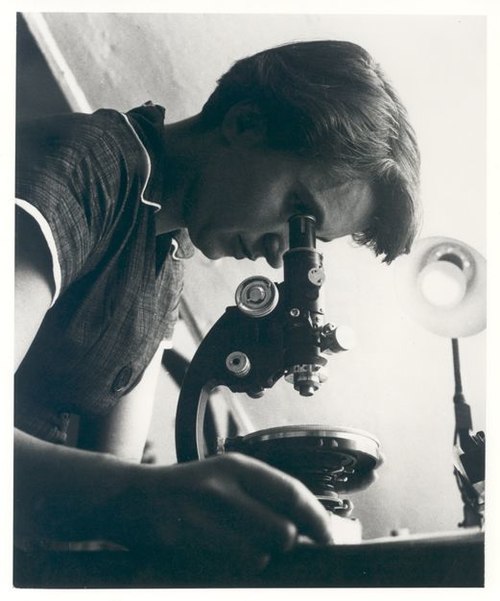 Rosalind FranklinX-ray crystallography
Sources & further reading
- Gertrude B. Elion: Biographical, NobelPrize.org
- The Nobel Prize in Physiology or Medicine 1988: Press release, NobelPrize.org
- Rosalyn Yalow: Biographical, NobelPrize.org
- The Nobel Prize in Physiology or Medicine 1977: Press release, NobelPrize.org
- Rita Levi-Montalcini: Biographical, NobelPrize.org
- Rosalind Franklin: Biographical Overview, US National Library of Medicine
- Rosalind Franklin, Wikipedia
- Rita Levi-Montalcini, Wikipedia
Researched from the sources above and checked against them. Spotted an error? Tell us.
Tikkun olam in action. This is part of tikkun olam, the Jewish idea of repairing the world, and every one of us can add to it.


