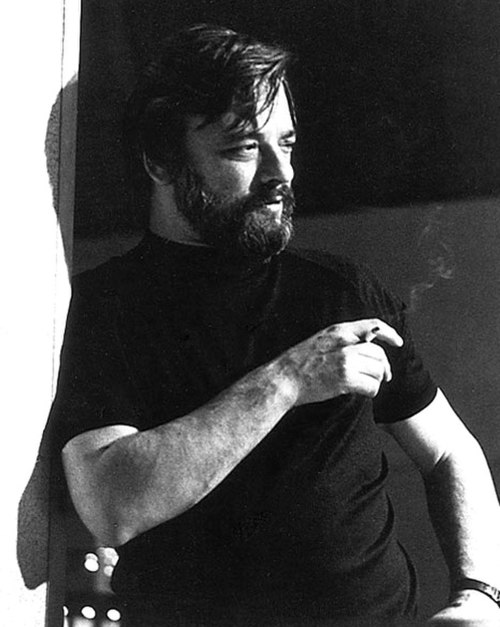
A solitary New York childhood
Stephen Joshua Sondheim was born on 22 March 1930 in New York City, the only child of Herbert Sondheim and Janet, known as Foxy. His parents were prosperous figures in the Manhattan garment trade, his father a dress manufacturer, and the household was outwardly comfortable but emotionally cold. Their bitter divorce in 1941 left the young Sondheim in the difficult sole custody of his mother, a domineering and, by his own later account, cruel woman whose treatment of him cast a long shadow over his life. He grew up clever, isolated and precociously self-reliant, finding in puzzles, games and music a private order that the chaos of his family could not provide. That early loneliness, and the search for structure within it, would become a recurring undercurrent of his art. Few major American artists have spoken so frankly about an unhappy childhood, or transmuted it so completely into work of lasting subtlety. He would later describe his mother's conduct in unsparing terms, and the wound never entirely closed, yet it also seems to have sharpened his lifelong attention to the gap between how people present themselves and what they actually feel.
The Hammerstein apprenticeship
After the divorce Sondheim moved with his mother to a farm in Bucks County, Pennsylvania, and there occurred the decisive accident of his life. The family of the great lyricist and librettist Oscar Hammerstein II lived nearby, and Sondheim, befriending Hammerstein's son James, found in the elder man a surrogate father and an extraordinary teacher. When the teenage Sondheim showed Hammerstein a musical he had written, Hammerstein dismantled it line by line, then taught him, methodically, how a song is actually built. It was an apprenticeship of unusual rigour. Sondheim went on to study music at Williams College and afterwards trained privately with the avant-garde composer Milton Babbitt. From these influences he absorbed two complementary disciplines: Hammerstein's insistence on character, clarity and emotional truth, and Babbitt's analytical command of compositional structure. The combination would make him a craftsman of formidable, almost architectural precision. Hammerstein's lesson, that a song must serve character and dramatic situation rather than merely please the ear, became the principle Sondheim would defend for the rest of his career, even when it cost him popular favour.
Lyrics for the masters
Sondheim's professional breakthrough came as a lyricist working alongside established giants. In 1957 he wrote the lyrics for "West Side Story", with music by Leonard Bernstein, a book by Arthur Laurents and direction and choreography by Jerome Robbins; the show transplanted "Romeo and Juliet" to the streets of New York and became a landmark of the American musical. Two years later he supplied the lyrics for "Gypsy", with music by Jule Styne, widely regarded as one of the finest of all musical-theatre scores. These were triumphs, yet they left Sondheim restless. He had wanted to write music as well as words, and feared being typecast as a lyricist for hire. The apprenticeship had to end. He resolved that his next major project would be one for which he composed the score himself, whatever the professional risk of stepping out from the shadow of more famous collaborators.
Composer and lyricist
That step came in 1962 with "A Funny Thing Happened on the Way to the Forum", a bawdy farce drawn from ancient Roman comedy, for which Sondheim wrote both music and lyrics; it ran for more than nine hundred performances and won the Tony Award for Best Musical. The path was not smooth: his next show, "Anyone Can Whistle", closed within days in 1964. But the early 1970s brought an astonishing run of achievement in partnership with the director and producer Harold Prince. "Company" in 1970 examined marriage and modern urban loneliness; "Follies" in 1971 was an elegiac meditation on memory and the lost glamour of the Broadway past; "A Little Night Music" in 1973 turned a Bergman film into a waltz-time chamber piece. Sondheim won the Tony Award for Best Score in three consecutive years, establishing himself as the most original voice in the American musical.
Reinventing the musical
Through the 1970s and 1980s Sondheim continued to push the form into territory it had never occupied. "Pacific Overtures" in 1976 told the story of Japan's opening to the West using elements of kabuki theatre. "Sweeney Todd, the Demon Barber of Fleet Street" in 1979 was a near-operatic Victorian melodrama of revenge and cannibalism, both grisly and grand. "Sunday in the Park with George", created with the playwright James Lapine and opening in 1984, imagined the inner life of the painter Georges Seurat and the cost of making art; it won the Pulitzer Prize for Drama. "Into the Woods" in 1987, again with Lapine, braided together familiar fairy tales and then darkened them into a parable about consequence, community and grief. Each show treated the musical not as light entertainment but as a serious dramatic and intellectual form capable of moral complexity.
Difficulty and the critics
Sondheim's ambition came at a cost, and an honest account must record it. His shows were frequently described as cold, cerebral or unhummable, prized by devoted admirers but resistant to the mass affection that greeted simpler musicals. "Merrily We Roll Along" in 1981, which tells its story of friendship and compromise in reverse chronological order, closed after a brief and painful original run before being rehabilitated by later productions. "Pacific Overtures", "Assassins" and others struggled commercially even as they were admired. Sondheim wrote intricate, harmonically demanding music and lyrics of dense interior wit, and he never condescended to an audience; some found this exhilarating and others alienating. He was candid about the loneliness of working at the edge of a popular form, and about the wounding power of reviews. His reputation, secure now, was won slowly and against real resistance, vindicated as much by the devotion of later productions and performers as by the verdict of opening-night critics.
Later years
Sondheim's later output was smaller but undiminished in seriousness. "Assassins" in 1990 assembled the figures who had killed or attempted to kill American presidents into a disturbing revue about violence and the national myth of success. "Passion" in 1994, an intense study of obsessive love, won the Tony Award for Best Musical. In his final decades he was as much a revered elder and teacher as a working composer, generous with younger writers and rigorous in his published reflections; his two volumes of collected lyrics, annotated with frank commentary on his own craft and failures, became essential reading for songwriters. He continued to develop new projects into old age. Honoured with the Kennedy Center Honors in 1993 and the Presidential Medal of Freedom in 2015, he remained a working artist, sceptical of complacency, until close to the end of his long life.
Identity and the inner life
Sondheim came from a secular Jewish family; he did not have a bar mitzvah until he was an adult, and his work very rarely addressed Jewish themes or his own homosexuality directly. Yet he reflected, late in life, that his sense of Jewish identity had deepened with age, observing that so many of the artists he most admired were Jewish and that art itself was as near to a religion as he possessed. He found lasting personal happiness comparatively late, marrying Jeff Romley in 2017. His art consistently turned its attention to the interior life, to ambivalence, regret, the difficulty of intimacy and the labour of creation, treating emotions usually smoothed over in popular entertainment with rare honesty. He was, in temperament and subject, a chronicler of the unresolved, and he made that honesty the foundation of his achievement. His characters are rarely allowed easy redemption; they question, hesitate, compromise and endure, and audiences recognised in them something truer than the tidy resolutions of conventional entertainment.
A death and a tribute
Stephen Sondheim died on 26 November 2021 at his home in Roxbury, Connecticut, at the age of 91. The response was immediate and extraordinary: theatres dimmed their lights, performers gathered spontaneously to sing his songs in public squares, and tributes poured in from several generations of artists who regarded him as the supreme craftsman of their form. Over his career he had written some two dozen musicals and accumulated an unmatched array of honours, among them eight Tony Awards, an Academy Award, multiple Grammy Awards, Olivier Awards and the Pulitzer Prize. The breadth of the mourning measured something beyond statistics. It reflected how completely he had reshaped what a musical could be, and how many writers, performers and listeners felt personally indebted to a body of work that had refused to flatter them.
Impact and legacy
Stephen Sondheim is widely regarded as the most important figure in the American musical theatre of the twentieth century's second half, the artist who proved the form could carry the weight of serious drama. He inherited from Oscar Hammerstein a craft and handed it on, transformed, to nearly every musical-theatre writer who followed; the contemporary stage is unimaginable without his influence. His insistence that lyrics serve character with absolute precision, his harmonically adventurous music, and his willingness to write about ambivalence, failure and the cost of art set a standard that later generations measure themselves against. His shows are revived continually around the world, studied as closely as plays, and a Broadway theatre now bears his name. Sondheim's enduring legacy is the demonstration that a popular art form, taken seriously enough, can become great art, and that honesty about the difficult interior of human life need never be condescended to.
Sources & further reading
Stephen Sondheim, Wikipedia · Researched from the sources above and checked against them. Spotted an error? Tell us.
A life of tikkun olam. This is part of tikkun olam, the Jewish idea of repairing the world, and every one of us can add to it.