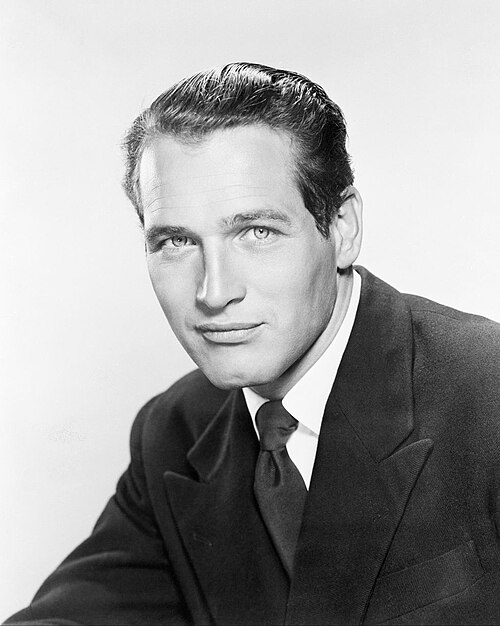
A boy from Shaker Heights
Paul Leonard Newman was born on January 26, 1925, in Cleveland Heights, Ohio, and grew up in the comfortable suburb of Shaker Heights on the east side of Cleveland. He was the second son of Arthur Newman, who ran a successful sporting goods store, and Theresa Newman, who helped in the shop while raising Paul and his older brother, Arthur Jr. His father was Jewish, the son of Jewish immigrants from Central Europe; his mother had been born into a Catholic family in a village in what is now Slovakia and had become a Christian Scientist.
The household was not religious in any Jewish sense, and Paul received no instruction in his father’s heritage. But Shaker Heights in the 1930s was a place where the line between Jews and Christians was sharply drawn, and he felt it. He discovered the stage early: at seven he played the court jester in a school production of Robin Hood, and at ten he performed at the Cleveland Play House in Saint George and the Dragon. He graduated from Shaker Heights High School in 1943 and briefly attended Ohio University before the war caught up with him.
War, college and the stage
Newman joined the United States Navy in the Second World War, hoping to become a pilot. He was dropped from the program and trained instead as a radioman and rear gunner in torpedo bombers, serving in the Pacific. Shortly before the Battle of Okinawa in 1945, his crew was grounded because their pilot had an earache, while the rest of the squadron flew to the aircraft carrier Bunker Hill. Days later a kamikaze attack on the ship killed several hundred men, including members of his unit. Newman would later speak of the role that pure chance had played in his survival.
After the war he studied drama and economics at Kenyon College in Ohio, graduating in 1949, then toured with summer stock companies, spent a year at the Yale School of Drama and moved to New York to study at the Actors Studio. In 1953 he made his Broadway debut in William Inge’s Picnic. One of the understudies was a young actress from Georgia named Joanne Woodward. They married in 1958 and stayed married for fifty years, raising their family not in Hollywood but in Westport, Connecticut.
A movie star who kept his name
His breakthrough came in 1956, playing the boxer Rocky Graziano in Somebody Up There Likes Me. Over the next half century he became one of the defining actors of American film, with roles in Cat on a Hot Tin Roof (opposite Elizabeth Taylor), Exodus, The Hustler, Hud, Cool Hand Luke, Butch Cassidy and the Sundance Kid, The Sting, The Verdict and Road to Perdition. He was nominated nine times for acting Oscars and won Best Actor for The Color of Money (1986), reprising the pool player Fast Eddie Felson twenty-five years after The Hustler. He also directed, raced cars at a professional level, finished second at the 24 Hours of Le Mans in 1979, and at seventy was part of a class-winning team at the 24 Hours of Daytona.
Early in his career he was urged to change his obviously Jewish-sounding surname. When the producer Sam Spiegel suggested he drop “Paul Newman,” he refused, asking whether Spiegel would prefer “S.P. Ewman.” Fame, though, was never the part of his life he took most seriously. By the late 1970s he had begun to use it for something else.
Salad dressing for a good cause
Newman and his friend the writer A. E. Hotchner used to make their own salad dressing and give it to friends as gifts. In 1982, encouraged by the response, they decided to sell it, each putting up $20,000 in seed money. Newman agreed to put his face on the label on one condition: every dollar of profit, after taxes, would go to charity. The first label carried the motto “Fine Foods Since February.”
The joke became a business. Newman’s Own grew from dressing into pasta sauce, lemonade, popcorn, salsa, frozen pizza and much more, sold in supermarkets across the United States and abroad, and its profits were given away year after year to a wide range of causes, from the New York Times Neediest Cases Fund to hospices, food programs and clean water projects. Newman and Hotchner told the story, with typical self-mockery, in their 2003 book Shameless Exploitation in Pursuit of the Common Good. Newman also arranged for the money to keep flowing after he was gone: the company passed to the Newman’s Own Foundation, which still gives away all of its profits and royalties. According to the foundation, Newman’s Own has now given more than $600 million to charity, today focusing on children who face adversity, nutrition and school food, and food justice in Native American communities.
The model itself was part of the gift. Newman helped found the Committee Encouraging Corporate Philanthropy to persuade business leaders to give more, and Newman’s Own showed that a company could compete on supermarket shelves while handing every dollar of profit to others. He was blunt that he saw nothing heroic in it; he was puzzled, he said, by people who had so much and gave so little.
A camp where sick children could be children
The cause closest to his heart was children with life-threatening illnesses. In 1988, using money from Newman’s Own to get it started, he opened the Hole in the Wall Gang Camp in Ashford, Connecticut, named after the outlaw gang in Butch Cassidy and the Sundance Kid. It was a residential summer camp for children with cancer, blood diseases and other serious conditions, with doctors and nurses on hand so that the children could swim, fish, ride horses, put on plays and simply be children, often for the first time since their diagnosis. Families paid nothing.
Asked why he had done it, Newman wrote about luck: the good fortune in his own life and its brutality in the lives of children who might never have the chance to put it right. The camp soon became a network. By 1994 there were camps in Europe, and the movement grew to include Barretstown in Ireland, camps in France, Italy, Hungary and the United Kingdom, Jordan River Village in Israel and many more in the United States. In 2012 the network took the name SeriousFun Children’s Network, a nod to Newman’s sense of humour.
How it changed the world
SeriousFun now has 30 camps and programs. According to the network, they have delivered more than two million camp experiences to sick children and their families from more than 50 countries, covering well over 100 medical conditions, always free of charge. Through a Global Partnership Program begun in 2008, it works with local organisations to run camps for children living with HIV and other serious illnesses in Botswana, Ethiopia, Lesotho, Malawi, South Africa, Eswatini, Tanzania, Uganda, Cambodia, India, Vietnam and Haiti. Independent evaluations have found that campers return home more confident and independent, and one study of camps in Ethiopia, India and Vietnam found that children were much more likely to keep taking their HIV medicines after attending.
Newman’s giving reached well beyond the camps. After his son Scott died of a drug overdose in 1978, he founded the Scott Newman Center to help prevent substance abuse. In 2006 he co-founded the Safe Water Network to bring clean drinking water to poor communities around the world. In 2007 he gave $10 million to Kenyon College for scholarships. Each of these was serious, but the larger achievement was an example: a famous man who decided, quietly and permanently, that the money his name could earn belonged to other people.
Jewish by choice of identity
As an adult Newman was drawn to Unitarian Universalism, but he called himself a Jew, saying it was “more of a challenge.” In his memoir, published after his death, he described a strong sense of otherness as a boy because he was half-Jewish. He learned that if you were Jewish, some avenues were closed to you, and he and his brother were hurt by it. He was kept out of a high school fraternity because he was Jewish, and in the Navy he got into a bloody fight with a sailor who used an antisemitic slur.
He did not hide where he came from. He kept his name, and in Otto Preminger’s Exodus (1960) he played Ari Ben Canaan, a Jewish underground fighter in the struggle for Israel’s independence. His Jewish identity was quiet and personal rather than religious, but it was real, and it sharpened the sympathy for outsiders that ran through his politics and his giving.
The man behind the blue eyes
Newman was famously private and wary of his own celebrity, and he liked to joke rather than preach. He was a committed liberal: he marched on Washington in 1963, campaigned for Eugene McCarthy against the Vietnam War in 1968, and was placed on President Nixon’s enemies list, which he called the highest honour he ever received. He was a devoted husband and father of six children, and his loss of Scott in 1978 shadowed him for the rest of his life.
He worked hard at everything and claimed no natural gift for any of it. He received an honorary Academy Award in 1986, the Kennedy Center Honors with Joanne Woodward in 1992, and the Academy’s Jean Hersholt Humanitarian Award in 1994 for his charitable work.
Last laps and legacy
Newman retired from acting in 2007, saying that his memory and confidence were going. He kept racing into his eighties. In 2008 he withdrew from directing a play at the Westport Country Playhouse because of his health, and he died of lung cancer at his home in Westport on September 26, 2008, aged 83. Even the Vatican newspaper L’Osservatore Romano praised his generosity.
His films are still watched and admired, but his most lasting work is on supermarket shelves and in the woods of Connecticut and dozens of other places around the world. Every bottle of dressing still pays for someone else’s good fortune, and every summer children who have spent too much of their lives in hospitals get to be ordinary children at camp, free of charge. Newman’s Own also inspired other businesses to adopt the same idea of giving away all their profits. Few people have turned celebrity into a more practical or enduring benefit for strangers.
Sources & further reading
Paul Newman, Wikipedia · About us, Newman’s Own Foundation · About us, SeriousFun Children’s Network · Reflecting on Paul’s impact to celebrate his 100th birthday, The Hole in the Wall Gang Camp · Paul Newman, Jewish Virtual Library · Paul Newman, Luck, Ezra Klein, The American Prospect (2008) · Researched from the sources above and checked against them. Spotted an error? Tell us.
A life of tikkun olam. This is part of tikkun olam, the Jewish idea of repairing the world, and every one of us can add to it.