A Jewish childhood in Germiston
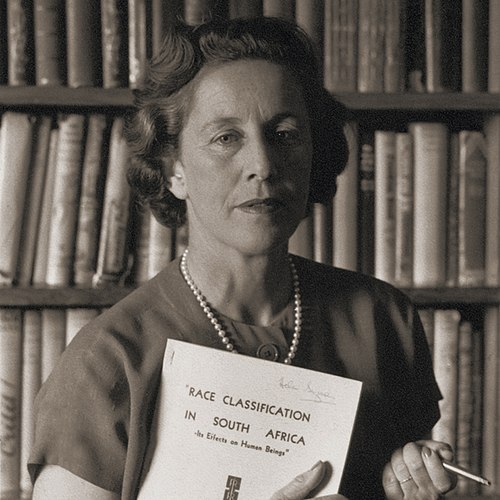
Helen Suzman was born Helen Gavronsky on November 7, 1917, in Germiston, a mining and industrial town near Johannesburg. Her parents, Samuel and Frieda Gavronsky, were Jewish immigrants from Lithuania who had come to South Africa to escape the restrictions placed on Jews in the Russian Empire. Her mother died shortly after her birth, and she was raised largely in the care of her father, a hide and skin merchant, in Johannesburg.
She was educated at Parktown Convent in Johannesburg, matriculating in 1933, and went on to study commerce at the University of Witwatersrand. At nineteen she married Dr. Moses Suzman, a physician fourteen years her senior, and the couple went on to have two daughters. Her early adult life was that of a comfortable Johannesburg professional's wife, and nothing about it suggested that she would become one of the best known political figures in the country.
From economics to Parliament
In 1941 Suzman returned to the university to study economics and economic history, and in 1945 she became a lecturer at Witwatersrand. Her academic work and her work with the South African Institute of Race Relations, including on the Fagan Commission, which looked at the pressures of African urbanization, opened her eyes to the hardship that pass laws and migrant labor rules imposed on Black South Africans in the cities. She later said the experience shaped everything that followed.
In 1953 she was elected to Parliament for the Johannesburg constituency of Houghton, representing the United Party, the main opposition to the governing National Party. The National Party had come to power in 1948 and was building the system of legal racial separation known as apartheid. Almost at once Suzman found that her own party was reluctant to oppose it. In her first term she and one other member of the United Party walked out rather than vote for the Separate Amenities Bill, which allowed public facilities to be segregated by race.
The lone voice
In 1959 Suzman hosted the meeting at which she and eleven other liberal members broke away from the United Party to found the Progressive Party, a new party that rejected racial discrimination. At the 1961 election every other Progressive candidate lost, and Suzman kept her seat by only 564 votes. For the next thirteen years, until 1974, she was the only member of Parliament who consistently and openly opposed apartheid.
She made the most of that position. In her first session alone she gave 66 speeches, moved 26 amendments and asked 137 questions. Over the thirteen years she made 885 speeches and asked 2,262 questions. Her questions were practical and relentless: how many people had been arrested under the pass laws, how many people were being held in detention, what had happened to a particular banned person, who had been beaten by the police and why. The answers, because they were given in Parliament, entered the official record and could be reported, even in a country where the press was heavily censored.
Detention, pass laws and police brutality
Suzman opposed the General Law Amendment Act of 1963, known as the 90-day detention law, which allowed the police to hold people without trial and without access to a lawyer. She often stood alone as the only member to vote against such laws. She also pressed the government on arrests under the pass laws, on bannings, which silenced and confined people without any court hearing, and on deaths and injuries in custody.
She used parliamentary privilege, the right to speak in the chamber without fear of prosecution, as a tool. Information that newspapers could not safely print could be read into the record by her and then quoted. She traveled to townships and squatter camps to gather evidence herself, and she attended funerals in which police violence was feared, in the belief that her presence might deter it. She also opposed measures that were not obviously about race. In 1971 she was the only member to vote against a law imposing mandatory sentences for cannabis offenses.
Visiting Robben Island
One of her best known acts was her visits to political prisoners. In 1967 she visited Nelson Mandela on Robben Island for the first time. His fellow Rivonia Trialists named him as their spokesperson, and he put their complaints about prison conditions to her. She raised those complaints with the authorities, and prisoners later credited her visits with helping to improve conditions. Mandela wrote that she was one of the few members of Parliament who took an interest in the plight of political prisoners, and recalled that she was the first and only woman ever to grace their cells.
She also visited other prisoners and banned persons, among them Robert Sobukwe, Albert Luthuli and Bram Fischer, and she was influential in the later release of Fischer, who was ill. She described herself as the honorary ombudsman of the dispossessed, and the writer Nadine Gordimer said she never refused anyone help. People from townships and rural areas wrote to her, and she took their cases up with officials.
A broader fight for rights
Suzman also worked on discrimination against women. She campaigned on legal inequalities in marriage and property, and she helped bring about matrimonial reforms in 1988. In 1974 her party at last gained more seats in Parliament, and in 1975 it merged with Harry Schwarz's Reform Party to become the Progressive Reform Party. It was renamed the Progressive Federal Party in 1977. She remained in Parliament until 1989, a total of thirty-six years.
Her record is not without criticism. She opposed economic sanctions and disinvestment as a way of pressuring the South African government, arguing that they would hurt Black workers most, and for a long time she supported a qualified franchise rather than an immediate universal vote. Critics in the African National Congress and the Communist Party denounced these positions. Even so, those who had been in prison or under banning orders consistently credited her with courage and with practical help.
After Parliament and recognition
When apartheid ended she did not retire. President Mandela appointed her to the electoral commission that oversaw the first democratic election in 1994, and she served on the South African Human Rights Commission from 1995 to 1998. She also served as president of the South African Institute of Race Relations and helped found the Helen Suzman Foundation in 1993, which works to defend constitutional democracy and human rights. She attended the signing of the 1996 constitution.
She was nominated twice for the Nobel Peace Prize, and in 1984 the committee chose Desmond Tutu. She received an honorary damehood of the Order of the British Empire in 1989, the Freedom of the City of Kingston upon Hull in 1987, and in 1997 the Order for Meritorious Service in gold from President Mandela. She collected 27 honorary doctorates. Western Boulevard in Cape Town was renamed Helen Suzman Boulevard in 2011, and both Liberia and South Africa have issued postage stamps in her honor. She died in her sleep on January 1, 2009, in Johannesburg, at the age of 91.
Her Jewish background
Suzman came from a Lithuanian Jewish immigrant family and was buried in a Jewish ceremony led by South Africa's chief rabbi. The Jewish Virtual Library describes her as a secular Jew who did not present herself as a representative of the Jewish community, but who tied her anti-apartheid work directly to her Jewish roots. She said that for Jews to support those in favor of racial discrimination was, in her words, the ultimate treachery to Jewish values.
She was critical of the Jewish Board of Deputies for not speaking out against apartheid. She also faced antisemitism herself, including hate mail and hostile remarks from Nationalist members of Parliament. Her work was not done for the Jewish community: it was done for all South Africans, and above all for the Black majority who had no vote and no voice in the chamber where she sat.
Legacy
Suzman's achievement was not to defeat apartheid, which she could not do from the opposition benches, but to make it impossible for it to operate unobserved. For thirteen years the minister responsible for every detention, banning and police action knew that the question would be asked, and that the answer would be on the record. Her visits to prisoners gave practical help to people the state intended to silence, and her presence in Parliament was a sign to South Africans that not everyone in that chamber agreed.
Today her legacy lives in the democratic constitution she saw signed, in the Helen Suzman Foundation's legal and policy work for constitutional rights, and in the example of one person using the ordinary tools of an institution, a seat, a question and a speech, to defend people who had no power at all.
Sources & further reading
Helen Suzman, Wikipedia · Helen Suzman, Jewish Virtual Library · Statement from the Foundation on the death of Helen Suzman, Nelson Mandela Foundation · Researched from the sources above and checked against them. Spotted an error? Tell us.
A life of tikkun olam. This is part of tikkun olam, the Jewish idea of repairing the world, and every one of us can add to it.