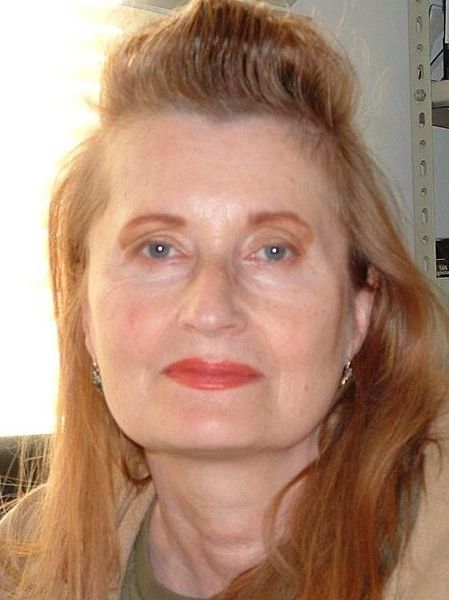
A father who survived, a family that did not
Elfriede Jelinek was born on 20 October 1946 in Mürzzuschlag, in the Austrian province of Styria, and grew up in Vienna. Her father, Friedrich Jelinek, was a chemist of Czech-Jewish origin and a non-observant, working-class socialist. During the Second World War he escaped persecution because he worked in strategically important industrial production, but many of his relatives were murdered in the Holocaust. He later became psychologically ill. Her mother, Olga Ilona Jelinek, born Buchner, came from a once-prosperous Viennese family and was Catholic, and Elfriede attended a Roman Catholic convent school.
Home was hard. Her mother planned a career for her as a musical prodigy and drove her relentlessly, with lessons in piano, organ, guitar, violin, viola and recorder from an early age, while the girl also had to cope with her father’s illness. At six she was sent to the clinic of the paediatrician Hans Asperger, an experience she later described bitterly. These pressures, a domineering mother, a damaged father and a culture that preferred not to talk about the war, would become the raw material of her art.
Music, breakdown and the first books
Jelinek studied composition at the Vienna Conservatory, passing the organist’s diploma examination in 1971, and studied theatre and art history at the University of Vienna. An anxiety disorder forced her to abandon university and left her isolated in her parents’ house for about a year; during that time she began to write seriously, partly as a form of therapy.
She had already published a first poetry collection, Lisas Schatten, in 1967, and won her first literary prize in 1969. Contact with the student movement turned her writing in a socially critical direction. Her early satirical novels, wir sind lockvögel baby! (1970) and Michael (1972), attacked popular culture and the advertising images of the good life. In 1974 she married Gottfried Hüngsberg, and for decades she divided her life between Vienna and his city, Munich.
Exposing violence against women
Jelinek became known to the German-speaking public with three novels: Die Liebhaberinnen (1975; Women as Lovers), Die Ausgesperrten (1980; Wonderful, Wonderful Times) and the partly autobiographical Die Klavierspielerin (1983; The Piano Teacher), the story of a piano teacher crushed by her mother’s control and her own repressed desires. In 2001 the Austrian director Michael Haneke made it into an acclaimed film starring Isabelle Huppert, which carried Jelinek’s work to audiences around the world.
In these books, the Swedish Academy observed, readers meet a pitiless world of violence and submission, hunter and prey. Lust (1989) went further, presenting sexual violence against women as a hidden template of the culture; some critics dismissed it as pornographic, while others saw its cold descriptions as a devastating moral indictment. Female sexuality, abuse and the power struggle between the sexes became central themes of her work, and her books have since been widely studied in universities, in gender studies as well as literature, for how they show the ways everyday language, entertainment and family life can normalise domination and abuse.
Confronting Austria’s past
Jelinek’s second great subject is Austria’s refusal to face its Nazi past. For decades after 1945 the country presented itself as Hitler’s first victim, and many Austrians preferred not to examine the enthusiasm with which much of the population had welcomed annexation in 1938. Jelinek insisted on looking. Her 1985 play Burgtheater satirised the conduct of celebrated Viennese actors during the Nazi era and caused a scandal. Her vast novel Die Kinder der Toten (1995; The Children of the Dead) depicts Austria as a realm of the dead, haunted by its murdered.
Her play Rechnitz (Der Würgeengel) (2008) takes as its subject the massacre of Jewish forced labourers near the castle of Rechnitz, in Burgenland, at the end of the war, and the decades of silence that followed. Jelinek has described herself as continuing an Austrian-Jewish satirical tradition, citing Karl Kraus, Elias Canetti and Jewish cabaret, and has said that satire is misunderstood in Austria today because the Jews who created that tradition are dead.
A new kind of theatre
Her path to the stage began on the radio. Her first radio play, wenn die sonne sinkt ist für manche schon büroschluss, was very favourably received in 1974, and she has since written a large number of radio plays and theatre texts, as well as screenplays, poetry, essays and libretti. Her radio play Jackie won the German war-blinded veterans’ radio play prize in 2004, and she won the Mülheim Dramatists Prize, Germany’s leading award for new plays, for Macht nichts, Das Werk, Rechnitz and Winterreise.
Over time Jelinek moved from the novel to the stage, and she is now considered one of the most important living playwrights of the German language. Her plays abandon conventional dialogue for what the Swedish Academy called a musical flow of voices and counter-voices: long, layered monologues in which many levels of society and history speak at once. Works such as Ein Sportstück (1998), In den Alpen (2002), Das Werk (2003) and the Princess Dramas, variations on the theme of women unable to live fully in a world that paints them over with stereotypes, have been staged at leading theatres across Europe.
In Die Schutzbefohlenen (2013; Charges (The Supplicants)) she gave voice to refugees seeking asylum in Europe, and the play has been widely performed as the continent debated migration. She has also translated Thomas Pynchon’s Gravity’s Rainbow, plays by Georges Feydeau, Christopher Marlowe’s The Jew of Malta and Oscar Wilde into German, and written a libretto for Olga Neuwirth’s opera Lost Highway.
Tapping on language
Jelinek has explained her method with a medical image: she taps on language to hear its hidden ideologies, much as a doctor taps on a patient’s chest. Her targets are the phrases everyone uses without thinking, the slogans of advertising and tourism, the clichés of romance and sport, the euphemisms of politicians. By repeating, twisting and colliding them, she makes the violence they conceal suddenly audible. The Swedish Academy placed her in a long Austrian tradition of linguistically sophisticated social criticism, from Johann Nestroy and Karl Kraus to Ödön von Horváth, Elias Canetti and Thomas Bernhard.
Her work has gradually reached English-speaking audiences through translators such as Gitta Honegger, Michael Hulse and Martin Chalmers. Ein Sportstück had its English-language premiere in 2012, and her play Jackie, one of the Princess Dramas, had its North American premiere in New York in 2013. Yale University Press published The Children of the Dead in English in 2024. A 2022 documentary by Claudia Müller, Elfriede Jelinek: Language Unleashed, introduced her life and work to a new generation. She has also collaborated with the composer Olga Neuwirth on opera, from Lost Highway (2003) to Monster’s Paradise (2026).
Nobel Prize and controversy
In October 2004 the Swedish Academy awarded Jelinek the Nobel Prize in Literature “for her musical flow of voices and counter-voices in novels and plays that with extraordinary linguistic zeal reveal the absurdity of society’s clichés and their subjugating power.” Because of her social phobia she could not travel to Stockholm, and she delivered her Nobel lecture by video. She had already received the Georg Büchner Prize, the most important German literary award, in 1998, and the Franz Kafka Prize in 2004.
The award was divisive. A member of the Swedish Academy, Knut Ahnlund, later resigned in protest, calling her work chaotic and pornographic. In Austria she has long been a highly controversial figure. She was a member of the Austrian Communist Party from 1974 to 1991, and in the 1990s she became one of the fiercest critics of Jörg Haider’s far-right Freedom Party; when it entered government in 2000, some of its supporters accused critics like her of betraying their country.
Jewish identity
Jelinek was raised in a Catholic school by a Catholic mother, but she has emphasised her Jewish identity as the daughter of a Jewish father who survived the Holocaust while much of his family did not. She has described herself as standing in a Jewish-Viennese tradition of satire and language criticism that she believes fascism destroyed and that is now dying out, and much of her writing about memory and guilt grows out of that family history.
Her public positions on Jewish questions have been complex. In 2024 she signed an open letter denouncing the Palestinian Campaign for the Academic and Cultural Boycott of Israel. In August 2026 she wrote on her website condemning Israel’s seizure of land in the West Bank, Gaza and Jerusalem and calling the two-state solution a lie. She remains, as the Swedish Academy put it, a dauntless polemicist who uses her website to comment on burning issues.
Legacy
Vienna made Jelinek an honorary citizen in 2021, the same year she received the Nestroy Theatre Prize for lifetime achievement, and in 2017 she received the Der Faust theatre prize for lifetime achievement. Her literary voice is difficult and deliberately uncomfortable, and she has always had as many detractors as admirers.
Her contribution is to have made silence audible. By turning the clichés of advertising, pop culture and polite conversation against themselves, she showed readers and audiences how ordinary language can hide violence against women and conceal a nation’s crimes. Her work helped open a long-delayed public reckoning in Austria with its role in the Nazi era, and it continues to give writers, actors and students around the world a model of literature that refuses to look away.
Sources & further reading
Elfriede Jelinek, Bio-bibliography, NobelPrize.org · Elfriede Jelinek, Facts, NobelPrize.org · Elfriede Jelinek, Wikipedia · Researched from the sources above and checked against them. Spotted an error? Tell us.
A life of tikkun olam. This is part of tikkun olam, the Jewish idea of repairing the world, and every one of us can add to it.