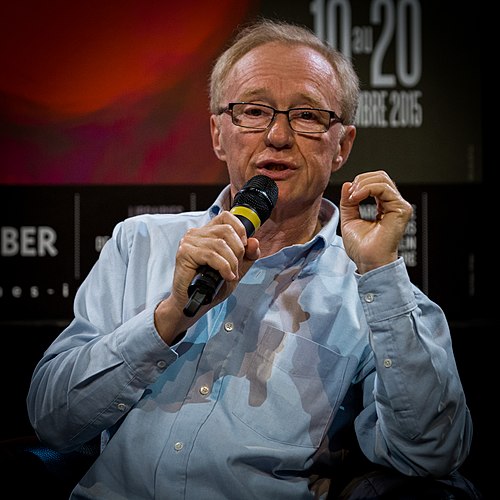
A Jerusalem childhood
David Grossman was born in Jerusalem on January 25, 1954, the elder of two brothers. His mother, Michaella, was born in Mandate Palestine to a poor Labour Zionist family; her father paved roads in the Galilee and traded in rugs on the side. His father, Yitzhak, had come from Dynów in Poland as a nine-year-old with his widowed mother, who had left after harassment by the Polish police and worked as a maid in Jerusalem’s wealthier neighbourhoods. Yitzhak drove a bus and later became a librarian.
It was his father who brought home the stories of Sholem Aleichem, and through them the boy discovered the vanished Yiddish world of Eastern Europe. At nine Grossman won a national quiz on Sholem Aleichem’s work. Around the same age he began working as a young reporter for a children’s magazine and as a child actor on Israel’s national radio, the start of a connection with the Israel Broadcasting Authority that lasted nearly a quarter of a century. He attended the high school attached to the Hebrew University, in one of its first Middle Eastern studies tracks.
Soldier, student, broadcaster
In 1971 Grossman began his military service in the intelligence corps; he was still in uniform when the Yom Kippur War broke out in 1973, though he did not see combat. He then studied philosophy and theatre at the Hebrew University of Jerusalem, while working at Kol Yisrael, the national radio, as a reporter, radio-drama actor and presenter, including a popular call-in programme on which children could ask teachers for help with their homework.
His first stories appeared in the literary journal Siman Kria, edited by Menachem Perry, who has edited his adult fiction ever since. In 1988 his radio career ended in a clash over censorship: according to English-language accounts he was dismissed after refusing to suppress news that the Palestinian leadership had declared a state and accepted Israel’s right to exist; Hebrew sources describe him leaving in protest at restrictions on reporting about Palestinians. Either way, the episode foreshadowed the role he would come to play in Israeli public life.
Into the occupied territories
Grossman’s first novel, The Smile of the Lamb (1983), set in the West Bank under Israeli rule, was already concerned with the occupation; it won the Prime Minister’s Prize and was later filmed by Shimon Dotan. In 1987 he travelled through the West Bank and published a series of reports that became the book The Yellow Wind. It described, in plain and humane language, the humiliation, despair and rage of Palestinians under occupation and the corrosion it was causing among Israelis. Appearing shortly before the first intifada erupted in December 1987, it read almost as a prophecy and made Grossman internationally known as a reporter as well as a novelist.
He followed it in 1992 with Sleeping on a Wire, conversations with Palestinian citizens of Israel about their divided identity, and later collected his political journalism in books including Death as a Way of Life (2003) and Writing in the Dark (2008).
See Under: Love
The book that established Grossman as a major novelist was See Under: Love (1986). It begins with Momik, a nine-year-old boy in 1950s Jerusalem growing up among Holocaust survivors who will not speak about what they have been through, who sets out to capture and tame the “Nazi beast” he believes is hiding in his parents’ cellar. The novel then opens into three further sections, each in a radically different form, including a fantastical account of a Jewish writer in a death camp telling stories to its commandant, and a final part written as an encyclopaedia of a child’s life.
Scholars have described the book as a landmark of a new Israeli literature of the Holocaust, written by the generation born after the catastrophe and shaped by its silences. When it appeared in English in 1989 it brought Grossman international recognition, and it remains one of the most ambitious Hebrew novels of its era.
Novels of intimacy
Grossman’s fiction moves easily between the political and the deeply private. The Book of Intimate Grammar (1991) follows a boy in 1960s Jerusalem who stops growing as he resists the adult world; it was filmed by Nir Bergman. The Zigzag Kid (1994) is a comic adventure about a policeman’s son on the eve of his bar mitzvah. Be My Knife (1998) is an epistolary novel of obsessive love, and Someone to Run With (2000), about a teenage boy and a runaway girl in the streets of Jerusalem, won the Sapir Prize and became a film and television series. The Zigzag Kid was later adapted for the screen in the Netherlands by Vincent Bal.
He is also a beloved children’s author, the creator of the Itamar picture books and many others, and has written plays, poems and an opera for children. His prose is known for its range of voices, its stream-of-consciousness passages and its willingness to blend realism with fantasy. His recent novels have been translated into English by Jessica Cohen.
Uri
In the summer of 2006 Israel went to war with Hezbollah in Lebanon. Grossman had initially supported the war as an act of self-defence, but on August 10, together with Amos Oz and A. B. Yehoshua, he held a press conference urging the government to accept a ceasefire rather than expand the fighting. Two days later, on August 12, his son Uri, a twenty-year-old staff sergeant in the Armoured Corps, was killed when his tank was hit by an anti-tank missile in southern Lebanon, in the final hours before the ceasefire took effect.
Grossman said that his son’s death did not change his views. Two months later he addressed about 100,000 people at the annual rally in memory of Yitzhak Rabin, delivering a searing critique of what he called Israel’s hollow leadership and urging his country to reach out to the Palestinians. He also refused to shake the hand of Prime Minister Ehud Olmert when receiving the Emet Prize in 2007.
To the End of the Land and after
When Uri was killed, Grossman was already deep into a novel about Ora, an Israeli mother who sets off on a hike across the Galilee to avoid the messengers she fears will come to her door with news of her soldier son’s death. He finished it after his loss, and To the End of the Land (2008; English 2010) became one of the most acclaimed Israeli novels of the century, a vast portrait of family life lived under the shadow of war.
Falling Out of Time, a hybrid of prose and verse about parents grieving their children, followed in 2011 and has been adapted for the stage many times. A Horse Walks into a Bar (2014), set during a single stand-up comedy show in which the comedian’s routine collapses into a confession, won the Man Booker International Prize in 2017, shared with Jessica Cohen. More Than I Love My Life (2019) traced three generations of women from Tito’s Yugoslavia to Israel and was nominated for the same prize in 2022.
A voice of conscience
Grossman has long been one of the most prominent voices of the Israeli peace camp. He has been president of Keshev, a centre for the protection of democracy in Israel, sits on the public council of the human rights group B’Tselem, and helped found an organisation providing legal aid to African asylum seekers. In 2010 he was beaten by police while taking part in weekly protests in East Jerusalem’s Sheikh Jarrah neighbourhood against settlers taking over Palestinian homes, and in 2023 he joined the mass protests against the government’s judicial overhaul.
After the Hamas massacre of October 7, 2023, he wrote of Israelis forced to recognise the depth of hatred toward them and of the need to remain alert, while demanding humane conduct from Palestinians and, later, condemning the toll of the war on Gaza’s civilians. In 2025 he told the Italian newspaper la Repubblica that he believed Israel was committing genocide in Gaza, a statement that provoked fierce controversy in Israel. In 2015 he had withdrawn as a candidate for the Israel Prize after the prime minister tried to remove two judges; he received the prize in 2018.
Honours and legacy
Grossman’s books have been translated into more than thirty languages, and he has received a long list of honours, among them the Bialik Prize (2004), the Geschwister-Scholl-Preis (2008), the Peace Prize of the German Book Trade (2010), the Prix Médicis étranger (2011), the Man Booker International Prize (2017), the Israel Prize (2018), the Erasmus Prize (2022), the Heinrich Heine Prize (2024) and the Thomas Mann Prize (2026). The Erasmus Prize Foundation chose him for its theme of “mending a torn world” saying no one embodied it better.
His work insists on seeing the inner life of others, survivors and their children, soldiers and their mothers, Palestinians under occupation, as fully as one’s own. A secular Jew rooted in Hebrew and haunted by the Yiddish past his father brought home, he has made empathy itself a kind of political act, and he continues to write and speak from Jerusalem as one of the most widely read writers Israel has produced.
Sources & further reading
David Grossman, Wikipedia · דויד גרוסמן, Hebrew Wikipedia · David Grossman, Erasmus Prize laureate 2022 · David Grossman, Wikiquote · Researched from the sources above and checked against them. Spotted an error? Tell us.
A life of tikkun olam. This is part of tikkun olam, the Jewish idea of repairing the world, and every one of us can add to it.