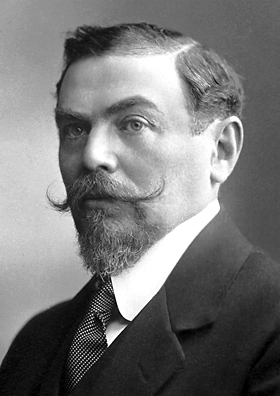
A Viennese boy who left school at fifteen
Alfred Hermann Fried was born in Vienna on 11 November 1864 into a Jewish family of modest means; his biographer Petra Schönemann-Behrens describes his parents as poor Hungarian Jews living in the imperial capital. He had little formal education. At about fifteen he left school and went to work in a Vienna bookshop, educating himself through the books he sold.
In 1883 he moved to Berlin, and in 1887 he opened a bookshop and publishing business of his own. It was in Berlin that his political and social ideas took shape, influenced at first by socialism. He was a young businessman with no university degree, no family connections and no political office, yet within a decade he would become one of the most important organisers of the European peace movement.
Lay Down Your Arms
In 1889 the Austrian writer Bertha von Suttner published Die Waffen nieder! (Lay Down Your Arms!), an anti-war novel that became an international bestseller. Two years later Fried read a newspaper report about a peace society she had founded in Vienna and wrote to her proposing a peace journal that he would publish if she would edit it. She agreed, and in 1892 their monthly, named after her novel, appeared in Berlin. The two remained close friends and collaborators for more than twenty years, and he was at her bedside when she died in 1914.
In 1892 Fried also co-founded the Deutsche Friedensgesellschaft, the German Peace Society, and from 1894 to 1899 he edited its Monatliche Friedenskorrespondenz. In 1899 he replaced Die Waffen nieder! with Die Friedens-Warte (The Peace Watch), which he edited until his death. The British writer Norman Angell called it the most efficient periodical of the pacifist movement in the world. Remarkably, it outlived its founder by decades: edited after his death by Hans Wehberg and moved to Zürich in 1933, it continued to appear long after.
Die Friedens-Warte was addressed above all to intellectuals: professors, lawyers, journalists and officials who might shape public policy. Fried withdrew from the German Peace Society and returned to Vienna in 1903, and from there he poured out newspaper articles and books on the cause. His Handbuch der Friedensbewegung was first published in 1905 by the Austrian Peace Society, and its expanded second edition of 1911 was published by his own journal.
Organise the world
Fried’s great contribution was an idea. Many nineteenth-century pacifists appealed mainly to conscience, urging people to renounce war on moral grounds. Fried thought this was not enough, and criticised writers such as Leo Tolstoy for placing too much faith in morality alone. War, he argued, was a symptom of a deeper condition, the anarchy of a world in which sovereign states recognised no common rules or institutions. Disarmament would follow naturally once nations were bound together by organisation. “If we wish to substitute for war the settlement of disputes by justice,” he wrote, “we must first substitute for the condition of international anarchy a condition of international order.”
The Hague Peace Conference of 1899 was a turning point for him. Thereafter he put his faith in economic cooperation and political organisation among nations: treaties, arbitration courts, international unions and regular conferences. In his Annuaire de la vie internationale, which he began in 1905 and later prepared with the Belgian internationalists Paul Otlet and Henri La Fontaine, he documented the growing web of international bodies, from postal and telegraph unions to the Pan-American movement, as evidence that history was moving toward world organisation. His biographer took her title from his rallying cry: Organisiert die Welt! (Organise the world!).
The forerunner of the League and the UN
Fried is remembered as one of the fathers of the idea of a permanent international organisation to keep the peace. He studied the Pan-American Union as a model of how nations could keep their own identities while cooperating within a larger framework, and he followed the two Hague Peace Conferences closely, writing a book on the second in 1908. His Handbuch der Friedensbewegung (Handbook of the Peace Movement), published in 1905 and expanded in 1911, was the most comprehensive work on the subject before the First World War.
After the war, the principle he had argued for became reality in the League of Nations, founded in 1920, and after the Second World War in the United Nations. In 1920 he published an essay calling the League an ethical institution. Today, when disputes between countries are taken to international courts, when states negotiate through permanent bodies rather than only through alliances, and when international organisations coordinate health, trade and communications, they are working in the framework Fried and his fellow internationalists imagined.
Organiser and writer
Fried was as tireless an organiser as he was a writer. He was a member of the Bern-based International Peace Bureau, secretary of International Conciliation for Central Europe and secretary-general of the International Press Union for Peace, and his efforts helped found the Verband für internationale Verständigung (Society for International Understanding) in 1911. A 1908 bibliography listed a thousand of his newspaper articles on the peace movement, and he wrote dozens of books and pamphlets.
He was also a prominent supporter of Esperanto, the international auxiliary language created by Ludwik Zamenhof, which he saw as a tool for understanding between peoples. In 1903 he published a German textbook of Esperanto with a German–Esperanto dictionary, republished in 1905.
Heart and intellect
Fried saw his partnership with Bertha von Suttner as a union of two approaches. Early in their collaboration he wrote to her that a scholarly treatise on peace by a Dresden jurist represented the North, while she, with her style of attack, represented the South: heart and intellect, he said, as if one could work without the other. He brought the intellect: a scientific, even hard-headed pacifism grounded in economics, law and organisation.
He spread these ideas in books for a wide public. Das internationale Leben der Gegenwart (International Life Today, 1908) surveyed the growing web of cooperation among nations; Die Grundlagen des revolutionären Pacifismus (1908) set out his theory, and was translated into French; Pan-Amerika (1910) presented the cooperation of the American republics as a model for Europe. In English, The German Emperor and the Peace of the World (1912) appeared with a preface by Norman Angell, and The Restoration of Europe (1916) argued for a durable postwar order. Stanford University later acquired his library, and his papers are kept with those of the League of Nations in Geneva.
Nobel Prize
In 1911 the Norwegian Nobel Committee divided the Nobel Peace Prize between Fried and the Dutch jurist Tobias Asser. Both were Jewish-born, and both, in different ways, worked to replace force with law and organisation in relations between nations: Asser through treaties on private law, Fried through the vision of an organised world.
Fried’s prize was a striking recognition for a self-taught journalist. It also reflected the respect he had earned from the wider movement, including Bertha von Suttner, who had herself received the Peace Prize in 1905.
War, exile and accusations of treason
Fried was in Vienna when the First World War broke out in 1914. Censorship and hostile public opinion made peace work there impossible, so he moved to neutral Switzerland, where he continued to publish Die Friedens-Warte as a rallying point for international peace efforts and worked to improve conditions for prisoners of war. The Austrian government accused him of treason, and he could not return home until the war ended. His wartime diary, published as Mein Kriegstagebuch in four volumes, recorded his own activities and those of his colleagues.
Before the war he had sometimes defended Germany, chronicling what he saw as Kaiser Wilhelm II’s positive attitude toward peace, and during the war he answered criticism of Germany in the Allied press that he thought unreasonable. Afterwards he was bitterly disappointed with the peace settlement and campaigned in print against the Treaty of Versailles, which he believed would sow new conflict.
In Switzerland he tried to keep open the lines between pacifists on both sides of the front, and he worked to ease the conditions of prisoners of war, one of the war’s most neglected humanitarian problems. For Fried, the catastrophe of 1914–1918 proved what he had argued for twenty years: that a world without common institutions would sooner or later stumble into war.
Death in poverty and a lasting legacy
Fried lost what savings he had in the collapse of Austria-Hungary. He died in poverty in Vienna on 4 May 1921, aged fifty-six, of a lung infection, and his ashes were placed at the Feuerhalle Simmering crematorium. Stanford University bought his library, and a collection of his manuscripts went to the archives of the League of Nations, now part of the United Nations Library in Geneva.
His life’s work had been to persuade Europe that peace is something to be built, not merely wished for. He was largely forgotten for decades, but historians have since restored him to his place as one of the founders of modern internationalism. His central insight, that peace requires not only goodwill but institutions, has shaped the League of Nations, the United Nations and the many international bodies that today allow countries to settle disputes by negotiation and law.
Sources & further reading
Alfred Fried, Biographical, NobelPrize.org · Alfred Hermann Fried, Wikipedia · Alfred Hermann Fried, New World Encyclopedia · Researched from the sources above and checked against them. Spotted an error? Tell us.
A life of tikkun olam. This is part of tikkun olam, the Jewish idea of repairing the world, and every one of us can add to it.