- Person
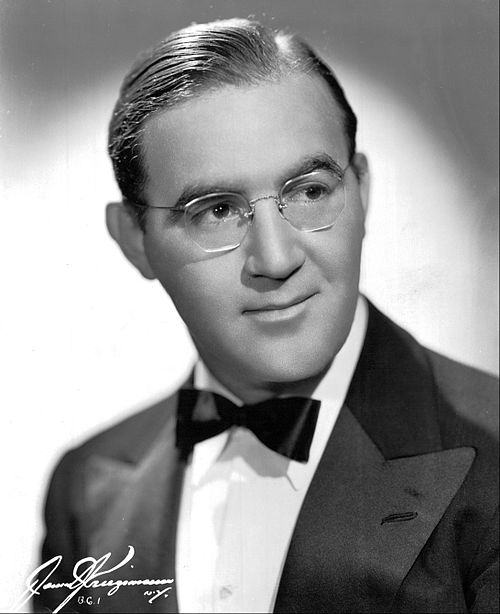
- Benny Goodman
- Lived
- 1909–1986
- Field
- Jazz clarinet
- From
- American
The story
Benny Goodman, the son of Jewish immigrants who grew up in a poor Chicago neighbourhood, became the leading clarinettist and bandleader of the swing era. Unusually for a jazz star, he also loved classical music, and he spent much of his career building bridges between the two worlds.
On 16 January 1938 Goodman led his band in a sold-out evening concert at Carnegie Hall in New York, the city's great home of symphonic music. He was the first jazz bandleader to perform there. Until then jazz had largely been treated as dance music. The concert, with the full band, the trio, the quartet and a jam session with guests from the Duke Ellington and Count Basie bands, presented it as music worth sitting and listening to. The writer Stan Ayeroff said the event helped jazz evolve from strictly dance music into music worthy of a discerning listening audience, and the critic Bruce Eder called it the most important jazz or popular music concert in history.
The concert was recorded almost by chance, and when Goodman's recordings were finally released by Columbia in 1950, the album became one of the first live recordings and double albums in jazz and the first jazz album to sell over a million copies. It has since been honoured by the Grammy Hall of Fame and the United States National Recording Registry, so new generations can still hear that night.
Goodman also used his success to commission new music. In 1938 he commissioned Béla Bartók's Contrasts for clarinet, violin and piano, written after an approach from the violinist Joseph Szigeti, and in 1940 Goodman and Szigeti took part in its first recording. In 1947 he commissioned Aaron Copland's Clarinet Concerto, paying two thousand dollars and giving Copland a free hand. Goodman gave its premiere on an NBC radio broadcast in November 1950, and the concerto, with its jazz touches, quickly became a standard of the clarinet repertoire. He also premiered or commissioned works by Malcolm Arnold, Morton Gould, Francis Poulenc and Leonard Bernstein, and recorded Mozart's Clarinet Quintet and Clarinet Concerto with the Boston Symphony.
Thanks to Goodman, jazz gained a place on the world's concert stages, and clarinettists everywhere gained lasting new pieces to play and teach.
Why it matters
Jazz is now performed and studied as concert art worldwide, and the Bartók and Copland works Goodman commissioned are still played by clarinettists and orchestras every year.
About Benny Goodman
The ‘King of Swing’, son of poor Jewish immigrants in Chicago, who led one of the first racially integrated jazz groups in America and brought jazz to Carnegie Hall in 1938.
More about Benny Goodman
Sources
- Benny Goodman Wikipedia
- The Famous 1938 Carnegie Hall Jazz Concert Wikipedia
- Clarinet Concerto (Copland) Wikipedia
- Contrasts (Bartók) Wikipedia
Another act of tikkun olam. This is part of tikkun olam, the Jewish idea of repairing the world, and every one of us can add to it.