A musician’s son from Chicago
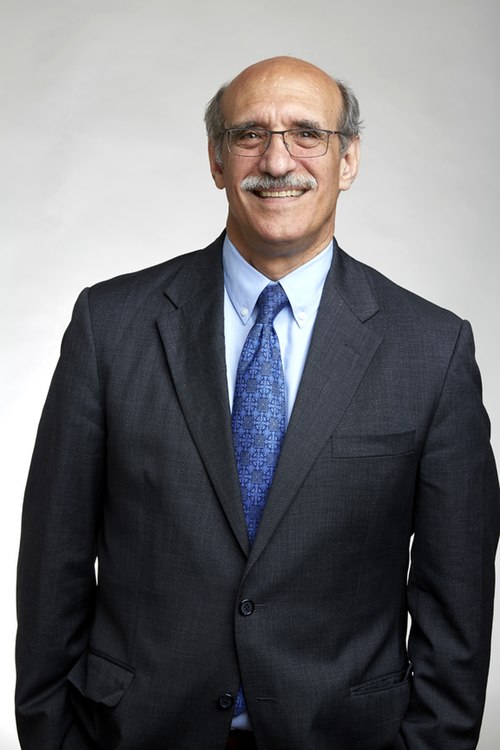
Martin Chalfie was born on January 15, 1947, in Chicago, the eldest of three sons of Vivian and Eli Chalfie. Three of his four grandparents were Jewish immigrants. His father’s parents came from Brest-Litovsk on the Russian-Polish border and settled in Cincinnati, where his grandfather, trained as a cabinet maker, worked as a tailor and his grandmother cooked in the executive dining room of the Manischewitz company. His mother’s father was born in Moscow.
Eli Chalfie was a self-taught musician who became staff guitarist at one of the country’s biggest radio stations and later played with the Russ Morgan Orchestra. His mother, Vivian, had to leave the University of Chicago when her parents could no longer pay the 100-dollar tuition, and went to work in the family dress-manufacturing business, which she later ran. His parents met at a USO breakfast for Jewish service members in Chicago during the Second World War. When Martin was eight the family moved to Skokie, a suburb chosen for its schools. He became a competitive swimmer, and at twelve his father gave him a classical guitar and taught him to play; he still plays today.
Dropping out, and finding a way back
Chalfie entered Harvard in 1965 unsure of what he wanted to do and settled on biochemistry. After a summer research project in which nothing worked, he decided that a career in science was not for him and spent his senior year taking courses outside science. Looking back, he wrote that he had been too afraid to ask for help, believing that needing help was a sign he was not clever enough. After graduating in 1969, with a red armband on his sleeve in protest at the police action against student demonstrators, he drifted through odd jobs: hospital surveys, selling dresses for his father, draft counselling and organising summer rock concerts in Cambridge parks.
He then taught high school chemistry, algebra and social science in Connecticut. A summer job in a laboratory at Yale Medical School changed everything. This time he asked for help, his experiment worked, and the results became his first scientific papers. He returned to Harvard for a doctorate in physiology, completed in 1977, then went as a postdoctoral researcher to Sydney Brenner’s laboratory at the Medical Research Council Laboratory of Molecular Biology in Cambridge, England, to study the tiny transparent roundworm Caenorhabditis elegans. In 1982 he joined the faculty of Columbia University in New York, where he has remained.
The genetics of touch
Cambridge suited him. Postdoctoral researchers were expected to find their own projects, and Brenner put his name only on papers containing his own experiments. Chalfie learned most from John Sulston, whom he called one of the most moral and fair people he had ever met. His first worm paper came about almost by accident: sent to look at electron micrographs of the touch-sensing cells and not knowing what else to do, he counted the microtubules, the tiny tubes inside nerve fibres, section by section. The jagged graph showed that, contrary to the accepted view, microtubules start and stop along the fibre rather than all beginning in the cell body. He joked that the one skill he brought to the work was the ability to count to fifty.
Chalfie’s main scientific passion has been the sense of touch. At Cambridge he took over a project on worms that could not feel a gentle touch, and at Columbia he built up a large collection of such mutants to find the genes that make touch-sensing nerve cells work. His laboratory went on to identify the proteins that turn a mechanical touch into an electrical nerve signal, part of a family of channels also found in human nerve and kidney cells. This work is fundamental to understanding how animals, including people, sense touch, and how those senses can fail. He admitted that a Cambridge habit of not publishing partial stories, combined with a strong tendency to procrastinate, meant he published nothing for six years at Columbia, to the alarm of senior colleagues; the papers that followed earned him tenure in 1989.
A jellyfish protein in a worm
In 1988 or 1989, at a seminar, Chalfie heard about the green fluorescent protein, GFP, found in the jellyfish Aequorea victoria. Osamu Shimomura had isolated it in 1962, and it glows bright green under blue or ultraviolet light. Chalfie had an idea: because his worms are transparent, if the GFP gene could be joined to one of his worm genes, the cells using that gene would glow, revealing in a living animal exactly where and when the gene was switched on.
The gene for GFP had just been cloned by Douglas Prasher at the Woods Hole Oceanographic Institution. Chalfie contacted him, and Prasher sent the DNA. A graduate student, Ghia Euskirchen, showed that bacteria carrying the gene glowed green. The great question was whether GFP needed any other jellyfish ingredient to light up. It did not. In 1994 Chalfie, Prasher and colleagues reported in the journal Science that GFP glows on its own in bacteria and in worms, where it lit up six individual touch-sensing nerve cells. The paper showed that GFP could be used as a marker of gene activity in any living organism without adding anything else.
Chalfie later said the GFP experiments took up a relatively small amount of his laboratory’s time. Their impact was enormous.
A light inside living cells
Before GFP, scientists studying where proteins go in cells usually had to kill and stain their samples, seeing only a frozen moment. GFP let them watch life as it happens. By joining the GFP gene to any other gene, researchers can make a chosen protein glow and follow its movements inside a living cell, track particular cells as an embryo develops, or watch tumours grow and spread. Roger Tsien, who shared the prize, extended the palette to many colours.
The Nobel committee called GFP one of the most important tools used in contemporary bioscience. It cited its use to watch nerve cells develop in the brain, to follow how cancer cells spread, to study nerve cell damage in Alzheimer’s disease, and to see how insulin-producing cells form in the pancreas. Today GFP and its descendants are used in laboratories all over the world, from testing how drugs reach their targets to building sensors that light up when brain cells fire. They have become as basic to biology as the microscope.
Credit where it is due
In October 2008 the Royal Swedish Academy of Sciences awarded the Nobel Prize in Chemistry to Osamu Shimomura, Martin Chalfie and Roger Tsien for the discovery and development of the green fluorescent protein. Chalfie said Douglas Prasher’s work had been critical and essential to his own. Prasher, whose research funding had run out, had left science and was working as a courtesy van driver at a car dealership in Huntsville, Alabama. Chalfie and Tsien invited Prasher and his wife to Stockholm as their guests for the Nobel ceremony, a gesture widely reported at the time. Prasher later returned to research in Tsien’s laboratory.
Jewish roots
Chalfie’s family story is one of Jewish immigration from the Russian Empire to the American Midwest. He grew up attending temple on the High Holy Days, and he recalls in his Nobel autobiography that his grandmother, a brilliant and independent woman who admired Eleanor Roosevelt, once said on the way out of temple that the story of Abraham’s willingness to sacrifice Isaac was ridiculous. It was, he wrote, his first introduction to questioning religious belief, and it stuck with him. He is counted among the Jewish Nobel laureates in chemistry.
A voice for scientists and for human rights
Chalfie has used his standing to speak up for other scientists. He has chaired the Committee on Human Rights of the US National Academies of Sciences, Engineering and Medicine, which works on behalf of scientists, engineers and health professionals around the world who are imprisoned or persecuted for their work or for peacefully expressing their views. He has also spoken often to students and young researchers, urging them to ask for help, to share credit and to follow their curiosity, lessons he learned the hard way. He has said that faculty members have an obligation to help younger colleagues, not just those in their own laboratories.
In 1989 he married the geneticist Tulle Hazelrigg, also a Columbia professor, and they have a daughter, Sarah. He keeps the rest of his family life private, except to note that April Fool’s Day is the most important holiday of the year in their home. He has written tenderly about his father, who in his last years had dementia but still played the guitar for hours a day; given guitar arrangements of Bach’s cello suites, he told his son that this fellow Bach was terrific, rediscovering him every day.
Legacy
Chalfie turned a curiosity from a jellyfish into a light that shines inside living things. Because of his simple, bold experiment, scientists everywhere can watch genes switch on, proteins move and cells divide, migrate or die, in real time. That window has sped up research into cancer, brain disease, infection and development, and it has trained generations of students. His career also offers a hopeful lesson: a young man who once quit science because his experiments failed went on to change how biology is done.
Sources & further reading
Martin Chalfie, Biographical, NobelPrize.org · Press release: The Nobel Prize in Chemistry 2008, NobelPrize.org · Alabama van driver headed to Nobel ceremony, NBC News (AP) · Committee on Human Rights: Annual Report 2023, Message from the Chair, National Academies · Martin Chalfie, Wikipedia · Researched from the sources above and checked against them. Spotted an error? Tell us.
A life of tikkun olam. This is part of tikkun olam, the Jewish idea of repairing the world, and every one of us can add to it.